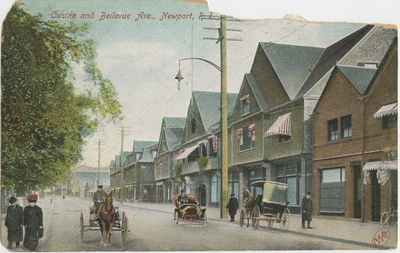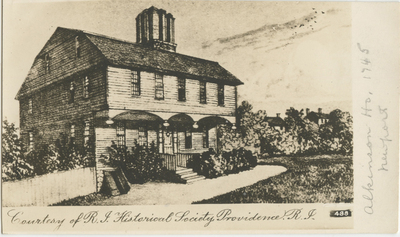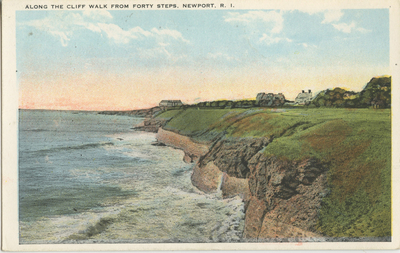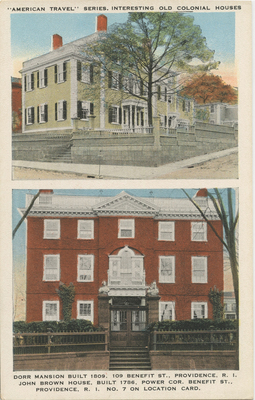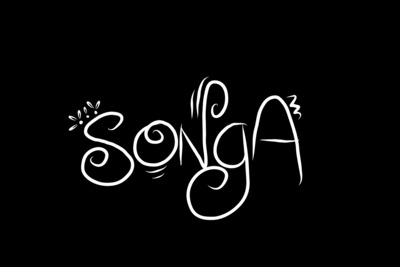
On was an interdisciplinary graduate periodical established by RISD graduate students in 2006. It featured essays and student work that related to a general issue theme. On was intended as a quarterly publication, but it is unclear if further issues beyond the first were ever published.
-

Designing for space; exploring ways of simulating nature and everyday activities in zero-g environment
Sayit Alisan
As a great outcome of our advanced technology, we built a spacecraft called the International Space Station (ISS) that orbits the Earth within the thermosphere and where we situated a bunch of astronauts to do scientific research for a designated period of time. For the last 20 years, ISS has been running by different astronauts who had to live in a new environment which is completely different than where they used to live before. Since they live up there for at least 6 months, one way or another they start missing any earth-like experience such as being in nature, wind, sound of rain etc. during that time they spent in that confined environment which literally makes everything even harder for them. This thesis explores some potential solutions to deal with this issue for astronauts aboard the ISS, as well as for those who will be gone for Mars one day, by exploring the ways of simulating the elements of nature and everyday activities in the zero-g environment in a way utilizing virtual reality technology (VR) and physical objects that will be working together.
-
Sabbatical Dialogue | Eric Anderson + Eduardo Duarte
Eric Anderson, Eduardo Duarte, Patricia Barbeito, and Academic Affairs
-
Solastalgic ecotone: the critical zone in suspension
Bareeq Bahman
This thesis explores the concept of critical zones of the shoreline to study the littoral ecosystem as a mechanism to unfold multi-scalar approaches to land-water interfaces. The investigation of the littoral is used as a tool to further understand the ground and situate it within wider landscape conditions. It focuses on the zone from the desert to the sea, its natural processes and its many layers that make it into a productive eco-infrastructure, here read through the lens of a critical ecotone where all living organisms interact. A lexicon curated from the study of the ecotone is developed to work as a form of analysis that repositions ourselves within the gradient between land and sea. By drawing on relations to the ecology and on a mapping of how we relate to this environment, a series of speculative topographies are designed, with the support of a detailed study of sea organisms that are critical ecosystem engineers.
-
The Wonders of the Human Head
Olivia Bartsch, Special Collections, and Fleet Library
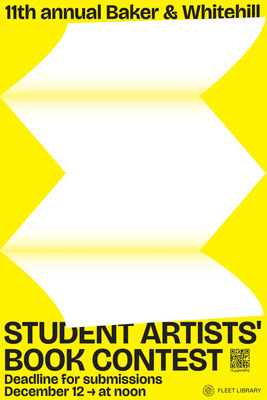
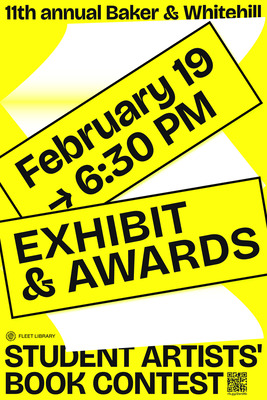
Entry for the 9th Annual Baker & Whitehill Student Artists' Book Contest. Opening Reception Thursday, March 02, 2023, Fleet Library, Main Reading Room. Juror: Andre Lee Bassuet.
-
Open articulations
Matthew Bejtlich
Open Articulations invites an exchange between human and environmental worlds through cycles of improvisation, reflection, and rebirth. It is a study of how exchanges emerge, what forms they can take, how they are mediated, and how we can sustain them with each other and with our surroundings. Through our coordinated immersion in landscapes and our spontaneous creation in them through frameworks encouraging play, we channel the spirit of a jazz drummer riffing with his midnight quartet, exchanging rhythms, images, sounds, movements, and textual fragments. A gentle breath, a flickering sensation, a gesture: expressions of a specific time rooted in a specific place.
The thesis is a window into how we experience and perceive landscapes in our own way through places that are often geographically separated, and how we find a sense of belonging in place through our improvisation and mindful presence in these spaces. Through a call and response with each other and with our own environments, we become motivated to explore new directions in our spaces, to take creative risks, and to nurture a more forgiving atmosphere, embracing our own and others’ mistakes. In making participatory archives of our experiences, we open a collective space for multiple voices to be heard and explore a shared history of a territory, thus offering new ways of understanding a place and each other. Together, our voices find new resonance points, commonalities, contrasts, and tunings, and our expressions take on new meaning as a result. This in turn shapes our next engagement with the world.
-
Whores, sluts, and bitches; the perceived limits of sexualisation and the affects on space
Chloe Jenny Bennie
Perceived sexualisation changes depending on multiple factors, this thesis is looking specifically at how tools and accessories are used in conjunction with altering power dynamics within a carefully orchestrated space to change how a person wants to be looked upon.
-
The “Body in Motion” as the Substance of Dance Improvisation? Based on Motifs from Maurice Merleau-Ponty’s Phenomenology of Perception
Lilianna Bieszczad
In the beginning of my academic career, it was my personal experience of dance practice that provided a direct impulse for studying the phenomenon of dance as art from a philosophical perspective. It was that same experience that drew my attention to the concept of aesthetic engagement proposed by Arnold Berleant. His theory, in my view, captures the fundamental aspects of dance in a unique way.[1] That early study led me to develop and promote the aesthetics of sensitivity, which in turn created a basis for the appreciation of dance as a practice that is inseparable from life.[2] Many problems explored by Berleant – such as the inseparability of perception from action, appreciation of the living and sensing body, and understanding of the space as relational and dependent on the body’s motion – can also be found in the thought of Maurice Merleau-Ponty. His arguments, in my opinion, help explain factors in modern dance such as somatic engagement in the process of its perception or the performative character of an event that is inseparable from its broadly construed context or the environment in which it occurs.
In the course of his academic career, Arnold Berleant has frequently referred to Merleau-Ponty’s thought and, inspired by the latter’s works, employed,, in his own reflection, notions such as those of chiasm, of the flesh of the world, or of the body as a field of forces – which he also used in reference to dance.[3] He has been most acutely sensitive, however, to the remnants of dualistic thinking present in terminology like that of “the interior” and “the exterior,” which he found even in Merleau-Ponty’s work.[4]
This article is a proposal for one of many possible ways of re-interpreting Berleant’s concept of dance as a practice in which elements of an existential nature are tightly connected with aesthetic, cognitive, or environmental ones. In this text, space in dance is not construed as something external to the body but as something emanating from its movement, merging with broadly understood surroundings, and becoming an embodiment of our being in the world.
-
Baking as a Means of Non-verbal Expression: An Aesthetic Inquiry on Conventual Pastry
Maddalena Borsato
The aim of this essay is to philosophically explore the domain of conventual pastry by understanding baking as a form of aesthetic expression. I intend to investigate the aesthetic meaning of making sweets, both for the specificity of this taste and for the link between tacit knowledge and the meaning of gift through cloistering. From the very beginning of its production in the monasteries, pastry developed not only as an economic livelihood but also as a way to create a meaningful language beyond the so-called intellectual activities. The philosophical interest lies in the relationship of food practice with intimate expression and then, with non-verbal communication, where the link between sweetness and religion has a significant role.
-
Regeneration with Maida Branch
Maida Branch and Edna W. Lawrence Nature Lab
March 18 hosted the sixth conversation in the Regeneration series with Maida Branch, founder + director of Maida Goods, a collective that supports the growth of Indigenous artists and preservation of their homelands through sustainable business practices. Take a look at this document with resources that were mentioned during the conversation to further your learning.
The conversation centered around Maida’s coming home story: her return to Vallecitos, New Mexico, in order to come home to herself, and her experience bringing MAIDA Goods to life to tell the stories erased and lost. She opened up with this story about the now-uninhabited Pecos Pueblo: “Within the pueblo there was a room that always had a fire going, and needed constant tending. There was always someone from the village who was assigned to attend to this eternal flame. The belief was that if the fire went out, so would the people and culture disappear.”
For Maida Branch, the way she tends to her flame is through MAIDA Goods. The collective allows her to learn more about where she is from and the people from which she came. She partners with local artists who preserve Indigenous histories in their work, including Brandon Adriano Ortiz, Josh Tafoya, Johnny Ortiz, Gino Antonio, and Camilla Trujillo. Using local materials and inspired by tradition, these artists bring stories of the past into the future through handcrafted objects like wool headbands, silver jewelry, ceramic spoons, bowls, and candlestick holders. The ability to use these objects every day makes life fuller and brings awareness to histories that might otherwise disappear with older generations.
Living in a small, fragile village, Maida strives to be thoughtful about bringing attention to her community and sharing their stories without exploiting the place. Small villages like hers are alive and full of people with distinct ways of life. She asks, “How can we strike a balance between not being erased, and not hurting ourselves or each other while we share our stories with the world? How can we regenerate instead of revitalize?” -
Bootstrapped: the Cowboy Nomad from Silicon Valley
Emily Bright
Silicon Valley is a place that grew out of the legends of the frontier. It has followed in the footsteps of Hollywood Westerns, counterculture frontiersmen, and cyberspace cowboys.
In Silicon Valley, the frontier has been a physical and a metaphorical landscape found between everything existing and everything new-- between ideas of the future shaping technology and technology shaping ideas of the future. This seemingly vast open landscape allows the well-meaning cowboy to use his unique position of privilege to spot and solve systemic technological and social issues.
As these Silicon Valley Cowboys enter the frontier in search of new unclaimed space, they end up wandering into the invisible recursive loops of the same particular future narrative and aesthetics.
-
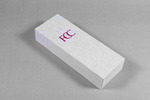
Fairmont Color Card: FCC
Sarah Bryant, Special Collections, and Fleet Library
1 box (8 folded sheets, 1 sheet) : color illustrations, mounted fabrics Title from front of folded sheets. Limited edition of 20 copies. "Fairmont Color Card is an exploration of the roles of textile, color, and fashion in the origin story of landfill culture. Text for the project was culled from 1977-1978 Home Furnishing Color Card, produced by The Color Association of the United States, Inc. and The Wastemakers, written by Vance Packard in 1960. Designed and produced between 2019 and 2021, the project began in one place and ended in another. Materials for this project include my sheets, my clothes, and thread color matched to these textile samples the walls, hair, and skin found in my home. Produced in an edition of twenty copies, the fabric collages included in this project are all identical save for one, the card titled "the significance of these private worlds," which is unique to each copy."--https://bigjumppress.com/section/507261-Fairmont-Color-Card.html "Techniques include: Letterpress printed text from handset Bembo type, textile, and foil blocking. Materials for the enclosure include binders board, Duo Bookcloth, and fabric."--https://bigjumppress.com/section/507261-Fairmont-Color-Card.html Two-part cloth-covered box, letterpress printed colophon sheet mounted inside box lid. Strips of fabric, some knotted, mounted to inside bottom of box. Library has copy no. 9, signed in pencil by the artist. Jan Baker Fund.
-
Commencement 2021 David Byrne and President Rosanne Somerson Intro and Opening Remarks
David Byrne and RISD President
Talking Heads founding member and onetime RISD student David Byrne joins President Rosanne Somerson in welcoming the Class of 2021 to RISD’s 137th Commencement.
-
Commencement 2021 David Byrne | Honorary Degree Recipient
David Byrne and RISD President
In eight takeaways from his brief time as a RISD student, Talking Heads founding member David Byrne shares with the Class of 2021 how RISD transformed his thinking and continues to influence his work in many mediums.
-
Sabbatical Dialogue | Charlie Cannon + Mary Anne Friel
Charlie Cannon, Mary Anne Friel, Patricia Barbeito, and Academic Affairs
-
Loneliness / Togetherness : Interiority and connection under isolation
Huaqin Chen
Inhabitants’ perceptions can be greatly impacted when they are in an enforced space, a state of incarceration. That sense of confinement can cause mental or physical health issues on account of the loneliness, lack of interaction or confusion of time and space. Living through enforcement and isolation deeply affect human cognition and behavior. We can also easily find precedents of living through enforcement in the plots of films. By studying narrative, this thesis reconstructs domestic space by investigating the changes in our daily life after our current pandemic. A spatial sequence is created according to the relationwship among time, space and motion by manipulating light, material, spatial proportion/ position/ order, etc.
There is always fierce debate between the practice of public health and human free will. In fact, these two deeply affect each other. How do architecture and interior space respond to this issue and increase people’s willingness to stay home? A collective experience is created for this new social connection that doesn’t require physical contact. With social distancing, people are still able to maintain the essential level of interaction with others through the design. By categorizing different clusters for different groups of people based on personal characteristics and daily routine, each community can have their own balcony type for interaction with their groups’ of people. The interiority in each cluster is also designed based on the group type and their own narrativity. This project can be a model for future isolated social existence or any other living conditions with restriction.
-
The sixth migration - rural/urban "heterotopia"
Pan Chen
Written during the pandemic of 2020/2021 ,as people moved out of cities with new options to work remotely, we have witnessed a new trend of urban-rural migration. This study looks in detail at rural /suburban communities in southern New Jersey and asks how a planning framework and community engagement strategy can come together to coordinate urban-rural development at different scales. This thesis project applies two types of design strategies - “top down” as planning guidelines communication and “bottom up” as community-oriented design to bring residents in the conversation of town development, and in the long term stimulate regional development to solve the problems caused by previous migrations. Starting with analysis of the built environment, social relationships and nature resources in rural New Jersey, the project tries to identify the potential rural towns and to structure the strategies in 3 scales - regional scale, town scale and district scale. It comes up with main principles - “connection”, “concentration” and “preservation” to guide the regional development as “Urban/Rural Heterotopia”.
-
Inclusive multi-sensory landscape: directing visually impaired people in a perception world
Tianqi Chen
This thesis explored the use of inclusive landscape design to provide visually impaired people and normal people with enhanced multi-sensory experiences, and for recognizing space, navigating move through spaces. Inclusive design is human design, inviting people in and giving the communicative power to space through stimulating one’s intuition and senses by repetition, sequencing, or patterning in design that signals time, space, and movement through the layouts of walking trajectories between important nodes or places of refuge. Through the visually impaired issue studies, solutions, and methods exploration, I developed principles as a solver, applied them on one site to transform space for testing my theory. This theory aimed to enhance public awareness of visually impaired people, pay attention to their outdoor experiences and provide everyone enhanced space experiences and motivate multisensory to emphasize the critical nodes, connect the fragmented spaces, direct people walking through intersections safely, and indicatively.
-
Commencement 2021 Sophie Weston Chien, Undergraduate Student Speaker
Sophie Weston Chien and RISD President
2020 Steven Mendelson Award for Community Service awardee Sophie Weston Chien BArch 20 urges RISD’s Class of 2021 to pursue ethically grounded creative practices and demonstrate care in all their work going forward.
-
When art education meets environmental issues: the interconnectedness of art and science
Eunhyung Julie Chung
In recent years, we have come to understand that the environmental crisis is no longer what we see in books or screens but it is what we are facing now. Along with the public's increasing interest in the environment post-COVID, this thesis explores the role of art in enhancing awareness of critical environmental issues. Through a literature review, the author examines theoretical concepts at the core of the history of art and science in search of ideas about the interconnectedness of science and art. The review explores why an interdisciplinary approach to education is vital to learning about environmental issues and the unique and non-subsidiary role art can play in understanding science. The author reviews current pedagogical models in settings such as schools, galleries, and museums, where there is an integration of art and science. And through an analysis of these models, the author identifies promising practices and areas they argue are in need of greater consideration.
In this thesis, the author focuses on various new approaches to environmental issues through art education that move beyond traditional concepts of environmental arts education and emphasizes the role of the "media as art teacher." The thesis presents the author's interdisciplinary experiences while in graduate school at the Rhode Island School of Design (RISD), where writing and research are incorporated into art practice as a possible conceptual foundation for integrated teaching and learning pedagogy. The author argues that environmental issues do not exist apart from us but are closely linked to us in various ways. However, they further claim there is still a significant gap in educational contexts between learners’ awareness and a deeper understanding of environmental issues. The author concludes that art education has considerable potential in regard to creativity development and empowerment which they argue can bridge this gap and lead to change.
-
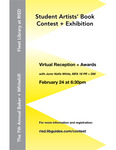
7th Annual Baker & Whitehill Student Artists' Book Contest 2021 Poster
Special Collections and Fleet Library
-
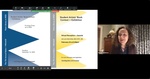
7th Annual Baker & Whitehill Student Artists' Book Contest 2021 Virtual Reception
Special Collections and Fleet Library
Slides presented in the recording of the 7th Baker & Whitehill Annual Student Artists' Book Contest Virtual Reception, held via zoom Wednesday, February 24th, 2021 at 6:30pm. Hosted by RISD Dean of Libraries Margot Nishimura, Special Collections Librarian Claudia Covert, guest juror Nafis White, MFA '18 PR + DM, President of the New England Chapter of the American Printing History Association (APHA) Alice Beckwith, Special Collections Associate Ariel Bordeaux, and RISD Libraries Administrative Coordinator Amy Doyle. Honorable mentions and award winning entries announced.
Grand Purchase Prize If We Could Make It Out Alive by Jonathan Dewanto, BFA, EFS 2024, Laurie Whitehill Purchase Prize Waiting for Democracy by Naya Lee Chang, BRDD, Furniture Design 2024, American Printing History Association - New England Chapter Purchase Prize A Book of Happiness by Shuyan Chen, BFA, Illustration 2023, Librarian's Choice The Woman's Way by Yukti Vishal Agarwal, BRDD, Textiles 2024
Honorable Mentions It's all "now" by Mario Fernandez-Moreno, BFA, Apparel Design 2022, How to be a CaNniBal in the 21st Century? by Vidhi Nayyar, BFA, EFS 2024, Ramen with White Privilege by Sarah Park, BFA, Apparel Design 2022, Secret Communication System by Jocelyn Salim, BFA, Illustration 2023.
-
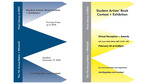
7th Annual Baker & Whitehill Student Artists' Book Contest 2021 Virtual Reception Presentation
Special Collections and Fleet Library
Slides presented in the recording of the 7th Baker & Whitehill Annual Student Artists' Book Contest Virtual Reception, held via zoom Wednesday, February 24th, 2021 at 6:30pm. Hosted by RISD Dean of Libraries Margot Nishimura, Special Collections Librarian Claudia Covert, guest juror Nafis White, MFA '18 PR + DM, President of the New England Chapter of the American Printing History Association (APHA) Alice Beckwith, Special Collections Associate Ariel Bordeaux, and RISD Libraries Administrative Coordinator Amy Doyle. Honorable mentions and award winning entries announced.
Grand Purchase Prize If We Could Make It Out Alive by Jonathan Dewanto, BFA, EFS 2024, Laurie Whitehill Purchase Prize Waiting for Democracy by Naya Lee Chang, BRDD, Furniture Design 2024, American Printing History Association - New England Chapter Purchase Prize A Book of Happiness by Shuyan Chen, BFA, Illustration 2023, Librarian's Choice The Woman's Way by Yukti Vishal Agarwal, BRDD, Textiles 2024
Honorable Mentions It's all "now" by Mario Fernandez-Moreno, BFA, Apparel Design 2022, How to be a CaNniBal in the 21st Century? by Vidhi Nayyar, BFA, EFS 2024, Ramen with White Privilege by Sarah Park, BFA, Apparel Design 2022, Secret Communication System by Jocelyn Salim, BFA, Illustration 2023.
-
Reflections on “Catching the Ghost: House Dance and Improvisational Mastery”
Renee Conroy
Contemporary Aesthetics recommends first reading Christian Kronsted’s article, “Catching the Ghost: House Dance and Improvisational Mastery,” appearing before this article.
This essay is a constructive response to Christian Kronsted’s “Catching the Ghost: House Dance and Improvisational Mastery,” in which he develops three topics introduced in his novel treatment of this club dance form. First, I consider the nature of the relationship between house dancing and house music. Second, I address the significance of “the vibe” in house culture. Third, I apply these reflections to Kronsted’s three puzzles of improvisational agency to demonstrate that an apt, aesthetic analysis of house dance is possible without depending on 4E assumptions about the nature of mind.