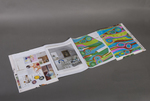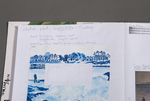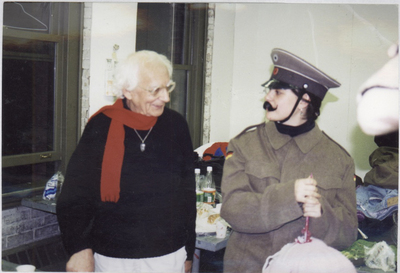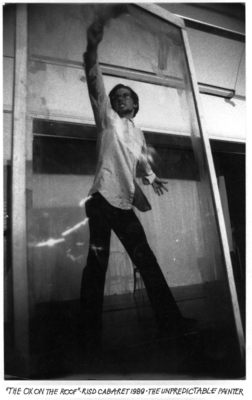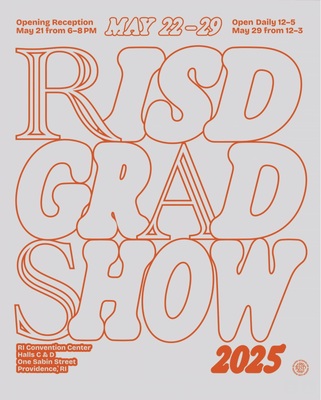
On was an interdisciplinary graduate periodical established by RISD graduate students in 2006. It featured essays and student work that related to a general issue theme. On was intended as a quarterly publication, but it is unclear if further issues beyond the first were ever published.
-

Field in adaptive reuse : discussion of the existence of the field and its influence
Yilun Shao
In a building like a pavilion, the walls are abstracted into pillars, and this hollowed -out design aesthetically reflects the concept of negative space in Asian aesthetics. The creation of the field is not by the enclosure of wall, but through the radiation of the pavilion’s spirit to create a negative space with fuzzy boundaries. If the spirits which dwell in the pavilion cannot radiate outward but must be contained within, visitors will not see this buildings, but sculptures form.
What is fascinating about architecture is that it can divide the space so that people enter and feel the effects of this division. In contrast to what I propose the completely enclosed space creates a break from human society to nature. Hegel wrote that, man is nature against nature itself . For any container, the empty part is for human use, but only if it is surrounded by the container. Such as in the adaptive renovation of the building, the emptiness and desolation of the ruins, as well as the beauty brought by the huge volume represent the empty. The reintegration of the original architectural structure in nature reshapes the role of the physical field . The texture of a wall, the taste of wind, and the intensity of sunshine are all integrated elements that constitute the integrity of the field , and as such the connection with nature cannot be broken.
The sense of space in adaptive reuse can be extended into a sense of time and rhythm. It is in the process of processing and shaping architectural space that people identify their emotions and ideals. The way we look at things, the way we behave, and the way we think all depend on the depth of the field in which we live. The depth of the field affects people to have different conceptions of an original object or architectural space and its value reflects our consideration and respect for the space in architecture.
-
Evolution of a type : street vending as urban strategy in Guangzhou, China
Yuying Shen
As China continues its program of building new cities and encouraging urban resettlement from smaller towns and the countryside, informal activities that were once typical of urban areas – such as street vending – are being evicted by the government in the name of cleanliness and beautification. In reality, the motivation of eviction has to do with land values and the desire to replace the low-end population: street markets in the downtown areas could be developed into programs that bring large-scale money-making, like shopping malls; street vendors are viewed as undisciplined, messy and outmoded.
If we recognize the conflict between the government and the public, how can landscape provide a framework of public open spaces that coordinates, compromises and bridges the gap? Can designers use street vending as urban strategy to revitalize urban development?
This thesis takes street vending as activism. Through creating a matrix of spatial types for street vending worldwide, the next step of the evolution is discovered. Using a series of strategies to different urban conditions in Guangzhou, the project considers the direction of urbanization towards the east for three city areas: the historic city, the modern city and the new city. Finally, a new vending prototype is proposed to improve living environment and boost individual businesses in the urban village, New city.
-
Film for landscape architecture : learning from Alfonso Cuarón's Roma
Ramon Solis
Introduction:
How can film inform landscape architectural thinking? In narrative film, we are spectators of unfolding space. In landscapes, our bodies enable us to author its unfolding.
In many ways, film is a well-suited and under-theorized territory for landscape. Its intersections are not without precedent, and in the following pages, I hope to describe the experiments, failures and potential scenarios I have uncovered for future practitioners of landscape architecture. A secondary intention of this thesis is as an articulation of my own practice, walking toward disciplinary edges, but always looking back to landscape architecture.
Site:
Roma (2018), directed by Alfonso Cuarón, serves as a case study of the perceptual dimensions of watching film, and on the interacting systems and forces that are manifested through its narrative. Still, Roma serves as a point of departure to investigate the emerging cross-disciplinary research of using moving images as a design tool.
At the heart of the film is Cleodegaria Gutierrez (Cleo), a maid who serves a well-off family of seven in the Colonia Roma district in Mexico City. Often the camera tracks her as she moves through various oppositional domains: interior and exterior, public and private, urban and rural. Through film we are also able to visualize material artifacts of culture and psychology. I want to understand the structure of this film, and how that structure is able to generate the particular qualities of space in the film.
Research Question:
Materially speaking, Roma, the film, is a movie, a sequence of projected light, two hours and fifteen minutes long. Geographically speaking, Roma is also a real place, a district in Mexico City and the setting for most of the film. Through the course of this thesis studio, Roma, the film, will serve as a site in which to investigate notions of space, place, time and memory using the following thesis question: How can film inform existing contemporary landscape practices in representation?
-
Commencement 2019 Ramon Solis, Graduate Student Speaker
Ramon Solis and RISD President
Graduate student speaker Ramon Solis MLA 19 encouraged his fellow advanced degree recipients to enjoy the well-earned fruits of their accomplishments at RISD and then to “get back to work” on making a meaningful impact in the world.
-
Commencement 2019 Boo City, President Rosanne Somerson
Rosanne Somerson and RISD President
Pre-ceremony performance by local Rhode Island band Boo City founded in 2009 by singers/songwriters Tai Awolaju and guitarist and RISD alum Andrew Moon Bain '98 SC. RISD President Rosanne Somerson gives a welcome address at RISD Commencement 2019.
-
Commencement 2019 President Rosanne Somerson Closing Remarks
Rosanne Somerson and RISD President
President Rosanne Somerson delivers commencement closing remarks.
-
Commencement 2019 Bryan Stevenson Address, Clip 1
Bryan Stevenson and RISD President
Clip of Bryan Stevenson's keynote address.
-
Commencement 2019 Bryan Stevenson Address, Clip 2
Bryan Stevenson and RISD President
Clip of Bryan Stevenson's keynote address.
-
Commencement 2019 Bryan Stevenson Address, Clip 3
Bryan Stevenson and RISD President
Clip of Bryan Stevenson's keynote address.
-
Commencement 2019 Bryan Stevenson | Honorary Degree Recipient
Bryan Stevenson and RISD President
At RISD’s Commencement ceremony on Saturday, June 1, keynote speaker Bryan Stevenson urged the Class of 2019 to “resist the politics of fear and anger” with the hope and power their creativity brings to the world. “When we do this we begin to create a different culture, a new kind of future,” the Equal Justice Initiative founder pointed out, calling on RISD’s newest alumni to invest their talents in creating more just societies. In addressing the 486 bachelor’s degree and 214 master’s degree recipients at the Rhode Island Convention Center, the acclaimed public interest lawyer emphasized the importance of “getting proximate” to individuals and communities in need. By listening to and learning from marginalized and oppressed people, Stevenson said, artists and designers are uniquely positioned to “at a bare minimum… affirm their humanity—and this can change the world. I believe in liberation—that there's something better waiting for us," he continued. "Stay hopeful. Our hope is our superpower."
-
Recharging Bangkok : a climate adaptive vision for Saen Saeb Canal
Ratchu Surajaras
This proposal aims to investigate an extensive role of Bangkok’s canal system that can potentially serve as a climate-adaptive and multi-functional infrastructure to help address the city’s environmental issues and to support the complex social needs. Together with municipal hydrological systems, the canals can mitigate flooding, land-subsidence and sea level rise while regaining lost cultural functions specific to Thai ways of living with water in both a contemporary context and future scenarios.
The investigation focuses on Saen Saeb canal as a primary study area which is historically one of the most important canals at the heart of downtown of Bangkok that connects Chao Phraya River and Bang Pakong River in Chachoengsao Province; it encompasses different transects of the capital city and context conditions form in the urban core to the periphery area. Relying on the fact that Bangkok is a delta city, this project has strategically turned the issues of flooding and land subsidence common in this kind of terrain into opportunities for social and cultural improvements by rethinking the relationship between canal and adjacent open spaces as flood mitigation tools and reconnects people to canal-scape, which can establish long-term strategies for the city to live with water. The study of the dynamic relationships between water, city, people and canal tectonics have been proposed as adaptive strategy that provides the diverse public realms, hydrological functions, and could be apply as rational principles applications for the other canals of the city.