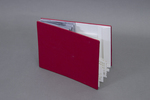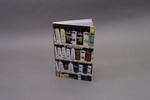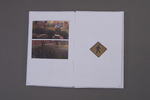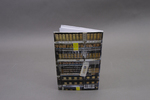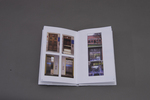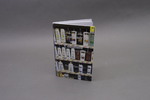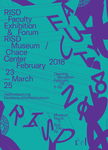
On was an interdisciplinary graduate periodical established by RISD graduate students in 2006. It featured essays and student work that related to a general issue theme. On was intended as a quarterly publication, but it is unclear if further issues beyond the first were ever published.
-

Emerging ecotone
Tongyi Zhang
Along with the development of society and economy, waste landscape becomes an inevitable result of urban involvement where technological innovation plays a very important role. Computer science, as the most important technology in the 21st century, also affects the physical spaces by enlarging our social distance. People prefer to contact physically less with others unless necessary, causing shrinkage of our community spaces. Abandoned commercial space, which has lost its social function, is one of the typical effects derived from both economic evolution and community shrinking.
In fact, Josh Sanburn (2017) in TIME mentioned “by 2022, analysts estimate that 1 out of every 4 malls in the U.S. could be out of business1,” which leaves amounts of empty buildings and wasted landscapes in urban and suburban areas. According to an article in The New York Times, dead malls are malls that have their glorious history but at least 40% of retail space is not used anymore2. They reflect that people’s attitude toward shared space has changed and demonstrate the limitation of physical space serve only one function under the context that is always changing. So, it’s our responsibility as landscape architects to explore possible ways of fitting multiple functions in limited spaces in order to enable a sustainable social and ecological community.
Rhode Island Mall in Warwick, RI, as one of the oldest big box malls in New England, was the start of a long boom in building retail space of all kinds. But nowadays, this place reflects the changing of economy and switching of people’s shopping habits nationwide. In addition, even though the building is surrounded by abundant community types of neighborhood, they are kept isolated by highways and a under utilized river, Pawtuxet River. So the isolation due to physical and sociological aspects makes the mall area a “lonely island”.
In this thesis, I treat the dying mall as a catalyst vessel of cultural activities to reunite communities, and also reveal the river as a thread to connect the surrounding communities for revitalizing the whole area. In terms of that, I take the design of Rhode Island Mall as a model to discuss how we create a “social ecotone” for reshaping the under valued space to valuable area in both social and ecological way.
-
Salt pans matter : a system of ecology and culture cohabitation for Cabo de Gata, Andalusia, Spain
Chenglin Zhu
This thesis book seeks new meanings for the concept of “cohabitation”, it is important to understand “cohabitation” as the link to connect cultural inheritance and natural restoration. We need to find a way to coexist with nature and create something beyond - the new relationship for “economy, nature, and culture.”
The salt pans in Cabo de gata of Andalucia, Spain is not just a potential habitat for the migrating birds, especially for flamingos, but also for the cultural heritage of the traditional craft of salt production. Unfortunately, it is the only salt pan still under operation in the region today. Actually, in recent years, the local salt pans have declined because the local traditional salt production has been replaced by industrially produced salt(chemical mined salt) from other countries. While the salt pans are gradually abandoned, the habitat lost, too.
It is important for us to think about ecosystem transformation and cultural protection at this point. Could the traditional salt industry still have value today? What is the potential for the future? The unique thing about the site is that the salt pan is facing to the sea and right beside the volcano, which creates a shift in scale from the deep topo to a vast flatness. It extracts the water from the sea to create the color palette, which is different from the natural salt pan.
This book brings an idea to guide the salt pan for future development from aesthetic, ecological and experiencial viewpoint. The first chapter will talk about the importance of the salt pan, how it works and how the craft of salt production relates to habitat.
The issue will lead us to think about how could we preserve this special landscape by keeping its natural function and cultural value but also by creating “a unique and valuable experience for visitors”. That could be the reason for it should exist even when the salt production has less economic value for this area in the future.
The design proposal for the “narrative experience”- an experience of knowledge and engagement, and experience about the interaction between the natural process and artificial production.
-
The Private Character of Natural Beauty: Shanshui Painting as a Model for Unity of Self and Natural Environment
David Adam Brubaker
How can each of us develop an aesthetic appreciation of nature as our home and not a resource to be exploited? Chen Wangheng answers that environmental beauty provides a sense of home through a unity of subject and object that belongs to the private character of the natural environment. But how is the display of the natural environment private? To uphold Chen’s remarks, I inspect the model of shanshui (山水 mountain-water) painting, as Chen suggests. I find that the private character of the natural environment and the related element zhi (質substance) in shanshui painting cannot be described in the object-oriented languages of pragmatism and analytic philosophy. To translate zhi, I use Merleau-Ponty’s term ‘le visible’ (the visible). As a result, Chen’s analysis of natural beauty and the unity of the human and nature in shanshui painting can be communicated. I show how shanshui paintings by Jizi express the unification of the individual person with nature. Chen revolutionizes environmental aesthetics with an alternative paradigm for human contact with nature.
-
Domestic disorientation
Marisa Adesman
At the center of all human life is the idea of ‘home’, and although this notion has persisted across time, the specific ideas and meaning of that word have changed significantly across the millennia. We are now in an unprecedented time of rapid change and social, economic and political upheaval, and from where we stand now, it is important to explore what ‘home’ means to us today, at both the individual and collective level.
The domestic space of the home, and the rooms within, represent a politicized site vis-à-vis gender, and these gender dichotomies are perhaps most prevalent in the kitchen and dining room. My studio practice centers around food – both its production and consumption, as well as the domestic spaces dedicated to food. Food is a powerful indicator and tool used to define who we are culturally, socially, economically, and politically. Surrounding the food we eat, there exists a web of interdependence between other people, animals, technology, industry, and economy. This web has been a rich subject for artists to explore and unpack throughout the years. American performance artist Linda Montana wrote in a 1981 issue of High Performance magazine that engagement with food manifests as “political statement, as conceptual device, as life principle, as sculptural material, for nurturance and ritual, for props and irony, as a scare tactic, in autobiography, as feminist statement, in humor, for survival.” Drawing on the long lineage of feminist artists who have investigated the semiotic potential of food and dining, I bring a critical self-awareness to the domestic space to appropriate, reclaim, and empower objects and symbols that have long been perceived as oppressive and confining for women.
The idea of femininity provides artists with access to a large visual vocabulary, and thus provides us with the opportunity to blur the lines between the formal stereotypes. These aesthetics of femininity also provide artists with space for creative new interpretations of harmful past preconceptions. I comment on the costs and implications of emotional labor, especially as they relate to the performance of femininity. My work extends to themes of the body as spectacle, performativity in personal and social relationships, and the tension between agency and expectation within contexts of intimacy and love. Through painting, video, and performance, I create visual narratives that disrupt restrictive ideas of gender, social identity, and femininity, and I strive for an elusiveness that defies the social categories that threaten to limit women. I question how visual disorientation of the domestic space, or domestic disorientation, works to unmoor and destabilize ingrained assumptions that have been historically limiting or debilitating for women.
-

Contemporary Art and the Global Turn
Alexander Alberro, Academic Affairs, Graduate Studies, Liberal Arts, Fine Arts Division, and Theory & History of Art & Design Department
A newly-formed transnational web of individuals and institutions has in the past three decades fundamentally changed the nature of contemporary art. Highlighting artworks and projects that have sought to make visible, analyzable and contestable the new forms of exchange, “Contemporary Art and the Global Turn” probes not only what has led to this complex transformation but also the impact it has had on the current conditions of artistic practice. In what ways is recent art distinct from previous modes of contemporary art? What are the conventions that contemporary artists face today? Where are they shaped? What precipitates them?
Alexander Alberro is Virginia Bloedel Wright Professor of Art History at Barnard College. He is the author of Abstraction in Reverse: The Reconfigured Spectator in Mid-Twentieth Century Latin American Art (University of Chicago Press, 2017); Conceptual Art and the Politics of Publicity (MIT, 2003), and has edited books on contemporary art including Working Conditions: The Writings of Hans Haacke (MIT, 2016), Institutional Critique: An Anthology of Artists Writings; Art After Conceptual Art (MIT, 2009); Museum Highlights (MIT, 2005), Recording Conceptual Art (University of California, 2001), Two-Way Mirror Power (MIT 1999); and Conceptual Art: A Critical Anthology (MIT, 1999).
Alberro is also the founding editor of the University of California Press’ book series “Studies on Latin American Art,” which commissions publications of art history and cultural practices emerging from Central and South America, the Caribbean, and the Latin American diaspora in the 20th and 21st centuries.
-
42nd Annual Gail Silver Memorial Lecture: Paola Antonelli
Paola Antonelli and RISD Museum
Paola Antonelli is senior curator of architecture and design and director of research and development at the Museum of Modern Art in New York. Her work investigates design’s influence on everyday experience, often including overlooked objects and practices. She was appointed director of MOMA’s new research and development initiative in 2012. Antonelli lectures frequently at global conferences and coordinates cultural discussions at the World Economic Forum in Davos. An inductee of the Art Directors Club Hall of Fame, she was recently rated one of the top 100 most powerful people in the world of art by Art Review.
-
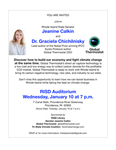
Global Thermostat: Carbon Capture Technology and Climate Change
RISD Archives and Graciela Chichilnisky
-
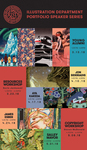
Illustration Department Portfolio Speaker Series
RISD Archives, Illustration Department, and Jalessa Bryant
Poster for the Illustration Department Portfolio Speaker Series 2018.
-
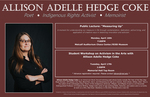
Allison Adelle Hedge Coke: Measuring UpLecture and Student Activism Workshop
RISD Archives and Liberal Arts Division
“Measuring Up” engages the audience in thinking about how contemplation, active living, and creative practice can contribute to innovation and activism. Hedge Coke also facilitates a workshop for students on activism in the arts.
-
Environmental diversity for student residence life
Jiaying Bai
Anxlety, stress and difficulties in handling human relationships are the three most serious and common mental health problems among students of the Rhode Island School of Design, according to Shauna Summers, director of RISD Counselling and Psychological Services. As one of the best design schools in the country, RISD admits top applicants. It's common for students who had brilliant grades and performance in high school to find themselves no longer the best among their collea13ues, Moreover, the seemingly constant perfect performance of those around them adds to anxiety and stress. For these students, it is hard to recognize value in life ether than through academic achievement. The sudden loss of previous relationships both with families and friends, as well as the pressure to generate new relationships at school, make it even more difficult for students to find support and relax.
The residence hall at 15 Westminster Street houses 500 RISD students. The fast and second floor of the building host the Fleet library, Portfolio Cafe and Other Collections, serving the entire school. The student dormitory occupies the third to eleventh floors of the building. This student housing is defined by sameness: repetition of spatial types, over and over.
Environmental diversity, be it through thermal, aural or visual means, stimulates and keeps the mind more mentally engaged, while monotony over time is detrimental to mental health, creativity and spirit. Avoiding monotony, then, would be particularly valuable for students at an art school. By introducing new public space and programs, as well as giving students more adaptive opportunities in the spaces they inhabit, architecture will have a profound effect on levels of creativity in students. Allowing contact between indoor and outdoor space; experimenting with spatial issues of public and private, areas optimized for work and leisure, quiet and distraction, will be added to the Rhode Island Hospital Trust Building, The private kitchens, along with the original shared space, such as lounges, workrooms and corridors, will form a new continuous bustling common space. large communal kitchens and study rooms, as well as niches along the widened winding corridors, will provide a variety of interior comfort zones, By increasing the area of windows and glass doors in the communal kitchens, a more dynamic: and diffuse lighting environment will be achieved. These doors, the new balconies extending form the communal kitchens, as well as the northeast open stairs will allow students get closer to the new center garden on top of second floor roof. The water system for interior green walls and fish tanks, as well as the sound from outdoors, will work as a pleasant white noise. In this diverse environment, students will be able to find interests and strengths outside of school work and be released from academic stress. A variety of collaborative environments, both living and academic environments, will help students better understand how to deal with relationships in a more relaxed environment and turn this peer pressure to peer support. Through a deeper understanding of the shared stress felt by all RISD students, anxiety will be reduced. Ultimately, mental health, creativity and productivity will be improved.