On was an interdisciplinary graduate periodical established by RISD graduate students in 2006. It featured essays and student work that related to a general issue theme. On was intended as a quarterly publication, but it is unclear if further issues beyond the first were ever published.
-

Personal analysis of the relationship of artist to the subject in figurative painting
Zuhal Feraidon
The work for my thesis includes a series of medium-scale paintings on wood panel in oil and acrylic. In these, I depict my friends, my relatives, and myself in full-body portrait style. I use a complementary color palette. The humans within my paintings are presented within an environment that has shallow spatial depth. The backgrounds in the paintings exist through flatness, serving as wallpaper behind the figure. The landscape backgrounds in my paintings are not specific to identifiable locations. The relationship between the figure and the ground is questioned through the overall composition. Both the background and the figure are painted in a way that emphasizes the transparency and liquidity of oil paint. These paintings belong to the series titled “Portrait of an American.” Each individual painting is titled after the name of the person depicted.
As a figurative painter, I ask myself about my right to depict another person. How do I make sure that I don’t alter the person represented as I paint them? How much control do I have over how the subjects within my paintings are perceived? And how do I uphold the responsibility of representing another person’s identity honestly and respectfully? These questions are a necessary part of my painting practice and process as I create portraits. The portraits are necessary because they show a demographic of Americans that are scarcely represented in popular media, in contemporary art, and in art history. With respect towards the people that I paint, and with a sense of caution in how I apply paint, I make figurative paintings which increase ethnic and racial diversity in the discourse of contemporary painting.
This thesis writing operates as a guide for my thoughts as I use some ideas from the history of painting to contextualize my experience and painting practice. I begin by looking at the idea of representation of living beings in Islam, and what it means to be drawing and painting people while identifying as Muslim. I will next investigate the problematics associated with the historical western paintings of “others,” in depictions of people of color by orientalists and white male artists throughout western art history. Lastly, I find and celebrate contemporary artists that enrich representation and diversify our understanding of human experiences. These explorations help me to answer the questions that I have posed for myself, and to become a better painter and an artist of integrity.
-
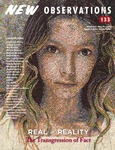
New Observations #133 | Real ≠ Reality: The Transgression of Fact
Mia Feroleto and Leah Poller
New Observations is a non-profit, contemporary arts journal written, edited, and published by the arts community. For more information visit newobservations.org.
-
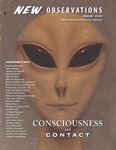
New Observations #132 | Conciousness and Contact
Mia Feroleto and Alan Steinfeld
New Observations is a non-profit, contemporary arts journal written, edited, and published by the arts community. For more information visit newobservations.org.
-
Manual / Issue 12 / On Further Review
Sarah Ganz Blythe, Editor-in-Chief; Amy Pickworth, Editor; Anita N. Bateman; Laurie Anne Brewer; Elon Cook Lee; Becci Davis; Jessica Deane Rosner; James Gabbarelli; Ronnie Goodman; Bethany Johns; Kevin McBride; Walter Mettling; Nell Painter; Allison Pappas; Pamala A. Parmal; Susan Scanlan; Lorén M. Spears; Shiyanthi Thavapalan; and Nick White
Manual, a journal about art and its making. On Further Review. This issue uncovers narratives once central to objects’ histories but that now have been systematically obscured, inadvertently overlooked, or otherwise lost. Softcover, 96 pages. Published 2019 by the RISD Museum.(On Further Review) contributors include Anita N. Bateman, Laurie Anne Brewer, Becci Davis, Jamie Gabbarelli, Bethany Johns, Elon Cook Lee, Kevin McBride, Walker Mettling, Jessica Rosner, Suzanne Scanlan, Nell Painter, Allison Pappas, Pamela A. Parmal, Shiyanthi Thavapalan, and Nick White.
-
A Role for Empathy in Decolonizing Aesthetics: Unlikely Lessons from Roger Fry
Ivan Gaskell
Artist and art historian Roger Fry used Paul Gauguin’s 1896 painting, Poèmes barbares, to advertise his 1910 exhibition, Manet and the Post-Impressionists. In Vision and Design (1920), Fry promoted the so-called “primitive” art of Oceania and sub-Saharan Africa as depending on unmediated perception that he associated with the Impressionists and Post-Impressionists. Although Fry’s assumption of an “ultra-primitive directness of vision” on the part of African makers ignores their own mediating conventions, his reliance on the Vischers’ notion of empathetic connection enhances the possibility of regarding the cultural products of peoples foreign to the percipient with what Paul C. Taylor terms an “ethical attentiveness that combats reductionism and objectification.” Further, such a form of attention can displace attempts to privilege European and Eurocentric art and thought, by referring to “primitive” art and thought, promoting recognition of their value in their own right.
-
Commencement 2019 Theaster Gates | Honorary Degree Recipient
Theaster Gates and RISD President
Artist Theaster Gates receives honorary degree.
-
Spontaneous laughter, laughter without reason
Evan Gilbert
What is the function of humor in today's society? What is the role of the comedian in increasingly clownish times? How does humor challenge power structures in contemporary life and art? How can painting deploy these methods in an effective manner?
The archetype of the trickster has appeared in myth and literature around the world for many centuries. In all instances it represents the disruptive side of the human imagination, a being that lives outside the rules of conventional behavior who seems to have hidden knowledge or secret understanding of how society truly functions. The archetype of the trickster can be embodied in many different ways in different times and places: from the God Hermes in Ancient Greece, to artists of the modern period such as Marcel Duchamp and Mike Kelley.
Like the trickster. artists create through disruption and exposure but in most cases become the most vulnerable to the things they are disrupting or exposing. I’m interested in creating paintings that operate visually as the trickster does in narrative.I want to create an image that function as visual riddles or satirical allegories, where past and present are happening simultaneously- as a way to expose societies pathologies and cyclical patterns. The use of visceral thinned oil paint or warped imagery acts as visual disruption, allowing me to work within a tradition while simultaneously mocking it.
Disruption and obstruction function as challenge of power. The politics of my paintings are embedded in their atmosphere and the material application of Proof Copy: Not optimized for high quality printing or digital distribution paint. Like the trickster their myths and actions are heavily coded. The results and origins of their tricks or jokes never immediately expose themselves, but are endlessly unfolding and expanding. They are jokes that tell themselves.
The figures in my paintings are comedic and playful. They explore tragedy and potential truth in the form of a joke, riddle, or game. With the use of visible brushwork, their bodies are depicted as malleable and open. In many of the works, a light source radiates from within each body. I’m interested in depicting the figures in my paintings as people with potential for transformation and movement. I want a sense that they have personal agency, but are still vulnerable to their surroundings and their interactions with other bodies.
Humor isn't always funny, and trickery isn't always tragic. In many cases a joke comes from a place of deep sadness and desperation, an urgent need to expose something for what it really is. The self-imposed humiliation of the clown or comedian disarms the viewer or audience and the viewer becomes as vulnerable as the performer. The audience become aware of themselves as performers in society.
-
Present and Future Adventures in Illustration
Jaleen Grove and Illustration Department
This article discusses current trends and the future of illustration. Several illustrators and educators are interviewed, such as Anita Kunz, Armando Veve, Barbara Nessim, and Martin Salisbury. Topics include publishing, virtual reality, children's books, diversity and representation, high tuition, and the lesser respect and pay that many illustrators experience. The article also relates the history of American illustration 1959-2019 in the form of a tongue-in-cheek boardgame The Illustration Game, in which players advance through the years, encountering typical events in the industry. The game-board is scattered with historical funny-in-hindsight quotes of well-known illustrators, designers and other professionals, which illuminate the thinking of the day.
-
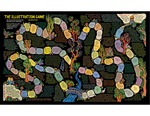
The Illustration Game
Jaleen Grove and Illustration Department
A satirical survey of the history of American illustration 1959-2019 in the form of a boardgame.
-
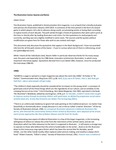
The Illustration Game: Quotes & Notes
Jaleen Grove and Illustration Department
Liner noes included with The Illustration Game boardgame providing sources of quotes and in-depth commentary by creator Jaleen Grove.
-
No long urban, can't be rural, definitely not suburban : the experience of Detroit
Karin Jane Hostettler
Detroit is a city of makers, dreamers and doers. When pushed to the brink the city does not step down, but instead continues to fight through grassroots movements, community advocates and neighborhood innovators. In this way Detroit has regained notoriety, not through corporate industry, banking or sports, but through those residents who have put their own difficulties aside for the betterment of their communities. However, the current economic and social developments in the city are centered around the downtown core of posterity, ignoring the work done by those individuals within the greater community context. In these neighborhoods, where autoworkers once lived in dense residential blocks, the current context cannot be more different; Detroit has created its own urban typology, that of transparency. Remembering the past and looking towards the future, performance and agriculture industries collaborate to form a new town center, void of street walls and automotive centric transportation, unified under a single roof as means of redefining the economic geography of Detroit.
These industries have always had a place in the city, even in the heyday of industry and manufacturing, and now they return to energize the community. Sweeping across Gratiot Avenue, this large horizontal roof collects these industries within it, as did the old auto-plants of the city, centering both economic and social empowerment for the residents of Detroit. There is a constant and active play between market and performance, it is a place for both business and leisure, of learning and making, and of growth and connectivity. The structure brings into play the Detroit vernacular of low, expansive industrial scale with the newly developed direction of transparency, where programs blend into a blur of activity, where performance is both market and Motown, activating and giving space for the rise and expansion of these individual movements.
Located in the neighborhood of Poletown East, the project relies heavily on restructuring the job market and transportation systems. Gratiot Avenue becomes the location of a new BRT line for the city, transporting both people and fresh food, and thus the heart of the structure. Where train tracks once lay connecting these hubs of industry, recreation appears, adding a human focused corridor to a historically automotive focused city. An array of performance spaces, recording booths, and practice rooms mix and interact with the encompassing market, and gathering and breakout spaces are loosely defined as one program or the other. Education acts as a programmatic sponge in the blending of market and performance, while surrounding industrial buildings are reutilized for the means of food and artistic production, all crossing paths under this single lid. Here, roof is both architecture and urbanism, creating a new typology of the town center.