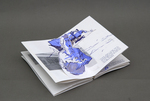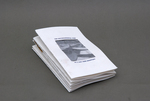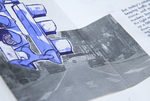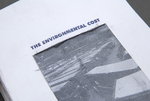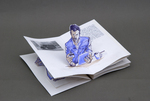
On was an interdisciplinary graduate periodical established by RISD graduate students in 2006. It featured essays and student work that related to a general issue theme. On was intended as a quarterly publication, but it is unclear if further issues beyond the first were ever published.
-

Postcards + Donuts | Carr Haus
Intercultural Student Engagement Office
RISD event promoting writing postcards to friends + free donuts! Held in Carr Haus café.
-

Postcards + Donuts | Ewing House
Intercultural Student Engagement Office
RISD event promoting writing postcards to friends + free donuts! Held in Ewing House Multicultural Center.
-

Postcards + Donuts | Prov Wash
Intercultural Student Engagement Office
RISD event promoting writing postcards to friends + free donuts! Held in Washington Place building lobby.
-
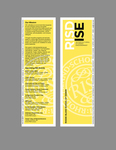
Reflection and Pride Room | Homer 313
Intercultural Student Engagement Office
Poster advertising the new RISD Reflection and Pride Room located in 313 Homer Hall, one of the six first year residence buildings on the RISD Quad, 55 Angell St.
-
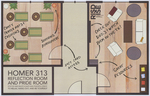
Reflection and Pride Room | Homer 313
Intercultural Student Engagement Office
Poster advertising the new RISD Reflection and Pride Room located in 313 Homer Hall, one of the six first year residence buildings on the RISD Quad, 55 Angell St.
-
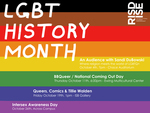
Reflection and Pride Room | Homer 313
Intercultural Student Engagement Office
Poster advertising the new RISD Reflection and Pride Room located in 313 Homer Hall, one of the six first year residence buildings on the RISD Quad, 55 Angell St.
-
RISD ISE button
Intercultural Student Engagement Office
Design for button promoting RISD office of Intercultural Student Engagement (ISE).
-
RISD ISE button
Intercultural Student Engagement Office
Design for button promoting RISD office of Intercultural Student Engagement (ISE).
-
RISD ISE button
Intercultural Student Engagement Office
Design for button promoting RISD office of Intercultural Student Engagement (ISE).
-
RISD ISE button
Intercultural Student Engagement Office
Design for button promoting RISD office of Intercultural Student Engagement (ISE).
-
RISD ISE button
Intercultural Student Engagement Office
Design for button promoting RISD office of Intercultural Student Engagement (ISE).
-

Very-Asian variation
Nicholas Oh
Nicholas Oh is a Korean American Artist currently working in Providence.
Oh graduated from San Francisco State University and he is currently a graduate student at Rhode Island School of Design.
He focuses on creating clay sculpture and mixed media installation that deals with race and identity as a Korean American in America.
Oh has done residencies at Shigaraki Ceramic Cultural Park, Japan and Anderson Ranch Arts Center, Colorado and has shown at Mills College Art Museum in California, Milwaukee Art Institute in Wisconsin, American Museum of Ceramic Art and Pence Gallery in California.
-
Autographic and Allographic Imitation: Revisiting Counterfeit in Linguistic and Musical Arts
Jeremy Orosz
Imitation within sonic arts, linguistic, musical, or otherwise, broadly defined, is a heterogeneous set of practices ranging from comical impersonation to outright counterfeit or forgery. This paper provides a taxonomy of imitation and mimicry within both language and music, dividing each into two respective categories, autographic imitation and allographic imitation, the terms for which are repurposed from Nelson Goodman’s Languages of Art.
-
Hyperlink : connecting space, time, language, and technology
Marie Otsuka
This thesis constitutes a methodology for examining our use of systems and tools. We are constantly generating physical and digital residues, and tracing them can reveal an underlying syntax of structures that produced them. I work with these artifacts to highlight the capacities and constraints of language and technology, and what results is a transparency that draws us closer to the raw material. Once broken down into bare elements, new forms can then be resynthesized. Both critical and celebratory, this inquiry uncovers logical structures to reimagine means of making and to create alternate tools for thought.
-
From armor to augmentation : reclaiming my everyday body
Molly Palecek
My work explores the silhouette of the body and how we can be empowered to augment it. First impressions are formed instantly and inform much of our social interactions, but these impressions are often made with the limited information of a quick glance and the simple outline of a body shape. There is a negative stigma about some body types and this can make social interaction daunting. This is especially true for women in general, for whom physical appearance is closely tied to perceived value by society. It is even more of an issue for women like myself, whose body type does not match the impossible, idealized female form perpetuated by modern media. My work explores how I can be empowered to change my silhouette to take control of the first impressions I make. It examines the idea of clothing as a form of adornment and augmentation, and how fashion can be used to remove negative stigmas and reclaim my sense of self.
-
Wastescape : stitching the process of natural decomposition back into the public realm
Yu Pei
The research starts with an interest in waste management in New York City which is the most wasteful city in the world. The city spends extra energy and creates more environmental and social problems by transporting them out of the city and dumping them in the landfill.
With the original question of how to bring the waste back to the city and how to get people close to the waste, Phase I investigates the composition, quantity and mobility of the waste management in New York City and raises the objective of bringing waste back into the city within the broader emotional experience of the sublime. Phase II scopes down to organic waste and explores the potentials of vacant lots inside of Lower East Manhattan. Phase III proposes a composting park on the East River that cooperates with the community gardens across the community and engages residents in different phases of waste management.
The research project is about how to connect urban residents to the magnitude of collective waste and to the phenomenon, process and power of the biome to transform organic waste back into soil, into food, and into a new life cycle. In the future of the Anthropocene and the era of the city, waste facilities and infrastructure are considered as opportunities to re-imagine the urban landscape and the relationship between human and nature.
-
On Habits and Functions in Everyday Aesthetics
Kalle Puolakka
A group of theorists in everyday aesthetics, named restrictivists, have explicated the notion of the everyday in terms of a particular stance of everydayness that they believe, in time, comes to characterize people’s relationships to their daily things and environments. The everyday is revealed to be something habitual and routine that, despite its ordinariness, provides a pleasurable sense of safety and trust. In this paper, I present a series of considerations drawing on John Dewey’s notion of habit, on the one hand, and Jane Forsey’s account of the aesthetics of design, on the other, that call into question the general image of the everyday present in restrictivists’ work. These examinations, along with a look at the notion of the everyday at the end of the paper, will show, I believe, that while restrictivism may very well capture some important aspects of everyday life, the structure and character some of its main proponents attach to the everyday do not have the necessity and inevitability they assume.