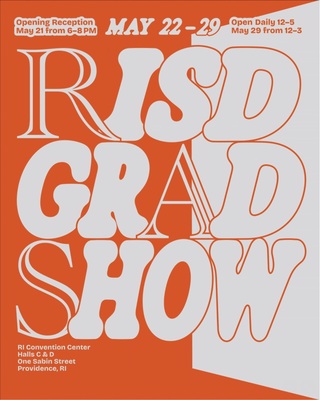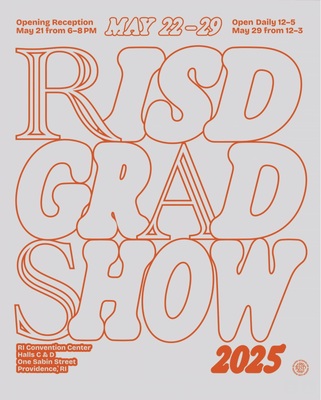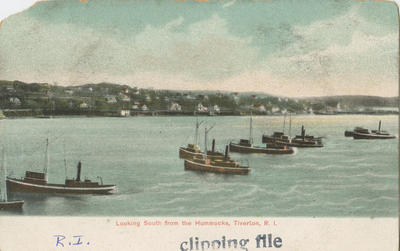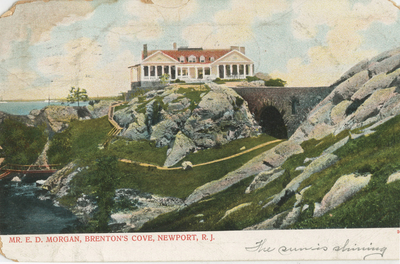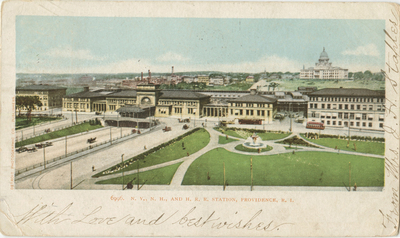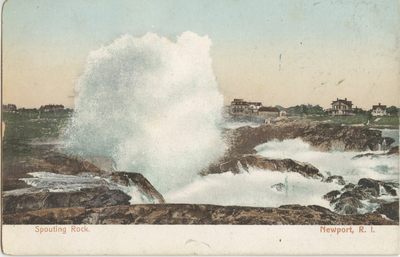
On was an interdisciplinary graduate periodical established by RISD graduate students in 2006. It featured essays and student work that related to a general issue theme. On was intended as a quarterly publication, but it is unclear if further issues beyond the first were ever published.
-

Field guide : collected studies of a symbiont
Jennifer Livermore
Field Guide is a collection of studies that explore how symbiosis relates to graphic design. These studies investigate how visual language constructs — and is constructed by — ideas about nature.
As a manipulator of language and imagery, I borrow the ecologist’s methods in order to make sense of our relationship with the natural world. My techniques include observation, collection, mutation, framing and recombination. I use these methods not to celebrate them, but to expose their subjective nature.
I approach visual language, technology, and our ecological home as an entangled set of ideas rather than estranged categories. My work investigates how power is linked to optics and perception, how evolution is a common creative language, and how the divide between ‘natural’ and ‘artificial’ is increasingly blurred. Overall, these studies are based in a desire to reveal symbiotic interactions.
The products of my inquiry embrace murkiness, blurriness, and interconnectedness. They highlight ecosystems rather than isolated details. They complicate the categories in which we place matter. I do not intend to rationalize information or provide answers. I strive to to raise questions about the relationship between what we make and who we are.
A guide can act as a document for identifying things that already exist, or as an assemblage of methods and tools to direct further creation. For my practice, this field guide acts as both.
-
On Dust: Memory as Performance and Materiality
Natasha Lushetich
The world's "worldliness" is, to a large extent, perceptually constructed through touch, kinaesthetics, and proprioception. Gesture, too, is embedded in sedimentations of the body's prior sensory exchanges with the environment. Materiality is transitive; it triggers sensory landscapes through performance. Consisting of particles of pollen, human and animal skin, hairs, minerals, soil, and burnt meteorites, dust is usually seen as the antithesis of the performative-material nexus. In this paper, I propose a different view: that dust is and acts as a connective tissue. Borrowing from Hélène Cixous's écriture blanche, Quentin Smith's degree presentism, and theorizing nostalgia as a structuring absence, I argue that dust does not numb memory but instead codes it. Activated by embodied acts that bring to light its metaphysical function, dust illuminates the grammar of existence in the spatial, temporal, and affective register.
-
The Problem of Thick Representation
Rafe McGregor
The purpose of this paper is twofold: to define the problem of thick representation and to show that the problem is a puzzle for representation rather than a puzzle for a specific art form or art, in general, as has previously been suggested. In the course of identifying and formulating the problem, I shall demonstrate why the solution proposed thus far fails to solve either the artistic problem at which it is aimed or the representational problem I define. I conclude by indicating two promising directions in which a solution might be found and by explaining the philosophical and critical significance of finding a solution.
-
For a better normal : fostering the informal sector in post-hurricane Puerto Rico, as a pathway for economic stabilization
Jonathan W. Melendez Davidson
For a Better Normal is a proposal to aid informal produce vendors in post-hurricane Puerto Rico. The project takes the shape of a toolkit that facilitates the creation of a cooperative buyer’s club. This cooperative not only provides vendors with the opportunity to create sustainable businesses, but also acts as a pathway to formalization. The outcome of this thesis becomes a case study for how to re-think the potential of the informal economy in relation to the Island’s economic crisis.
-
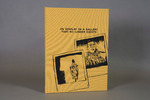
On display in a gallery that no longer exists
Walker Mettling, Special Collections, and Fleet Library
1 volume, 36 pages. Color illustrated title page. Includes ten color risograph prints. Silkscreen cover with stitch binding. This book is a visual document of the RISD Museum 2017 Artist Fellow, Walker Mettling. It includes his drawings and observations from his time in RISD Museum (particularly storage). "I drew all the artifacts in the book with my left hand, using a superstition against handling sacred objects with your right hand (to ward off curses) as a way of trying to respect these objects." - walkermettling.tumblr.com/page/2 "Writen and drawn in January/February 2018.. Book binding by Julia Gualtieri. Screen printed at AS220 Industries in Providence RI."- colophon.
-
Rising above disruption
Paola Alexandra Mondino
Climate change is real. Given the rising number of natural disasters affecting communities across the globe, this is a universal concern for all. From warming oceans to the decreasing of ice sheets and global sea level rise, we have problems. In the wake of increasingly frequent natural disasters, a community’s identity is abruptly interrupted repeatedly – an identity built upon history and traditions created over time, pulled apart over and over. When dealing with damaged communities post-disruption, another identity must emerge, shaped to incorporate the need for future resilience, while acknowledging the presence of the affected area’s past.
South Florida is very familiar with the impact of natural disasters. Hurricane Andrew of 1992 remains one of the worst and is referenced as the greatest possible catastrophic impact a single storm could have on a community and its infrastructure. The Miami Marine Stadium survived Andrew and continues to stand strong. The site has evolved identitiy over time – from boat-racing, to a concert-filled stadium, into abandonment by the city after Andrew, to adoption by underground culture as a “graffiti haven” – but it is now deteriorating significantly and in need of a new identity in order to survive. Due to the continuity of hurricanes and subsequent flooding, along with the high projected sea level rise for the area, Miami’s beach culture identity is also at risk.
The proposed intervention for the stadium’s new identity therefore brings to light a design for the present and future – both a reactivation for the stadium’s past life and an opportunity for Miami’s beach culture to outlast sea level rise. Redesign of Miami Marine Stadium will question the typical layout and social structure of the beaches of today. It will anticipate the identity of future beaches for Miami by acting as the curator in directing the relationships between the existing structure and its natural environment.
-

Convening: Raid the Icebox Now
RISD Museum, John W. Smith, Dominic Molon, Fred Wilson, and Ingrid Schaffner
The RISD Museum launched its multi-year Raid the Icebox Now exhibition project with a convening of participating artists and curators on June 20, 2018.
Museum Deputy Director of Exhibitions, Education and Programs Sara Ganz Blythe helped to organize a mini-symposium on June 20 assessing the legacy of the original Warhol show. Museum Director John Smith, Richard Brown Curator of Contemporary Art Dominic Molon, Carnegie International Curator Ingrid Schaffner and celebrated NYC artist Fred Wilson—also known for pushing curatorial boundaries—discussed how Raid the Icebox I has influenced museum exhibitions over the past 50 years, encouraging curators to question the dominant narrative and honor the voices of contemporary artists.
The project celebrated the 50th anniversary of the Museum's exhibition Raid the Icebox 1 with Andy Warhol, a landmark example of artist-curated museum exhibitions.
-
Climate Futures 1 | Climate Futures, Design and the Just Transition, Session 1: The Labor of Just transitions: Energy Democracy, Trade Unions and Blue Collar/Pink Collar/Green Collar/White Labor
NCSS Graduate Program, Liberal Arts Division, Jonathan Highfield, Sean Sweeney, Alyssa Battistoni, and Myles Lennon
The concept of the just transition has its roots in the labor movement and the international labor movement has been one of the major forces pushing for the adoption of this concept in global climate negotiations. But labor is under attack across the planet--and just transitions beyond fossil capitalism will require the broadest possible alliance of social forces to move us towards a coherent vision of energy democracy. In this session, we explore the opportunities and the tensions around the call for rapid and just transitions. Can the struggles for energy democracy be expanded by thinking more carefully about the alliances that can be built between blue/white collar, green/pink collar conceptualizations of labor? What might be the theoretical and practical opportunities that exist between labor-focused just transitions and movements mobilizing around gendered labor and racial justice? Can the international labor movement become a mechanism for thinking about multi-scalar just transitions?
-
Climate Futures 1 | Climate Futures, Design and the Just Transition, Final Discussion: Long-term Visions for Just Transitions: Degrowth, Left Ecomodernism, Ecosocialism, or beyond?
NCSS Graduate Program, Liberal Arts Division, and Thea Riofrancos
The question of whether a long-term vision for the just transition should be premised on Left ecomodernism, degrowth, green growth, a critical and hybrid ecosocialism or some position in between has become ever more intensely debated across the pages of Jacobin, Monthly Review, New Left Review and in many other places besides. From debates around automation/UBI and plenitude to the 100% renewables/green nuclear debates, from the question of whether sustainable agriculture will involve sustainable intensification or new agro-ecologies to debates around the green new deal, the Green Left seems to be increasingly split on key issues. What is a viable long term vision for a political economy concerned with the just transition?
-
Climate Futures 1 | Climate Futures, Design and the Just Transition, Session 4: Designing Just Transitions: Green Design and Global Supply Chains
NCSS Graduate Program, Liberal Arts Division, Thea Riofrancos, Peter Little, Julie Klinger, and Dustin Mulvaney
Rapid and just decarbonization of the global economy must occur as soon as possible. Critical scholarship has demonstrated that all things remaining equal, a rapid transition to renewable energy and transportation systems is going to have significant impacts on land use patterns, ecologies and communities all along the global supply chain. Yet, it is also clear that critiques of the material impacts of renewables can take very different forms and be used to bolster very different kinds of political projects from environmental justice activism to ecocentric romanticism, from anti-civilization/neo-primitivist currents, to pro-nuclear ecomodernists and anti-renewables fossil-fuel advocates. In this panel, we seek to explore how critical scholarship on global supply chains can engage fully with hazardous impacts of the big renewables roll out whilst also keeping the door open for reconfigurations and different modes of deployment that open up new possibilities for energy democracy.
-
Climate Futures 1 | Climate Futures, Design and the Just Transition, Session 3: Environmental Activism, Social Justice, and the Just Transition
NCSS Graduate Program, Liberal Arts Division, Timmons Roberts, Nicole Fabricant, Camilo Viveiros, and Kai Bosworth
To what extent does the concept of the just transition open the potential to build new horizons for activist movements struggling for environmental justice, housing justice, energy justice and indigenous justice here and beyond? How do local movements, around particular sites of fossil capital, energy grids, housing, and transit, scale up and out, and link up as part of translocal, national, and transnational environmental justice movements? How do these movements orient to capitalism, the state, electoral politics, and other movements not explicitly identified as environmentalist?
-
Climate Futures 1 | Climate Futures, Design and the Just Transition, Session 6: Just Transitions, Public Ownership, and Platform Cooperatives
NCSS Graduate Program, Liberal Arts Division, Timmons Roberts, Juliet Schor, Johanna Bozuwa, and Kate Aronoff
Would a just transition in the U.S. require the implementation of green social democracy? And/or do we need to move forward with new visions of social ownership, plentitude, and platform co-operatives? In this panel we will explore and appraise the range of different visions and proposals that are currently on the table for re-imaging left-green futures.
-
Climate Futures 1 | Climate Futures, Design and the Just Transition, Session 2: Design, Creative Labor and the Just Transition
NCSS Graduate Program, Liberal Arts Division, Anne Tate, Daniel Aldana Cohen, Nicholas Pevzner, Namita Vijay Dharia, and Elizabeth Dean Hermann
The just transition implies that we decarbonize our energy systems but also embark on a much broader redesign of our socio-material relations and landscapes. What role can design play in thinking about just transitions? What might the designed landscapes of just transitions look like? Who should be the designers of the just transition? To what extent might a just transition involve a revaluing of the creative labor and design intelligences of many different kinds of people beyond the world of professional designers?
-
Climate Futures 1 | Climate Futures, Design and the Just Transition, Introduction
NCSS Graduate Program, Liberal Arts Division, and Damian White
Framing and Welcome
-
Climate Futures 1 | Climate Futures, Design and the Just Transition, Session 5: Political Aesthetics and Low Carbon Futures
NCSS Graduate Program, Liberal Arts Division, Damian White, Ijlal Muzaffar, Anastasiia Raina, and Jesse Goldstein
What might the design aesthetics of a just transition look like? Might it involve a move beyond eco-nostalgia for “the Nature we have lost” and a recognition that we are going to have new relations to new socio-natures and technonatures and designs with new natures? How does the struggle for post and decolonial interventions impact who has voice and how is represented in the just transition? Might a just transition involve thinking about futures but in ways that break from older modernist futurings?
-
The Acclimatization Society
Sarah Nicholls, Special Collections, and Fleet Library
1 volume. "The Acclimatization Society is a new limited edition pamphlet about birds that are local to New York City, their adaptations, and survival tactics. Focused on select native and invasive species in their urban habitats: the rock pigeon, red-tailed hawk, sparrows, and European starlings, the text also explores speciation--the process by which species adapt to circumstances, develop genetic mutations, and in time, evolve into new species. The title of the pamphlet references the voluntary associations in the 19th and 20th centuries that encouraged the introduction of non-native species into locations worldwide." Title from cover. "In conjunction with Avifuana: Birds & Habitat on view at Wave Hill, April 7-June 24, 2018"--Colophon. Letterpress and linoleum (linocut) block prints on paper (24 x 55 cm) folded accordion style and sewn into printed cardstock cover with pamphlet stitch. "Brain Washing From Phone Towers is a series of informative and entertaining Informational Pamphlets produced by hand on a seasonal basis. These small-scale publications combine text (handset in metal type) and image (carved in wood or linoleum) produced via obsolete technology in editioned works which are distributed at will to a chosen audience. The content of the series aims for historical interest, commemorative intent and a healthy dose of humor, and the distribution methods are based on the values of the gift economy."--Provided by artist.
-

Hispanic Heritage Month
Intercultural Student Engagement Office
Poster promoting Rhode Island Hispanic Heritage Month September & October 2018 local events.
-
LGBT History Month
Intercultural Student Engagement Office
Poster advertising LGBT History Month events held at RISD, October 2018.
-
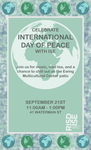
Peace on the Patio | International Day of Peace
Intercultural Student Engagement Office
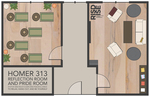
Poster advertising the celebration of the 2018 International Day of Peace on the Ewing Multicultural Center patio.
-

Postcards + Donuts | 15 West
Intercultural Student Engagement Office
RISD event promoting writing postcards to friends + free donuts! Held in 15 Westminster St. building lobby.