
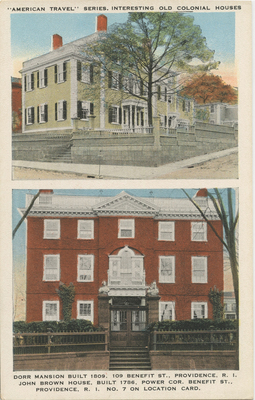
On was an interdisciplinary graduate periodical established by RISD graduate students in 2006. It featured essays and student work that related to a general issue theme. On was intended as a quarterly publication, but it is unclear if further issues beyond the first were ever published.





-
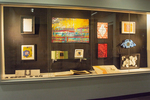
Shared Obessions | NAHP Members' 2023 Annual Showcase
Fleet Library, RISD Color Lab, and North American Hand Papermakers
Shared Obessions | NAHP Members' 2023 Annual Showcase satellite exhibit in conjunction with the opening reception ceremony held on the 2nd floor of the RISD Fleet Library, 15 Westminster St. Providence, RI. Additional work displayed at the RISD Color Lab, 30 North Main St., Providence, RI.
-

Sustainable Seismic Architecture: Exploring the Synergy of Mortise-and-Tenon Joinery and Modern Timber Construction for Reducing Embodied Carbon
Cong Li
Abstract
This design thesis explores the potential of combining ancient Mortise-and-Tenon joinery techniques with modern timber construction to create sustainable seismic architecture that simultaneously reduces embodied carbon. By studying the enduring qualities of Mortise-and-Tenon structures and their ability to withstand earthquakes, this research uncovers a synergistic relationship between traditional joinery methods and contemporary building materials, unlocking significant opportunities for embodied carbon reduction ranging from 7 to 40% compared to other modern architecture construction.
The research reveals that Mortise-and-Tenon structures commonly incorporate large roof systems, acting as mass dampers that provide flexibility and distribute weight evenly to columns. By transferring the substantial roof load to the columns, these structures exhibit a dynamic interaction with the surrounding landscape. Inspired by this discovery, the subsequent phase of the thesis focuses on modern large roof architecture, with a commitment to incorporating wisdom from the past and exploring possibilities for the future.
Practical design solutions derived from the knowledge and insights gained throughout the research are crucial for my thesis design project. Therefore, the final design proposal centers around a high school in Chula Vista, California, with particular emphasis on the gymnasium building. By reinterpreting traditional structures with new materials such as cross-laminated timber (CLT), the design seeks to address seismic threats while honoring the legacy of the past.
In summary, this thesis presents a design approach that harnesses the sustainable qualities of Mortise-and-Tenon joinery and integrates them with modern timber construction to create earthquake-resistant structures with reduced embodied carbon. The research highlights the significance of embracing innovative methods to achieve truly green and sustainable architecture. By sharing the highlights, valuable insights, and outcomes of this thesis project, the presentation aims to inspire the audience and foster a deeper understanding of the transformative potential of sustainable seismic architecture.
-
Recipes for Building Relationships
Adriana Lintz
This thesis explores the history of women's access to education and the issues of gender disparity in education. I focus on single-gendered schools as I write from personal experience to describe the benefits for individuals in single-gender educational systems. I cite conflicting research on how men and women learn regarding biological, cognitive, and developmental differences. I illuminate some of the benefits of single-gendered education through research, experience, and personal communications. I write about the controversies and disparities regarding education and single-gender schools. I document research on the issues women face in education and the politics of women’s bodies and minds in educational spaces. In these spaces, I explore the importance of educating individuals and provide evidence for the importance of inclusion and accessibility.
-
Eviction to Placement: Rethinking the current supportive housing systems for hidden homeless families
Fang-Min Liou
This thesis focuses on repurposing unoccupied office space into affordable housing systems tailored to meet the unique needs of homeless families. Families with children make up 36 percent of the homeless population overall and children’s homelessness status is almost always “hidden." Architecture and design can play a vital role in addressing social inequity by creating improved living environments for the houseless community through adaptive reuse of underutilized space situated within dense urban areas with the greatest access to resources to support these families, evoke feelings of comfort, security, and hope.
The following thesis accommodates three basic needs of homeless families: community, residential, and workplace for onsite support systems. Open-plan building layouts are designed to foster social interaction, while communal spaces and onsite support systems within the building promote a sense of vertical micro-community, empowering homeless families to take their crucial first steps towards societal integration, elicit a feeling of comfort and tranquility. By modifications to the building facade and slabs, balconies and atriums offer ventilation, glimpses of nature, and connections to the vibrant streetscape. More than just architectural enhancements, this aims to tangibly transform these spaces into havens that exude warmth and belonging.
The underlying strategy aims to seize current economic and development challenges, such as office vacancies, and utilize them to benefit those most in need, the homeless families. This multifaceted approach addresses the urgent housing crisis, urban development, and health issues simultaneously – respecting existing infrastructure and retooling it for future life.
-
Water Relations, Understanding Our Relationship to Water: Through Research, Diagrams, and Glass
Tian Li
As I observe the different ways human civilization interacts with water, I reflect on how I have interacted with it personally, in Califronia and Hawai’i. I also learn about the largest water-controlling infrastructure in China and its effects on the land and people. In Providence, I notice the infrastructure around the canal that keeps the water in. This relationship to water is unique to a post-colonial world where water is a commodity in which we spectate. What relationships did people have with water before we polluted the waters and created all this concrete infrastructure around it?
Through listening to Lorén M. Spears, member of the Narragansett Tribe, we begin to understand a different relationship. The environment we currently observe is documented but obstructed through these lenses I’ve created with glass. In obstructing our current perception, the visual and auditory effects are meant to create a space of reflection and questioning.
-

RE:Making: A Documentation of Work by Angela Lorenz Book Launch
Angela Lorenz, Judith Tolnik Champa, Massimo Riva, Claudia Covert, Jennifer Liese, Margot McIlwain Nishimura, Fleet Library, and Special Collections
Please join us Thursday, October 12, 2023 at 6:30 PM EDT at the Fleet Library as we celebrate the publication of RE:Making, a volume of 70 essays on historical observation, collections, transformation, and material applications in the work of book artist Angela Lorenz (Brown ‘87) from 1982 to 2022. Lorenz will be in conversation with Special Collections Librarian Claudia Covert, Editor Judith Tolnick Champa and contributors to the volume’s essays, including Massimo Riva, Jennifer Liese, and Margot McIlwain Nishimura.
Description from the publisher, the jenny press, New Haven, CT:
/="/">
/="/">"With essays from over 70 scholars, collectors, librarians, curators, and journalists on Lorenz's work from 1989 to 2022. Includes a reflection from Angela on her juvenilia from 1982 to 1988. Edited by Judith Tolnick Champa with Jae Jennifer Rossman. Trade Edition. Color images of all works plus QR codes to videos. 200 pages."
Books will be available for purchase and signing by the author. Free and open to the public.
-
VeneTron
Angela Lorenz, Special Collections, and Fleet Library
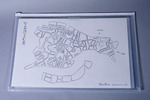
1 volume (unpaged) : map. 1 plastic envelope with zip closure holding 2 sheets of paper and 7 plastic sheets (each 28 x 44 cm) that include a map of Venice and index to locations of works of art; plastic stencil sheets have names of artists and pricked points for overlaying on map to discern locations of works. "VeneTron is a low-tech art-finding device that reveals locations of work by seven important Venetian artists. It addresses the complicated and confusing geography and history of Venice, Italy and is named for the Tron family, which rose to power in the 15th century. Getting from point A to point B in Venice is challenging because the city "center" is a series of islands currently connected by bridges. However, the VeneTron map is a watercolor based on an 18th century engraved map with only one bridge in the entire city, the Rialto. At that time boats were used even more, and bridges were wooden planks used or removed at will. Today, even with hundreds of bridges at your disposal, you might be headed in the right direction "as the crow flies" but suddenly the street will dead-end at a body of water. There are mistakes on maps, including Google Maps, when compared to Google Earth. It is very easy to get lost or take a wrong turn, even when you basically know your way around. Also, the VeneTron map has canals that don't exist today, except for on street signs; where the street name begins with "Rio terà" that tells you a former canal, or rio, was filled in."-- Colophon. Giovanni Bellini -- Vittore Carpaccio -- Rosalba Carriera -- Giulia Lama -- Jacopo Tintoretto -- Tiziano Vecellio -- Paolo Veronese.
-
Pond / Map
Elizabeth Mackie, RISD Color Lab, and North American Hand Papermakers
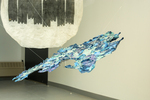
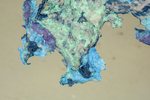
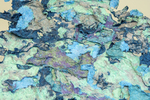
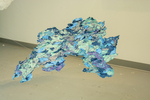
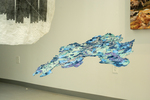
Pond/Map 2023, Handmade Abaca Paper and Pigment, 23"x 24"x 2.5". Elizabeth Mackie is an interdisciplinary artist working in handmade paper, sculpture, installations, photography, video, sound, and textiles. Elizabeth has exhibited her artwork and videos in various institutions throughout the United States and abroad, including Japan, Taiwan, Australia, Bulgaria, England, Canada, Austria, Poland, Spain, Denmark, France, Italy, Republic of Cyprus, Germany, Israel, Chile and Brazil. Current exhibitions include EARTHSPEAK: Giving Voice to Paper, International Biennial for Paper Fibre Art 2023/24, National Taiwan Craft Research and Development Institute (NTCRI); IAPMA Congress exhibition: Paper Alive, Dresden, Germany; and Mother Nature vs Human Nature: The Inequity of Climate Resilience, 2023 New Jersey Arts Annual.
Shared Obessions | NAHP Members' 2023 Annual Showcase exhibit on view at the RISD Color Lab, 30 North Main St., Providence, RI in conjunction with the opening reception ceremony held on the 2nd floor of the RISD Fleet Library, 15 Westminster St. Providence, RI. Additional work displayed at the RISD Fleet Library.
-
Pond / Map
Elizabeth Mackie, RISD Color Lab, and North American Hand Papermakers
Pond/Map 2023, Handmade Abaca Paper and Pigment, 23"x 24"x 2.5". Elizabeth Mackie is an interdisciplinary artist working in handmade paper, sculpture, installations, photography, video, sound, and textiles. Elizabeth has exhibited her artwork and videos in various institutions throughout the United States and abroad, including Japan, Taiwan, Australia, Bulgaria, England, Canada, Austria, Poland, Spain, Denmark, France, Italy, Republic of Cyprus, Germany, Israel, Chile and Brazil. Current exhibitions include EARTHSPEAK: Giving Voice to Paper, International Biennial for Paper Fibre Art 2023/24, National Taiwan Craft Research and Development Institute (NTCRI); IAPMA Congress exhibition: Paper Alive, Dresden, Germany; and Mother Nature vs Human Nature: The Inequity of Climate Resilience, 2023 New Jersey Arts Annual.
Shared Obessions | NAHP Members' 2023 Annual Showcase exhibit on view at the RISD Color Lab, 30 North Main St., Providence, RI in conjunction with the opening reception ceremony held on the 2nd floor of the RISD Fleet Library, 15 Westminster St. Providence, RI. Additional work displayed at the RISD Fleet Library.
-
Pond / Map
Elizabeth Mackie, RISD Color Lab, and North American Hand Papermakers
Pond/Map 2023, Handmade Abaca Paper and Pigment, 23"x 24"x 2.5". Elizabeth Mackie is an interdisciplinary artist working in handmade paper, sculpture, installations, photography, video, sound, and textiles. Elizabeth has exhibited her artwork and videos in various institutions throughout the United States and abroad, including Japan, Taiwan, Australia, Bulgaria, England, Canada, Austria, Poland, Spain, Denmark, France, Italy, Republic of Cyprus, Germany, Israel, Chile and Brazil. Current exhibitions include EARTHSPEAK: Giving Voice to Paper, International Biennial for Paper Fibre Art 2023/24, National Taiwan Craft Research and Development Institute (NTCRI); IAPMA Congress exhibition: Paper Alive, Dresden, Germany; and Mother Nature vs Human Nature: The Inequity of Climate Resilience, 2023 New Jersey Arts Annual.
Shared Obessions | NAHP Members' 2023 Annual Showcase exhibit on view at the RISD Color Lab, 30 North Main St., Providence, RI in conjunction with the opening reception ceremony held on the 2nd floor of the RISD Fleet Library, 15 Westminster St. Providence, RI. Additional work displayed at the RISD Fleet Library.
-
Pond / Map
Elizabeth Mackie, RISD Color Lab, and North American Hand Papermakers
Pond/Map 2023, Handmade Abaca Paper and Pigment, 23"x 24"x 2.5". Elizabeth Mackie is an interdisciplinary artist working in handmade paper, sculpture, installations, photography, video, sound, and textiles. Elizabeth has exhibited her artwork and videos in various institutions throughout the United States and abroad, including Japan, Taiwan, Australia, Bulgaria, England, Canada, Austria, Poland, Spain, Denmark, France, Italy, Republic of Cyprus, Germany, Israel, Chile and Brazil. Current exhibitions include EARTHSPEAK: Giving Voice to Paper, International Biennial for Paper Fibre Art 2023/24, National Taiwan Craft Research and Development Institute (NTCRI); IAPMA Congress exhibition: Paper Alive, Dresden, Germany; and Mother Nature vs Human Nature: The Inequity of Climate Resilience, 2023 New Jersey Arts Annual.
Shared Obessions | NAHP Members' 2023 Annual Showcase exhibit on view at the RISD Color Lab, 30 North Main St., Providence, RI in conjunction with the opening reception ceremony held on the 2nd floor of the RISD Fleet Library, 15 Westminster St. Providence, RI. Additional work displayed at the RISD Fleet Library.
-
Pond / Map
Elizabeth Mackie, RISD Color Lab, and North American Hand Papermakers
Pond/Map 2023, Handmade Abaca Paper and Pigment, 23"x 24"x 2.5". Elizabeth Mackie is an interdisciplinary artist working in handmade paper, sculpture, installations, photography, video, sound, and textiles. Elizabeth has exhibited her artwork and videos in various institutions throughout the United States and abroad, including Japan, Taiwan, Australia, Bulgaria, England, Canada, Austria, Poland, Spain, Denmark, France, Italy, Republic of Cyprus, Germany, Israel, Chile and Brazil. Current exhibitions include EARTHSPEAK: Giving Voice to Paper, International Biennial for Paper Fibre Art 2023/24, National Taiwan Craft Research and Development Institute (NTCRI); IAPMA Congress exhibition: Paper Alive, Dresden, Germany; and Mother Nature vs Human Nature: The Inequity of Climate Resilience, 2023 New Jersey Arts Annual.
Shared Obessions | NAHP Members' 2023 Annual Showcase exhibit on view at the RISD Color Lab, 30 North Main St., Providence, RI in conjunction with the opening reception ceremony held on the 2nd floor of the RISD Fleet Library, 15 Westminster St. Providence, RI. Additional work displayed at the RISD Fleet Library.
-
Explorations and Reflections: Gendered Experiences in Teaching and Learning
Francesca Matarese
This thesis explores the history of women's access to education and the issues of gender disparity in education. I focus on single-gendered schools as I write from personal experience to describe the benefits for individuals in single-gender educational systems. I cite conflicting research on how men and women learn regarding biological, cognitive, and developmental differences. I illuminate some of the benefits of single-gendered education through research, experience, and personal communications. I write about the controversies and disparities regarding education and single-gender schools. I document research on the issues women face in education and the politics of women’s bodies and minds in educational spaces. In these spaces,I explore the importance of educating individuals and provide evidence for the importance of inclusion and accessibility.
-
“Little Old Wales”: Expressions of Nationalism, Language and Pride in Welsh Football
Abigail Mathieson
Welsh football, through its use of material culture, language, and acknowledgements of history, has become a major force in representing Welsh national identities locally and globally. This thesis expands on Benedict Anderson’s idea of the “imagined community” through contemporary research from academic sources and from voices throughout the Welsh footballing community. It highlights the significance of the sport in national identity, especially within smaller nations such as Wales with histories of post-colonialism. Along with this, football shows the role cultural nationalism plays in the nation of Wales and in its independence movements.
-
Appropriate that Bridge: Appropriation as a way of Intervention
Haochen Meng
Appropriation is an action of intervention in many fields, including legislation, culture and design. To appropriate something (or someplace) means to violate its original ownership and claim it, which in most cases is illegal. However, appropriation doesn’t have to be an illegal act: it can be permitted by the authority and become a “reuse” of an object or space. For example, street dining is often authorized by city governments, so they indicate a transition of the ownership of the street from the vehicles and pedestrians to the restaurants and diners. In architectural terms, appropriating a space (or structure) mostly equals giving it a new program. Lara-Hernandez, Melis and Caputo (2017) define appropriation of the built environment as a continuous synergy between citizens and the urban landscape displayed through specific activities that contributes to the edifice of the social urban landscape. “Appropriation of public spaces allows citizens to take part in the production of urban space, beyond the mere inhabitation/fruition of the already formed urban space by giving citizens the right to completely manage and use their everyday life” (Lefebvre, 1992).
Another action of appropriation is to “Squat”. It is the action of occupying an unoccupied area of land or building that someone does not own. This usually refers to homeless people occupying part of the streets, houses or other types of space owned by the others. In Architecture of Appropriation, there is a seven-step-practice of squatting that can legalize the act of squatting. “In the Netherlands, squatting a building is a complicated and now criminalized intervention in the built environment, yet one that requires an organized structure of solidarity and support as well as specific knowledge and experience.” (Boer, 2019). It is possible to have legitimized squatting. It is also possible to peacefully appropriate something without causing any tension or violating any law.
In summary, the appropriation of architectural space might be illegal in the beginning, but like the artists moving into SoHo in NYC, the act of appropriation or even squatting can be a way to stimulate the economy and eventually completely transform the space. I wish to find possible methods to appropriate the Crook Point Bascule Bridge, the selected site properly and create new programs for the neighborhood. This intervention is not only re-appropriating the urban space, but also making new spaces that have the potential to be appropriated by the locals in the future.
-
Toronto Rewilded
Forrest Meyer
Global urbanism has left almost no room for native ecology, this has an adverse effect on biodiversity, so adverse that biodiversity has been lost at an alarming rate globally, accounting for between 50-70% of species eradication. Having witnessed firsthand on the land I grew up on, the immense positives of native plantings on the creation of biodiversity, I am eager to implement native plantings in an architectural thesis. Not only is this important to flora and fauna, and the environment, but also for the biophilic connection humans crave with their environs. The reintroduction and preservation of native plantings, species, and by extension, ecosystems is a process now coined as rewilding. This thesis is an exploration of the implementation of rewilding in our ever-urbanizing world. How can a city adopt strategies to combat the severe loss of biodiversity? How can we push the bounds of what is acceptably wild in our cities? What does wild mean to us?
-
CRACKS OF THE CITY: Crack as an invitation for informality
Yusha Miao
随着城市的扩张和发展,城市规划将效率和易于管理放在首位,从而创造出干净、整洁和无障碍的空间。街道更宽更平坦,建筑物更统一,公园更开放。
然而,这种“美丽”城市的愿景却忽视了各类非正式、非主流人群的需求,抹杀了部分人的表达和生存空间。
城市变得不那么包容,失去了基于当地历史和背景的非正式活动所带来的魅力和灵活性。
如果城市采用更加松散和多孔的规划方法,为非正式活动提供潜在场所,例如带来氧气和光线的缺口,非正规经济和那些被推到边缘的经济体将有机会蓬勃发展。设计师不应完全站在制定规则和秩序的立场上,而应提供自发产生活动的可能性。通过接受非正式城市空间不可预测和不受控制的性质,我们可以为这些地区注入新的活力。
本论文通过引入几种增强裂缝的干预措施来挑战现有的城市体系,作为对非正式性的邀请。我的建议涉及打破不同表面的界限,模糊用途和功能。
使用选择性的“阈值”使一些空间变得模糊,甚至更难接近或欢迎,并使它们的用途不明确。它可以创建一系列只对愿意进入的人开放的“城市秘密花园”。这些地方是有选择性的,并且具有更多样化和非正式使用的潜力。
As cities expand and grow, urban planning prioritizes efficiency and ease of management, resulting in clean, uncluttered and accessible spaces. The streets are wider and flatter, the buildings more uniform, and the parks more open.
However, this vision of a "beautiful" city ignores the needs of various informal and non-mainstream groups, and obliterates the expression and living space of some people.
Cities become less inclusive, losing the charm and flexibility that come with informal events based on local history and context.
Informal economies and those pushed to the margins will have the opportunity to thrive if cities adopt a more loose and porous approach to planning, providing potential sites for informal activities, such as openings that bring in oxygen and light. Designers should not be entirely in the position of establishing rules and order, but should provide the possibility of spontaneously generated activities. By embracing the unpredictable and uncontrolled nature of informal urban spaces, we can breathe new life into these areas.
This thesis challenges the existing urban system by introducing several interventions that enhance fissures as an invitation to informality. My proposal involves breaking down the boundaries of different surfaces, blurring use and function.
Using selective "thresholds" blurs some spaces, making them even less approachable or welcoming, and makes their purpose unclear. It could create a series of "urban secret gardens" that are only accessible to those willing to enter. The places are selective and have the potential for more varied and informal uses.
-
Confronting and Caring for Spaces of Service
Tia Miller
Hotel service spaces have existed as a typology of willful erasure and strategic manipulation for centuries. As criticism around unfair labor practices continues to grow in the post-pandemic world, how can we better confront the hidden necessity of service space while also caring for workers who maintain the buildings we design? Leveraging the common comparison of hotel front of house and back of house spaces to a theater’s main stage and backstage, what can be learned when the spaces are reconstructed as open and observable sets? What choreographies exist in these spaces and how do they change when the back and front stages are combined in a way that better considers care and comfort of service workers?
-
Reorientation
Soleil Nguyen
A non-linear narrative to understand the place and character of my neighborhood.
-
Celebrate Scarcity: Water Harvesting as Cultural Keystone
Jiajun Ni
As Phoenix, Arizona’s population has been increasing intensely in recent years, the city is facing a potential water crisis because of the over-extraction of underground water and a gradual decrease in water supply from the Colorado River. To solve the crisis, Phoenix has promoted water-saving lifestyles for citizens and built aquifers to capture stormwater and floods. However, these decisions are not inherently sustainable since they are too costly and centralized without enough consideration of different community contexts. Therefore, we need to rethink the water-efficiency system that is zoomed into the community level.
This thesis explores a water-collection model that is driven by both landscape features and community engagements. By building physical and social connections between community members and the water collection, we can create resilient cultures and landscapes that help to promote water efficiency. The thesis is also a manifesto of connecting urban populations back to the natural landscapes that enhance people’s environmental awareness for generations.
-
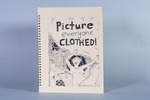
Picture Everyone Clothed!
Georgia Oldham, Special Collections, and Fleet Library
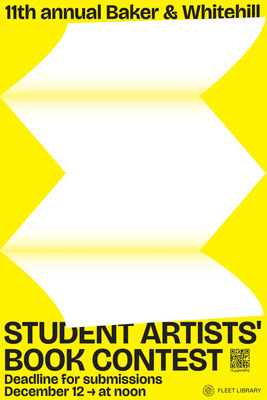
Entry for the 10th Baker & Whitehill Student Artists' Book Contest. Opening Reception Thursday, February 29th, 2024 Fleet Library, Main Reading Room. Juror: Ian Cozzens BArch 05.
-
Infinitely Incredible Configurations
Jenni Oughton
As a designer, I am intent on charting out a radically different perspective on the future. To instigate movement beyond current design thinking centered on problem solving, I propose a shift toward design fiction—a deliberate and direct inquiry into the realm where design meets science fiction, and how that merges with reality. My practice uses science, speculative fiction, and technology as positive models to both generate prompts and spur design outcomes. I borrow from the author Isaac Asimov's three categories of science fiction narratives to instigate a way of structuring this design endeavor: What if ..., If only ..., If this continues … and how these questions can ask what “possible societies of the future… might or might not develop” as a result of new designs and technologies. Within this framework I leverage the theory of the quantum multiverse to explore infinite possibilities.
"Infinitely Incredible Configurations" is a rethinking about how we might navigate through the world and transform the power that our voice has in it.
-
[De]Composition: Grounding Architecture
Skylar Perez
This thesis forages through a multitude of entangled scales that utilizes geologic time, water bodies, farming systems and fungal networks to reorient how we as humans herald the vital connecting force that is SOIL.
Reimagining how approaches to soil care could alter visions of innovation and land management in the arid region of Llano Estacado (Lubbock, TX).
The research embraces soil a place full of life and microbial activity that systematically contributes to local ecosystems and planetary health.
How do we build soil?
-
In a Condition of No Light
Alana Perino
In a Condition of No Light is an autofictional investigation into lineages of familial domesticity. The performances therein circumnavigate one family in one domestic environment, yet are in dialogue with repertoires learned and rehearsed within legacies of myth, literature, theater, film, music, and image; as well as through the otherwise untraceability of embodied memory and inherited trauma. The methodologies used are primarily photographic but also encompass practices reaching towards sculpture, installation, and performance. The line of questioning reserved for this inquiry is how a home, its objects, and inhabitants generate, spacialize, and embody the conditions of wealth, whiteness, and gender. At stake is the potential to fracture calcified molds, reenvision archetypes of enmeshment, and develop rituals of empathy across time, selves, and generations through the impossible practice of healing.
-
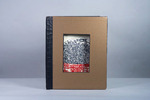
Wonderlandia
Daniel Pulido, Special Collections, and Fleet Library
11 unnumbered pages (some folded) : color illustrations (some foldout). Illustrated title page. Includes various types of illustrations including linocut and woodcut. Printed dark blue and red on beige paper. "1 aguafuertes con xilografía mdidas: 56 x 38 centímetros. relizadas en atelier alt schlachthof, Sgmaringen. Aemania, 2019". "6 linografías con xilografía 38 x 28 centímetros, realizadas en Ibagué Colombia, 2023". Text contains ornamental initials. Edition comprised of 4 copies. Handwritten poem with etchings, color woodcuts and linocuts, on mould made paper. Daniel Pulido is an artist and poet born in Colombia. He is a member and co-founder of the artist's group TallerContil in Nicaragua. He had lived in Nicarague since the Sandinist revolution. In 2021 he had to emigrate to Columbia and now lives in Ibagué. Handbound [sewn] by the artist. Front cover board has cutout window, revealing a print on first page.