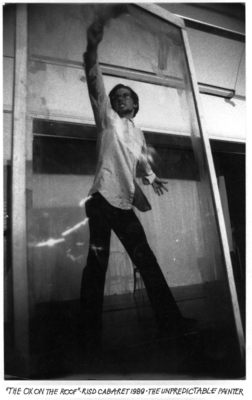
On was an interdisciplinary graduate periodical established by RISD graduate students in 2006. It featured essays and student work that related to a general issue theme. On was intended as a quarterly publication, but it is unclear if further issues beyond the first were ever published.
-
Contemplation
Ann Motonaga, Fleet Library, and Special Collections
Graduate student, year of graduation: 2018. Major: Architecture. Class: The Photobook. Faculty: Lindsey Beal.
-
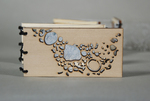
Contemplation
Ann Motonaga, Fleet Library, and Special Collections
Graduate student, year of graduation: 2018. Major: Architecture. Class: The Photobook. Faculty: Lindsey Beal.
-
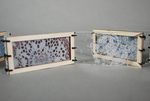
Contemplation
Ann Motonaga, Fleet Library, and Special Collections
Graduate student, year of graduation: 2018. Major: Architecture. Class: The Photobook. Faculty: Lindsey Beal.
-

A Conversation with Kara Walker
RISD Museum and Kara Walker
Accomplished artist Kara Walker (RISD MFA 1994, Painting/Printmaking), winner of a MacArthur “genius” fellowship, is best known for her candid investigation of race, gender, sexuality, and violence through silhouetted figures that have appeared in numerous exhibitions worldwide. The RISD Auditorium was full to capacity for this much-anticipated Artist Talk. This video was produced by RISD Museum.
-

Edward Yang's Confusion
Law Nga-chun and Lo Chun-cheong
Edward Yang (in Chinese 楊德昌, 1947-2007) is one of the most renowned Taiwanese directors, whose works raise criticisms of modernity. Since the New Culture Movement in the 1910s and 1920s, Chinese literati have queried the place of traditional Chinese culture, especially Confucianism, on the road to modernization. This paper gives an account of Yang’s understanding of modernization and the Confucian tradition as illustrated in his work, A Confucian Confusion (1994). We argue that, though he despised politically endorsed Confucianism as ideology, without sufficient justification Yang nonetheless reserves the possibility of taking Confucianism as a supplement to modernity.
-
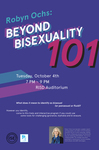
Beyond Bisexuality
Intercultural Student Engagement Office
A poster presented by the office of Intercultural Student Engagement at RISD for a talk by Robyn Ochs called Beyond Bisexuality 101 in the RISD Auditorium.
-

International Day of Peace
Intercultural Student Engagement Office
This is an illustration of the International World Day of Peace on September 21 2016 presented by the office of Intercultural Student Engagement at RISD. A reception and short films were shown on the RISD campus.
-
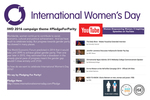
International Women's Day
Intercultural Student Engagement Office
An informational poster for International Women's Day 2016 presented by the office of Intercultural Student Engagement at RISD. A pledge for Parity and speeches on YouTube were mentioned.
-
ISE Info Card (front)
Intercultural Student Engagement Office
The front of the card for RISD students from the office of Intercultural Student Engagement with its logo displayed.
-

OISS card (front)
Intercultural Student Engagement Office
The front of an Office of International Student Services card at RISD with its logo.
-
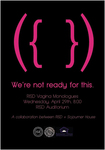
Vagina Monologues
Intercultural Student Engagement Office
A poster from RISD Intercultural Student Engagement about a presentation of the Vagina Monologues.
-
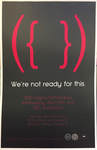
Vagina Monologues
Intercultural Student Engagement Office
A poster from RISD Intercultural Student Engagement for a presentation of the Vagina Monologues.
-
Earth and the Moon
Yusuke Oono, Special Collections, and Fleet Library
1 volume (unpaged) : color illustrations. 360° book. "The 360° book is a new revolutionary format that enables the artist to create a panoramic three-dimensional world. The book opens and expands into a dynamic circle of pages. Each page is finely crafted works of art, drawing the viewer from a scene of two dimensions to a three-dimensional world/diorama."--Container. Text on cover and container in Japanese and English. Package design by Kazushige Takebayashi. Book opens and expands into a 360-degree panoramic scene of the Earth and Moon. Lasercut carousel book.
-
Macabre Fascination and Moral Propriety: The Attraction of Horror
Marius A. Pascale
Why does the horror genre serve as a source of pleasure, given its aim to induce fear in the audience? I examine two general solutions to this phenomenon, referred to as the paradox of horror, which differ based upon their position regarding the possibility of deriving pleasure from fear. Each of the possible solutions contains significant flaws. I argue that, by adjusting a meta-theory originally proposed by Susan Feagin, it is possible to craft a solution that addresses the paradox while preserving the idea that, at times, fear can be enjoyed. The article concludes by considering the moral status of macabre fascination, which is often subject to recrimination. Given that such fascination is a driving force behind the willingness to engage with horror, does it follow that these works ought to be viewed as morally problematic? Drawing upon the concept of a moral saint, I argue the lack of macabre fascination is problematic. Exercising this fascination is beneficial to the development of character traits. Thus such indulgences are, within reason, morally acceptable.
-

Transformation
Weixinyue Peng, Fleet Library, and Special Collections
Undergraduate student, year of graduation: 2020. Major: Experimental and Foundation Studies. Faculty: Martie Holmer.
-
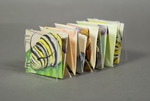
Transformation
Weixinyue Peng, Fleet Library, and Special Collections
Undergraduate student, year of graduation: 2020. Major: Experimental and Foundation Studies. Faculty: Martie Holmer.
-
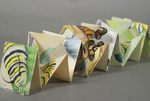
Transformation
Weixinyue Peng, Fleet Library, and Special Collections
Undergraduate student, year of graduation: 2020. Major: Experimental and Foundation Studies. Faculty: Martie Holmer.
-
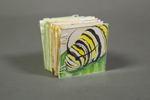
Transformation
Weixinyue Peng, Fleet Library, and Special Collections
Undergraduate student, year of graduation: 2020. Major: Experimental and Foundation Studies. Faculty: Martie Holmer.
-

Transformation
Weixinyue Peng, Fleet Library, and Special Collections
Undergraduate student, year of graduation: 2020. Major: Experimental and Foundation Studies. Faculty: Martie Holmer.
-
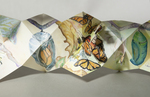
Transformation
Weixinyue Peng, Fleet Library, and Special Collections
Undergraduate student, year of graduation: 2020. Major: Experimental and Foundation Studies. Faculty: Martie Holmer.
-
Expanding horizons, expanding self: an incentive to get out of the classroom and start using art to explore your community with placed-based arts investigation
Erin Poindexter
The three primary components of Place-based Arts Investigation (PBAI) are an understanding of place, arts-integration, and arts-based research, each with a heritage in and of itself. These ideas work in tandem to form the keystones of PBAI, a model for interdisciplinary arts-based learning that utilizes the multiple languages of art as methods of inquiry and self-reflection without stifling curiosity. Developed with the intention to provide a true model for ‘arts integration’ in teaching and learning, PBAI uses the distinct advantages of visual art education to engage the learner through multiple modes of inquiry while providing periods of guided reflection (Gude, 2007). PBAI purports that every community performs as a microcosm of the world at large. Upon further inspection, the community (the place, the people, and the ways in which they are connected) will elicit the same natural history, power struggles, and ethical questions of any standard curriculum. By a community’s particularity, it becomes accessible and relatable. Supported by case studies and qualitative research from personal histories and interviews, this thesis book explores PBAI within the context of three facets of ‘place’ in depth: Urban Wild, Downtown or the Built Environment, and Centers of Culture. Adherence to the principles of PBAI has the capacity to empower student learning, develop empathy for environmental and social justice, and to build engaged citizens who are invested in the future of their community.