On was an interdisciplinary graduate periodical established by RISD graduate students in 2006. It featured essays and student work that related to a general issue theme. On was intended as a quarterly publication, but it is unclear if further issues beyond the first were ever published.
-
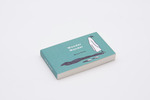
Wonder Wander
Minna Floss, Special Collections, and Fleet Library
1 volume, 144 pages. Cover title. The winner of the Napa Flipbook Competition 2016 by Swedish animator Minna Floss. Edition of 500 copies. Edition number from Printed Matter website. Offset printing. Perfect binding.
-

Documentary Film: Wintersession Shoe Design in Italy with Kathleen Grevers and Khipra Nichols
Kathleen Grevers, Khipra Nichols, Apparel Design Department, and RISD Global
Short film describing annual Wintersession travel course Italy: Shoe Design Prototyping. Apparel Design Senior Critic Kathleen Grevers, Industrial Design Associate Professor Khipra Nichols and RISD students reflect on how annual the course broadens concepts of and inspires innovative approaches to footwear design.
-
Ontology and the Aesthetics of Cinematographic Bodies
Jean-Yves Heurtebise
If it is true, as Bergson claimed, that the universe is the sum of images (less than “objective” things but more than “subjective” representations), and if it is correct, as Deleuze said, that this hypothesis bears direct consequences for our understanding of the cinematographic art, then the analysis of cinematographic images and, especially, of the cinematographic images of the body (this living part of matter, this incarnated form of consciousness) can provide not only interesting aesthetic comments about specific directors and films, but also a philosophical understanding of the diverse modes of the sensible incarnation of human bodies. Interestingly enough, the more we believe in the truth of aesthetic images, the more we believe in the ontological reality of the body, that is, the more does ontological reality become, essentially, “imaginal.”
-
Positioning and Discernment: A Comment on Monique Roelofs's The Cultural Promise of the Aesthetic
Kathleen M. Higgins
This essay offers replies to the critical commentaries on The Cultural Promise of the Aesthetic presented by Kathleen M. Higgins, Carolyn Korsmeyer, and Mariana Ortega. The essay shows how the probing questions and criticisms that the three commentators raise bring out details in the framework of relationality, address, and promises through which the book theorizes the aesthetic.
-
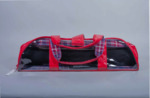
Visionaire 65: Free: Deluxe Edition Marc Jacobs Red
Marc Jacobs and Greg Foley
36 sheets rolled in cloth bag : color + 1 set of decals (10 pieces) + 1 carrying case Title from colophon on decal envelope 36 prints in a custom bag by Marc Jacobs with leather luggage tags and a set of 10 travel decals Limited edition of 150 numbered copies
"VISIONAIRE 65 FREE: Deluxe Edition is the luxury culmination of the three original VISIONAIRE 65 FREE site-specific installations, into a collectible edition of the eponymous New York publication. The concept for the installations mused upon the democratic power of art, the imperative nature of the poster, and simultaneously explored the double meaning of the concept "FREE", wherein both the artists and viewers are posed the thematic questions of what not only 'free' means symbolically or literally, but also in terms of 'worth' in the art-world and its relationship to creative freedom itself. The three, free, interactive public art exhibitions were mounted during three important cultural weeks across Miami (Art Basel, Dec 2015), Los Angeles (Oscar's week, Feb 2016), and New York (Frieze Art Fair, May 2016), where twelve, large format art images per city were released, self-curated and collated by attendees ... Visionaire offers 65 FREE: Deluxe Edition as a purchasable and shippable issue comprised of all thirty-six art posters. Realizing that the contents needed packaging, Visionaire tapped friend and long-time contributor Marc Jacobs. Collectors can now acquire all thirty-six art posters for the first time, housed in a beautiful, custom, hand-numbered Marc Jacobs travel bag, designed exclusively for the edition, to add to their VISIONAIRE collection. In this sense, the tongue-in-cheek irony of "FREE" is not lost on VISIONAIRE, nor to the lifelong collectors of the publication or the contributing artists, whose sense of 'free' is often challenged by the art market and its expectations over creative freedoms." -- publsiher's website https://visionaireworld.com
Miami artists: Daniel Askill, Marco Brambilla, Glenn Brown, Fabien Cousteau, Miley Cyrus, Marilyn Minter, Jack Pierson, Fyodor Pavlov-Andreevich, Sagmeister & Walsh, David Salle, Matthew Stone, Mickalene Thomas Los Angeles artists: Marina Abramović, Doug Aitken, Spike Jonze, Ariana Grande, Shepard Fairey, Kahlil Joseph, Abu Bakarr, Mansaray, Richard Phillips, Matthu Placek, Sterling Ruby & Raf Simons, John Stezaker, Hank Willis Thomas, Gus Van Sant New York artists: Daniel Arsham, John Baldassari, Anton Corbijn, Wim Delvoye, Milton Glaser, Gigi Hadid, Glenn Ligon, Christian Marclay, Shirin Neshat, Yoko Ono, Ugo Rondinone, Mario Sorrenti
-
Salon Discussion of all Topics in the Old Library
Moderator: Michael Kelly
*Please note* Salon Discussion of all Topics will be held in College Building, 2 College St, Providence, RI 02903. Walking Directions: When you leave Chace Center, take a left on N. Main St. and take the first left at the intersection – N. Main St. and College St. – go up the hill to the next intersection – College St. and Benefit St. – turn left onto Benefit St and go in the entrance on your left. Go up the stairway on the left.
-
"Can the Audience Want?" On the Artistic Status of Contemporary TV-Series
Angela Keppler
This paper takes up a question that Theodor W. Adorno posed in 1963 relating to television. The aim is to situate the new TV series, which are part of so-called Quality TV, against the backdrop of the tradition, and to analyze the forms in which the medium is being used. An inspection of pertinent sequences leads to the conclusion that the enjoyment we experience when watching these series stems from the very type of active-passive involvement that Adorno described as being essential only for objects of high culture.
-
Verb things: changing the conversation
Kendra Kirchmer
The way we communicate has a direct impact on our impressions of the world this thesis argues that the various forms of abstraction represented by language and the focus on objectivity in development of explicit knowledge have created the impression that the world of inanimate things is a static one. Through both text and furniture objects, this thesis proposes a metaphoric re-languaging of the way we understand our objects, from nouns to verbs as a means to enhance our interactions with them and through them with ourselves and others.
-
Address and the Lure of the Aesthetic: Reflections on Monique Roelofs, The Cultural Promise of the Aesthetic
Carolyn Korsmeyer
Monique Roelofs argues that some of the aesthetic power of art is traceable to the way that works address their audiences, promising the creation of cultural community. Such communities become exclusionary when modes of address presume and perpetuate social hierarchies. This paper explores this notion in works where moral and aesthetic precepts seem to conflict and whose address induces attitudes that one would reject in “reality” but that are required for the full appreciative grasp of a narrative.
-
The Institutional Margins of Aesthetics: A Study Proposal
Jozef Kovalčik and Max Ryynänen
A considerable number of classical texts in aesthetics and cultural philosophy were originally published outside of the framework of institutionalized academic scholarship. One can begin the modern story with two loners, Nietzsche and Kierkegaard, then continue with the Frankfurt School and end the short list with the French “wave” (Blanchot, Bataille). Contemporary aesthetics benefits also from the work of thinkers like Susan Sontag and Nicolas Bourriaud, who have a huge scholarly impact but who built their careers outside academia. We intend to 1) sketch out a short historical overview of the scholars within aesthetics who could be considered to have worked in the institutional margins, 2) ask if there may be a particular advantage to working that way, and 3) defend and develop a more conscious relationship toward academic margins: could we benefit from a more active relationship with this phenomenon? In arts this is commonplace, and concepts like "outsider art," "outlaw art," and "alternative art" are words that point to different spheres of work in a respectable manner. We may find value In using them to give the margins more institutional justification, which would, in the end, profit the whole institution. This is something we hope to see happen in aesthetics.
-
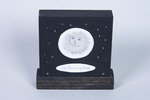
The Man in the Moon
Bryan Kring, Special Collections, and Fleet Library
1 wooden box : black and white illustrations. Title and statement of responsibility from box Signed by the artist Accompanied by wooden support stand (2 cm x 10 cm x 2 cm) "This is a moveable book without words. It is a free association dreamlike movie that begins with a vision of the man in the moon. When the wooden dowels are turned a scroll of very thin paper within the box reveals backlit drawings with a silent cinematic feel. Holes punched in the black cover paper illuminate like stars in the night sky framing the 'movie'"--Description from 23 Sandy Gallery website, viewed May 17, 2019 Scrolling box book. Handscroll. Two wooden dowels at the bottom of the piece turn the illustrated scoll either to the left or right. Dowels also fit into the wooden base so the upper piece can sit upright.
-
Continuum of significance
Diane Lee
At the intersection of multiple simultaneous timelines, Continuum of Significance is a graphic design practice that acknowledges time and meaning as fluid, shifting variables. By challenging notions of obsolescence and assumed valuations, the work brings forward stories and experiences that might otherwise go unnoticed, or quickly fade from memory.
This body of work explores various attempts at reconciliation, vacillating between faster modes of production, and a practice deeply anchored and concerned with history, research, iteration, and contemplation. Materials gleaned from the mundane: the expired historic archive, and the vivid digital cache, are recomposed to invoke a slow read in our fast world.
Timelines are not fixed; the past is an active part of where we are and where we are going. Its meaning and interpretation undergo continuous renegotiation across the spectrum of time.
-
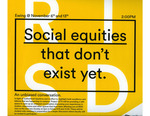
Social Equities That Don't Exist Yet.
Project LETS and RISD Archives
Poster for Social Equities that Don't Exists Yet, an unbiased conversation sponsored by the RISD chapter of Project LETS (Let's Erase The Stigma). Project LETS is a mental health advocacy group as well as a peer support network, dedicated to erasing the stigma around mental health and talking about mental health issues, especially as it relates to the RISD experience.
-
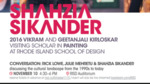
Conversation: Rick Lowe, Julie Mehretu, and Shahzia Sikander
Rick Lowe, Julie Mehretu, Shahzia Sikander, and Painting Department
Pakistani-born artist and RISD alumna Shahzia Sikander, the Painting Department's 2016 Kirloskar Fellow, organized a lecture and conversation with Rick Lowe and Julie Mehretu (RISD MFA ’97) to discuss the cultural landscape from the 1990’s to present day and their part in shaping it. The friends developed a dialogue about artists supporting artists, collaborations, mentoring, and what lies ahead.
-
Origami condition design
Yin Lu
Origami is not a brand new discussion anymore, since its value in robotics had been recognized in recent decades. However, no clear or deep discussion happened on how to apply origami on architecture or other practical scale design, because they barely share common characteristics of material and operation. Architects try hard to blend origami into architecture design, what they pursue is the form. I am confused that whether origamishaped design could be regarded as origami design, or in other words, when we talk about origami design, what is it?
The first thing I’d like to clarify in thesis project is the nature of origami, with or without its form. Origami condition is about the operation. My research start with form but will focus on operation.
Secondly, I’d like talk about tectonics, how to bring origami design into reality and what I learn from realistic models. For larger scale design, a stronger and cheaper material may be needed to spread origami design principle.
The last, as the goal of my thesis semester, I will work on engaging origami theory in 1:1 scale product design to build a pratical vocablary of 1:1 scale operation which won't be limited by paper and origami.
Origami is a great topic with a lot of potential. Besides those three points I mentioned above, in the term of a project which may last for years, origami could be a methodology and a principle to help improve kinetic character of architecture. Demolishing the materiality of architecture could be a exciting jorney in the future.
Nevertheless, I reminded myself every day, there are two aspects in my project I should pursued, being practical and being peotic at the same time. I have no idea what a piece of paper could be after being folded, why not just let "folding" tell my by itself?
-
Commencement 2016 Lisa Maione, Graduate Student Speaker
Lisa Maione and RISD President
Lisa Maione, RISD grad student gave an address at RISD Commencement 2016.
-
Artist on Art / Mary Beth Meehan
Mary Beth Meehan
New England–based photographer Mary Beth Meehan discusses her series Seen/Unseen. This body of work includes large-scale portraiture, a blog, and a public art installation located in downtown Providence, Rhode Island. Seen/Unseen raises questions about how we see one another as individuals through the personal portraits and stories of Providence residents.
Four of Meehan’s portraits have been acquired into the RISD Museum collection. This purchase was made possible through a gift from Joseph A. Chazan, M.D. and Mary Beth Meehan.
-

Artist on Art / Mary Beth Meehan
Mary Beth Meehan
New England–based photographer Mary Beth Meehan discusses her series Seen/Unseen. This body of work includes large-scale portraiture, a blog, and a public art installation located in downtown Providence, Rhode Island. Seen/Unseen raises questions about how we see one another as individuals through the personal portraits and stories of Providence residents.
Four of Meehan’s portraits have been acquired into the RISD Museum collection. This purchase was made possible through a gift from Joseph A. Chazan, M.D. and Mary Beth Meehan.
-
Dimensional flatland: Beamer, drone, flash drive
Scarlett Xin Meng
The impact of the Internet and digitization is pervasive and pervious. Users constantly interface with a constructed virtual world of worlds, simulated by signs and representations. The web content appears to exist but only fades into oblivion. Digital imageries promise the HD real but can never be as phenomenal as our physical experience, and instead render an alternative fantasy of deceptive factuality. This is a hyperlinked network of data and pixel information that takes no solid permanent shape, and claims zero responsibility for altering and molding our consciousness in this technological fiction.
Dimensional Flatland: Beamer, Drone & Flash Drive responds to such phenomena with provocative and poetic gestures: The work appropriates the views of the machines, whose logic and illogic I employ to generate an abstract realm to criticize and dramatize, and to represent the simulated immaterial world in conflict with the “real” material one with which we are familiar. It probes into the mechanism of realism through digital imaging, and examines different modes of expression and representation with self-criticality.
Graphic design deals more and more frequently with screen-based media, and yet the screen is not a neutral medium but an aggressive glow. Our spectatorship with thescreen has transformed from a pure fascination into a desire for participation and intervention— from an outside position to a critical insider role. Unveiling the invisible and intangible mechanism behind the screen, this thesis presents a series of work that liberates digital tools from their prescriptive functional constraints, traces back to the point of origin, and evokes our very sensibility and imagination in the hyperspace.
-
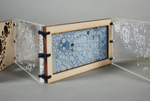
Contemplation
Ann Motonaga, Fleet Library, and Special Collections
Graduate student, year of graduation: 2018. Major: Architecture. Class: The Photobook. Faculty: Lindsey Beal.
-
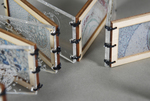
Contemplation
Ann Motonaga, Fleet Library, and Special Collections
Graduate student, year of graduation: 2018. Major: Architecture. Class: The Photobook. Faculty: Lindsey Beal.