On was an interdisciplinary graduate periodical established by RISD graduate students in 2006. It featured essays and student work that related to a general issue theme. On was intended as a quarterly publication, but it is unclear if further issues beyond the first were ever published.
-

The Limits of Knowing: Determinism, Uncertainty, and What’s Beyond the Human Gaze
Xilong T. Zhang
This essay traces a personal philosophical and artistic journey from rigid belief in scientific determinism to an evolving embrace of uncertainty, subjectivity, and computational perception. Raised in an atheist, scientifically grounded household in China, the author initially adopted Newtonian determinism and Laplace’s thought experiment of a fully predictable universe as guiding principles. These beliefs informed early artistic practices rooted in Constructivism, geometry, and rule-based aesthetics. However, a failed attempt to fully optimize life through deterministic control led to physical and mental collapse, prompting deeper exploration into Cartesian dualism, quantum mechanics, and the limits of reason. Through Heisenberg’s Uncertainty Principle and the observer-dependent reality revealed by the double-slit experiment, the author reevaluates their worldview, finding resonance in Taoist fluidity and John Dewey’s pragmatism. The essay then expands into existentialism and the role of human perception in constructing reality, culminating in artworks that juxtapose structured forms with improvisational gestures. Further reflections on AI, particularly Latent Diffusion Models, reveal alternate, non-human modes of perception. Through projects like Cryptic Synthesis and Codex Temporalis, the author explores how machine vision reconfigures notions of authenticity, identity, and meaning, ultimately suggesting that alternative perspectives are necessary to probe the limits of reality.
-
Comfort in Contradiction
Yanchen Zhao
This research explores why modern visual experiences often feel hollow—why suburban McMansions imitate classical architecture and why luxury spaces feel staged. Instead of simply criticizing these aesthetics, I want to understand them: Why do we embrace symbols disconnected from history? What makes them feel familiar and comforting?
Using Jean Baudrillard’s idea of hyperreality and Marshall Berman’s view on modernity, I examine how today’s aesthetics are simulations—designs that no longer refer to a real past but exist as self-repeating symbols. Everyday objects borrow classical decorations without structural purpose, offering a sense of tradition and familiarity without real historical connection. Modernity, while promoting progress, also isolates us, leading to a desire for visual familiarity.
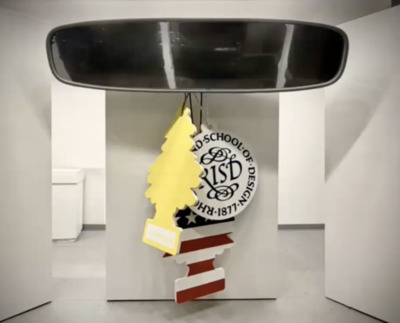
Through speculative design, visual essays, and branding experiments, I rework suburban architecture, luxury branding, and corporate aesthetics to reveal their hidden structures. Inspired by Zhuangzi’s Daoist philosophy, I see these simulations not as failures but as reflections of our own needs.