
On was an interdisciplinary graduate periodical established by RISD graduate students in 2006. It featured essays and student work that related to a general issue theme. On was intended as a quarterly publication, but it is unclear if further issues beyond the first were ever published.



-

The Aesthetics of Terrorism and the Temporalities of Representation
Robert Appelbaum
Representations of terrorism, in fiction and non-fiction, summon their readers and viewers to examine terrorism in any of at least four modes of temporality: the past, the past perfect, the continuous present, and the simple present. This essay explains those modalities and shows how they work with reference to novels, a film documentary, and contemporary American television, including the documentary Black September and the series NCIS. The modalities are ideological as well as narratological functions and are sometimes employed to occlude the historical and pragmatic dimensions of terrorist violence. Terrorism is always already aesthetic and “hyperreal,” in Jean Baudrillard’s sense of the word, but to contemplate the aesthetics of terrorism is to occupy a certain geopolitical and historical position with regard to it, in addition to a location in hyperreality.
-
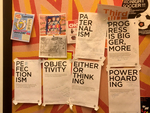
WISD White Institutional Supremacy by Design Posters March 2019
RISD Archives
WISDRISD (White Institutional Supremacy in Design) solicitation posters.
-
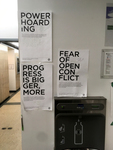
WISD White Institutional Supremacy by Design Posters March 2019
RISD Archives
WISDRISD (White Institutional Supremacy in Design) solicitation posters.
-
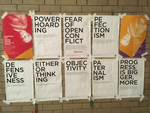
WISD White Institutional Supremacy by Design Posters March 2019
RISD Archives
WISDRISD (White Institutional Supremacy in Design) solicitation posters.
-
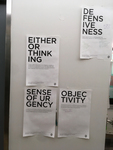
WISD White Institutional Supremacy by Design Posters March 2019
RISD Archives
WISDRISD (White Institutional Supremacy in Design) solicitation posters.
-
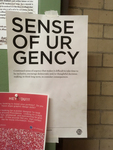
WISD White Institutional Supremacy by Design Posters March 2019
RISD Archives
WISDRISD (White Institutional Supremacy in Design) solicitation posters.
-
Mis jarrones
Marco Sebastián Arroyo Hoebens
This thesis offers an insight into the complex relationship between identity, memory and the creative process. A Q&A follows, designed to deepen the understanding of the self in different situations, places, cultures and design objects.
Apparently, memory has a leading role in triggering creative processes and this has forced me to do further research on my own past and on the objects that my memory retains. In the end, this “research on the self” has produced an interesting view on this particular creative process of designing.
-

On Repair
Kader Attia, Theory & History of Art & Design Department, RISD Museum, Academic Affairs, Graduate Studies, Liberal Arts, and Fine Arts Division
For many years, Kader Attia has been exploring the perspective that societies have on their history, especially as regards experiences of deprivation and suppression, violence and loss, and how this affects the evolving of nations and individuals — each of them being connected to collective memory.
His socio-cultural research has led Kader Attia to the notion of Repair, a concept he has been developing philosophically in his writings and symbolically in his oeuvre as a visual artist. With the principle of Repair being a constant in nature — thus also in humanity —, any system, social institution or cultural tradition can be considered as an infinite process of Repair, which is closely linked to loss and wounds, to recuperation and re-appropriation. Repair reaches far beyond the subject and connects the individual to gender, philosophy, science, and architecture, and also involves it in evolutionary processes in nature, culture, myth and history.
Kader Attia (b. 1970, Dugny, France), grew up in Paris and in Algeria. Preceding his studies at the École Supérieure des Arts Appliqués Duperré and the École Nationale Supérieure des Arts Décoratifs in Paris, and at Escola Massana, Centre d’Art i Disseny in Barcelona, he spent several years in Congo and in South America.
The experience with these different cultures, the histories of which over centuries have been characterised by rich trading traditions, colonialism and multi-ethnic societies, has fostered Kader Attia’s intercultural and interdisciplinary approach of research.
In 2016, Kader Attia founded La Colonie, a space in Paris to share ideas and to provide an agora for vivid discussion. Focussing on decolonialisation not only of peoples but also of knowledge, attitudes and practices, it aspires to de-compartmentalise knowledge by a trans-cultural, trans-disciplinary and trans-generational approach. Driven by the urgency of social and cultural reparations, it aims to reunite which has been shattered, or drift apart.
In 2016, Kader Attia was awarded with the Marcel Duchamp Prize, followed in 2017 by the Prize of the Miró Foundation, Barcelona, and the Yanghyun Art Prize, Seoul.
Conversation followed with Kate Irvin and Leora Maltz-Leca.
This lecture is co-sponsored by the RISD Museum, as part of Repair and Design Futures.
-
Ordinary Monsters: Ethical Criticism and the Lives of Artists
Christopher Bartel
Should we take into account an artist’s personal moral failings when appreciating or evaluating the work? In this essay, I seek to expand Berys Gaut’s account of ethicism by showing how moral judgment of an artist’s private moral actions can figure in one’s overall evaluation of their work. To expand Gaut’s view, I argue that the artist’s personal morality is relevant to our evaluation of their work because we may only come to understand the point of view of the work, and therefore the work’s prescribed attitude, by examining the values, attitudes, and behaviors of the artist. This view is defended against a rival account offered by Bernard Wills and Jason Holt, which holds that the artistic evaluation of an artist’s work is independent from the moral evaluation of their life except in extreme cases.
-
Reflections on the Aesthetics of Violence
Arnold Berleant
Violence has long been a factor in human life and has been widely depicted in the arts. This essay explores how the artistic and appreciative responses to violence have been practiced, understood, and valued. It emphasizes the difference between the aesthetics of distant, disinterested appreciation and the engaged appreciative experience of violence in the arts, and insists on the relevance of their behavioral and ethical implications.
-
In Defense of Cities: On Negative Presentation of Urban Areas in Environmental Preference Studies
Anu Besson
This paper critiques a common research method, image-based studies, in assessing environmental references. The method is used, in particular, in the fields of environmental psychology, landscape studies, and health studies, here called empirical environmental preference studies or EEP studies. I argue that the established view in the EEP field that nature is inherently experienced as more aesthetically appealing and restorative than urban environments may be biased because of the image-based method. This paper presents a literature review of EEP studies, discussing them in a framework of environmental and everyday aesthetics. The conclusion is that EEP studies may strip cities of their physical, socio-cultural, and aesthetic layers; and comparing nature and cities as places of restoration may be unfruitful as our relationship with nature and urban environments is dissimilar.
-
Mindful interactions
Shreyans Bhandari
Mindful Interactions illustrates how we’ve become addicted to our smart-phones, and how its use in our everyday life affects our physical, social, emotional health and wellbeing. This design study proposes four product designs that make us aware of using apps, and compel us to reconsider their use during bedtime, mealtime, on-the-go and at home. As our pocket sized devices continue to evolve, the outcome of this thesis becomes a case study for rediscovering and applying the “human” in human centered design.
-
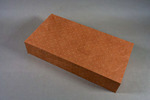
Fashioning
Denise Bookwalter, Special Collections, and Fleet Library
20 unnumbered pages : illustrations Limited edition of 32 numbered copies. Title from colophon. "To read the book please put your hands into the cover handles and open your arms."--Colophon "Fashioning is the second book collaboration between Denise Bookwalter and Lee Emma Running. In Fashioning the artists continue their work with their intimate relationship with clothing. Clothing retains the story of the wearer. In Fashioning the artists capture their relationship with clothing by making rubbings of embellishments found on personally significant garments. The drawings directly capture a moment in the life of the textile. The textile contains its own evidence of the hands that made it and the bodies that wore it. Each of the rubbings were transferred to letterpress printing plates, printed in white, resit dyed, and waxed to create a book structure that becomes a book the reader wears. Fashioning is a tactile experience embedded in cloth and paper."--Publisher's statement at the Small Craft Advisory Press website (viewed February 19, 2020) Treated natural leather cover with stippled title and two dyed leather handles attached to front and back covers. Holds 20 leaves, concertina bound to one another by two 3-4 cm accordion folded paper strips running through every page. Images were transferred from crayon rubbings to letterpress printing plates, printed in white ink, resit dyded, and waxed. Issued in case lined with brown paper.
-
Unimproved : land observation at the edge of progress
Adam Somers Bowen
As residents of the United States, all of us have benefited from the resources that this land provides. Some of these resources are responsibly managed, like some logging operations and grazing land. Some are much more harmful, like hydroelectric dams that have drowned Indigenous lands, and block natural habitat. Whether through development or extraction, we as humans have the special ability to drastically change the world around us in a very short amount of time. In a time of rapid environmental change, we need to find ways to better connect, observe, and assess the landscape so that as a society, we can make more informed and compassionate choices on how to manage our shared resources. When we talk about stopping climate change, we have to stop talking about returning to a nostalgic past. We have to start talking about a hopeful but different future with a very rough patch in between.
The United States Federal Government has long mapped, and surveyed the land of this country to promote expansion, extraction, and tourism. I am proposing a set of tools, distributed by a new branch of the Department of the Interior, the Civilian Corps of Landscape Reassessment, as a means to give citizens a point of access to the discourse and conversation around land issues and create collaboration between citizens and through active participation, increase personal investment.
-

Visionaire 68: Now!
Candice Breitz, Hank Willis Thomas, Cecilia Dean, James Kaliardos, and Greg Foley
1 box (10 posters) : color illustrations Visionaire 68 Now! the Collectors Edition is produced in a limited 200 hand-numbered editions, expertly printed on exhibition canvas using archival ink-jet printing. The posters in the Collectors Edition measure 17 inches x 22 inches. Sex Work Rights / Candice Breitz -- Equal Voting / Zoe Buckman & Hank Willis Thomas -- Opiod Crisis / Nan Goldin -- Women's Rights / Kim Gordon -- Identity / Martine Gutierrez -- Gun Control / Katerina Jebb -- Criminal Justice / Tiona Nekkia McClodden & Pusha T. -- Resistance / Marilyn Minter -- Gender Equality / Faith Ringgold -- Climate Change / Vivienne Westwood. Examining and taking inspiration from this essential tool of modern political activism, Visionaire re-contextualizes the protest poster as art object, albeit one with a practical purpose. This editioncomprised of ten images with text addressing the current state of the worldexploits the democratic power of art and the traditional, political imperative of the protest poster. The works in this edition are intended to be used on the streets of our cities and towns to proclaim what we hold dear. Ten rolled-up posters housed in a drop-spine box. Library has copy number 6 of an edition of 200. Gift of the Publisher. RISD Alumnus, Gregory E. Foley, AP 1991.
"Examining and taking inspiration from this essential tool of modern political activism, VISIONAIRE re-contextualizes the PROTEST POSTER as art object, albeit one with a practical purpose." This edition—comprised of ten images with text addressing the current state of the world—exploits the democratic power of art and the traditional, political imperative of the protest poster. The works in this edition are intended to be used on the streets of our cities and towns to proclaim what we hold dear." -- publsiher's website https://visionaireworld.com
-
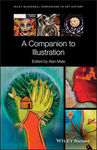
Framing Questions and Modes of Inquiry in Illustration Process and Critique
Robert Brinkerhoff
Every creative act begins with a question—whether consciously or unconsciously formed—and illustrators may enhance their approaches to visual problems by framing a line of critical inquiry that invigorates conceptualization. While inventories and lists of questions are suitable ways to begin, there exist many different modes of questioning—verbal and non-verbal, manual and cognitive, linear and discursive, intuitive and rational, integrative and deconstructive. This chapter explores diverse methods for inquiry in problem definition and resolution, describing a variety of models and incorporating observations by professional artist-educators to expose different strategies for illustrators.
-
N Square Innovation Summit at RISD (2018)
Center for Complexity
N Square Innovation Summit (November 13-16, 2018)
Marking the completion of N Square Innovation Network cohort one and the launch of cohort two, N Square and RISD co-hosted the intensive program with longtime partners PopTech and Nucleus. The summit comprised master classes in design and topic-specific workshops, culminating in Signals for the Future: New Ways to Tackle Nuclear Risk, an exhibition and discussion. The exhibition showcases new tools and ideas developed by members of the inaugural cohort of fellows from the N Square Innovators Network.
-
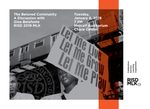
MLK 2019: Gina Belafonte
Center for Social Equity & Inclusion and Student Affairs
2019 MLK Series guest speaker, Gina Belafonte lecture The Beloved Community January 8th, 2019 at the Metcalf Auditorium, Chase Center, RISD 7:00 pm. The Center for Social Equity and Inclusion (SEI) welcomes you to a conversation with Gina Belafonte inspired by Dr. Martin Luther King’s popularized notion of the “Beloved Community,” focusing on the pivotal and complex social issues facing our communities and how we can address them through art making.
Poster designed by FAVOR Design & Communications.
-
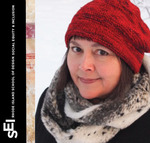
Sonya Kelliher-Combs | A Sense of Place
Center for Social Equity & Inclusion, Painting Department, and Sonya Kelliher-Combs
The Center for Social Equity + Inclusion and the Painting department sponsored an artist talk and conversation with Alaska-based artist Sonya Kelliher-Combs as part of the ongoing RISD Indigenous Arts Series. The lecture took place on February 26th, 2019 at 5:00 pm in the Michael P. Metcalf Auditorium, Canal St., Providence, RI. Sonya Kelliher-Combs (Inupiaq/Athabaskan)was born in Bethel, Alaska, in 1969 and raised in Nome, she holds a bachelor of fine arts (1992) from the University of Alaska Fairbanks, and a master of fine arts (1998) from Arizona State University, Tempe. Her artwork continually references a sense of place, history, culture, and family. Kelliher-Combs is the recipient of numerous awards including the Eiteljorg Museum Fellowship, the Anchorage, Alaska, Mayor’s Individual Artist Award, the Arctic Education Foundation Academic Excellence Award, and the Best of Show honor at the Visual Arts Center of Alaska’s Vision of New Eyes exhibition. Her work can be found in numerous private and public collections including the National Museum of the American Indian, Anchorage Museum, Eiteljorg Museum, British Royal Museum, Institute of American Indian Art Museum of Contemporary Native Art, and Alaska State Museum.
-
Representation and Transparency in Artistic Astronomical Photographs
Stephen Chadwick
The development of astronomical photography has raised many interesting epistemological, metaphysical, and ethical questions, in addition to questions in aesthetics. One such question concerns the nature of the aesthetic properties possessed by these photographs. In this article I concentrate on one such property, namely representation. That artistic astronomical photographs are representational cannot be disputed, but whether this is an aesthetic property is open to question. In this article, I show that it is an aesthetic property and compare it with the analogous property associated with paintings and traditional artistic photographs. In order to do this, I explain what makes astronomical subjects unique and the effect this has on the way the photographs are produced. I argue that it is in virtue of this uniqueness that representation as an aesthetic property of artistic astronomical photographs significantly differs from the analogous property of paintings and traditional artistic photographs.
-
Throngs
Yinan Chen
Ceramic is an important element of my artworks. It is a material with strong bearing capacity, and at the same time, it is a tool with the attribute of nature and social function, for the similarity with humans can be found in it. Thanks to its characteristics, I am able to transform the forms, colors, and quality to complete my works. Collected from nature, carved with human hands, the clay is cultivated and my expectation of the outside world is satisfied.
-
Walking mediation : bringing back rituals on temple visits on Mount Putuo, Zhejiang, China
Tianjie Chi
Mount Putuo is a culturally significant Buddhist pilgrimage site with over a 1000 years history. Traditional walking paths were marginalized on Mount Putuo after a new bus circulation was developed to accommodate more visitors efficiently.
In the past, people were arriving at the old dock, walking through the forests, meeting pavilions and gates, and finally reach the temple. Linear spaces and trees embracing the path help them clean up their mind before they meet burn the joss sticks. Nowadays, most visitors arrive at the modern new dock and spend 20-30 minutes to wait in line for the bus, playing phone or chatting with each other. The bus will take them to any temple they want within10 minutes without any walking uphills. A better circulation efficiency is essential at this age, but the memories and experience that time left on the walking journey worth a callback.
On today’s Putuo, there remained two old sections of stone-paved paths are still in use by traveling monks and individual visitors. Those sections are maintained and beautiful, while what between them is a wooden sidewalk along the road. And this sidewalk didn’t include any viewpoints along the journey. Thus, instead of keeping bringing back the old paths, I decided to develop a new walkway that can link the existing old sections together, continue the space experiences and active those view spots.
To do that, I did case studies on the existing old path and walked the island myself. Then I did little research on the methodology of Buddhism Practicing and considered how to merge those philosophies into the journey. Finally, I came out with a project that is a path and a choreography of walking experience that can help people meditate on their way heading the temple. This path did interactive with the bus route so it can be experienced as a single section or as a long journey from the sea to the top of the mountain combined with the existing stone-paved path.
-
Bitter son
Adam Chuong
This thesis concerns itself with centering the experiences of Asian Americans in order to better understand the complexities of the Asian American diasporic experience. The title of this thesis, 苦儿, roughly translates into English as “bitter son,” and is phonetically pronounced in Mandarin as “queer.” It lives directly at the intersection of these identities — Asian, American, Queer. This body of work is an act of making space and taking up space in an institution and discipline that has not largely been concerned with minority identities, or when it has, it has been misguided and prone to tokenism. It is a call to current and future designers to identify their role as community members inside and outside of design.