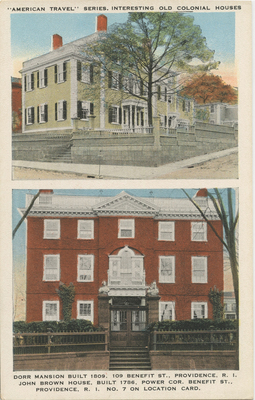
On was an interdisciplinary graduate periodical established by RISD graduate students in 2006. It featured essays and student work that related to a general issue theme. On was intended as a quarterly publication, but it is unclear if further issues beyond the first were ever published.
-

How to be simultaneously precise and nondescript
McKinzie Trotta
As I stood by my car, I kept coming back to the phrase. It is more difficult to hit a moving target. This time, it was not just a passing platitude. I thought more. Just as it is more difficult to intentionally hit a moving target, a moving target is simultaneously more difficult to intentionally miss. It might be easier to hit a moving target if what one is really trying to do is miss it. Isn’t this why car accidents happen? People hit the thing they are by all means trying to avoid. Everyone is in motion and despite mostly going in the same direction, a collision. This may be common sense, but it left me wondering how someone still managed to hit my parked car. It became clear, he was not looking.
Artmaking feels like it can parallel one of these concepts. Not an accident I try to avoid or a target I try to hit; rather, it is like shooting high and far in the direction I want a target to be and then sprinting along the trajectory to plant the target before arrow meets earth. Archers draw their arrows. Artists draw their targets, sometimes still managing to miss the mark (I know I do). It is this state of simultaneity that interests me. How to be simultaneously precise and nondescript? I ask this question often. I thought the 5 more I wrote it in my notebook, the better I would know what I really meant by it.
-
Blueridgelivin' : environmental development and suburban sprawl
Chris Villalta
This thesis focuses on investigating how precolonial Blue Ridge Cherokee construction was resilient to time and weather, integrated place, and respected the environment, traditions, and politics, to better integrate landscape, climate, ecology, and regionally specific architecture.
-
To protect the hell yeah and every hell yeah's variations
Lukey Walden
I try to imagine a scrutiny free from transaction and authority, where time and generosity are not scarce. If real generosity divests from the expectation of returns, then what are the full implications of imaging someone in this way, through touch? My sitters gave me permission to stare at them in private. What happens to this momentary consensual gaze over time, prolonged into months of looking? Prolonged into an abundance of labor, abundance of attention, abundance of precious materials?
-
Lived-in grassland : nomadic architecture in the nomadic community of Mongolia
Linxi Wang
Traditional modes of living and production on the Mongolian grassland are quietly changing under the impact of modern civilization, and a higher demand for a comfortable life is on the way. Shifts in career and lifestyle have changed expectations Mongolians have for housing, and traditional dwellings have not adapted to these new demands in the modern era. Fortunately, thousands of years of constant transition in nomadic life have prepared Mongolians to adapt to the new mode of survival and living in the process of constructing their residential buildings. The process of improvement of living conditions is bound to mean traditions have to change and foreign culture must be embraced, joined and integrated with traditional regional culture. How do we protect traditional culture with so much change? Simultaneously, how might these dwellings help nomads better adapt to modern life? What is the pattern of the next generation of grassland life? My design is divided into two phases.
Trial and Transformation:
This phase is to renovate the existing Mongolian grassland housing in a simple way, determining design rules for modern Mongolian houses, and forming a model that can be duplicated. Interior space planning and layout are the main target of the renovation. According to the layout rules of traditional Mongolian yurts, a gathering space, like a circular living room, is to be designed, which represents the cultural center with a stove as the core of family living space in traditional layout, including technical issues of the kitchen and toilet, indoor ventilation, lighting and privacy.
Future and Challenges:
An increasing number of people will leave the grassland for urban life. What will be needed to support the next generation? For those who remain, what type of housing will they choose to live in on the grassland? What kind of innovative changes will take place in the pattern of the house of the nomads? Will the selection and application of various materials both be capable of protecting the environment and bringing different vitality to the grassland? During this phase, the possibilities and diversity of living spaces for nomads in the future will be mainly explored. I designed a house built on the prairie. It has the basic functions and the public space. The living space is independent and can be assembled any time to serve different purposes. The ethos of the Mongolian nomads will remain unchanged no matter what the modern life will be like in future. It will last on the prairie. it's reflected not only in the architectural form, but also in the new lifestyle of Mongolians.
-
Internal resonance
Xiangyu Wang
This thesis explores the interaction between my inside and outside worlds. It includes my discussion towards Zen methodology, homeostasis, nature, antiquity, inner order and the concept of Qi. It can also be seen as a process that scrutinizes my daily life and looks deep into those things which slowly echo in my body and push me to make my own response.
-
Regeneration with Karen Washington
Karen Washington and Edna W. Lawrence Nature Lab
December 18 hosted the third conversation in the Regeneration series with Karen Washington, a farmer, community activist, and food advocate. Make sure to take a look at this document with resources that were mentioned during the conversation to further your learning.
Karen gave a passionate and informative presentation on how inequitable and fragile the food systems are in the U.S. She shared how she and her community try to dismantle the current systems, and what we can do within our own communities to move towards food systems that are just and equitable. She says “The food system doesn’t need to be fixed. It needs to be changed.”
She argues that “food itself cannot stand alone. There are intersections with economics, history, housing, environment, health, and more.” In order to truly change our unjust food systems, we must begin by asking “What does food security truly look like for people of color in low income neighborhoods?” If we take this more holistic approach, and focus on organizing within our communities at the grassroots level, we can begin to dismantle the current systems and create a more regenerative future.
Karen encourages individuals to start with small, compassionate actions. Connect with your neighbors, go out into your local community, and see who needs help. Cook an extra meal for someone who is struggling. Get involved with your local community garden. She says, “Can we have more love and compassion in 2021? Can we say ‘I love you, let me help you, let me feed you?’ Now is the time we need each other more than ever. We need to be the people that make sure our communities are fed. When you see something that is unjust, say something. Your voice is your power.”
-
Re-occupation : buildings, ideology and decolonization in Northeastern China
Ziyu Wei
Buildings often survive longer than a single human generation, and many witness significant transitions from generation to generation. When we approach varied eras that have washed over an unchangeable building like tides eroding a bank repeatedly, how can we distinguish the building’s primary identity and judge its fate?
In Northeastern China, a Japanese dormitory survives as a witness of Manchurian colonization, early socialism and the economic recession that caused its abandonment until today. The city also suffers a swiftly aging population and brain drain as the brightest of the youth move away. How can an intervention build dialogue and revive a declining city? How can space reshape cultural cognition and confidence for migrated young people to return home? How can the architecture engage with the binary of history and ideology? Architecture is not an embodiment of form and function, but an armature for history and memory. This thesis not only proposes to change the situation and revitalize the local society but calls for research, contextualization, questioning, and reinterpretation of many epochs of history in Northeastern China. The paintings, videos, and architectural intervention that compose this thesis are an ensemble of this obsession and nostalgia. In the last two decades, a range of cultural phenomena, including popular music, comedy, sentimental literature and movies originate from the Northeast and influence all of China.This rich cultural landscape demands an equal architectural renaissance in the Northeast. The pioneers of this renaissance are an existing vernacular form: bathhouses, which contain multiple services and experiences. Inherited from the worker class “banya” in soviet Russia, today’s Northeastern bathhouse is a microcosmos to integrate different groups of people. By occupying the central public space in the dormitory as a water hub including bath and entertainments, I create a catalyst within the abandoned building. Programs including retirement accommodation and kindergarten engage many generations and aim to reuse the old dormitory for solving new social issues. A reincarnated Soviet-era theater commemorates divested collectivism. Tangled geometries decolonize the rigid plan and shape new relationships between different programs. The rest of the site remains empty, ready to embrace the local community and keep changing as identity shifts in the future. Architecture makes a new history, while history also makes a new architecture.
-
Visions of Political Form: Kantian Free Play and Urban Space
Ryan Wittingslow Ph.D.
A number of commentators have examined Kantian beauty in regards to its political promise. According to these readings, the free play inherent to beauty is a precondition for realizing political forms that are both pluralistic and non-coercive. But what does this mean for the design of urban spaces where pluralistic and non-coercive politics are supposed to take place? In this paper I offer a reading of urban beauty via a Kantian lens. I argue that any assessment of urban beauty is, in part, an assessment of that space’s capacity to encourage the free play necessary for non-coercive politics and a rich public life. Under this formulation, Kantian free play is not only a necessary feature of any experience of beauty but also a design ethos that can meaningfully inform urban form.
-
Discovering the potential of the public realm : revitalizing dead zones in Fall River, Massachusetts
Rui Xie
Specifically, this thesis asks can the superimposition of opposites—applying the conditions of a small community to the conditions and scale of a large city—be a solution to examine public spaces, revitalize dead zones, and strengthen community?
-
Energy convergence
Xiaoyu Xu
The current state of our urban systems and infrastructure is untenable in light of ongoing urbanization, population growth and complexity of modern life, including the problem of the city’s deactivation. Current systems lack the level of integration and shared intelligence that our technology advancements allow and modern life requires.
And if we understand landscape and its systems as inherently integrated and self-sustaining and essential to the optimal functioning of our cities, then we can position urban landscapes as the foundation and framework for all future urban system redesign and development.
-
Web trauma and haunting images : experimentations on materiality, installation, and operation of screens
June Yoon
This thesis seeks to compose dynamics among the screens, images, and space for viewers to confront what we easily ignore: the haunting ghosts of mistreated humanity in this age of web-trauma.
-
Clay beneath the tree: an exploration of design processes in community development
Shiya Zeng
Parents bought their kid a new toy and said: “Here you go, enjoy.” he plays with it for three hours, and then I go back to play with the clay beneath a tree. The “new toy” is an analogy of a traditional Design-Funding-Implement design process. The reason why “clay” is more attractive is that clay is flexible and manipulatable, which allows for continually engaging, reshaping, destructing, and exploring. More importantly, clay unleashes one’s imagination that unlocks thousands of possibilities. Community design process is “heartwork” that enhance well-being, equity, and agency for change. This is why the process matters.
This thesis is about an alternative way of engaging the community in the landscape design process. One that cares about people’s humanity encourages creativity and incorporates more variables in decision making. This thesis is an exploration of design at these two scales – community development process and design of place – within the community of Lower South Providence. The process for me is an analogous to “leading clay to a pot,” meaning using the traditional collaborative process of pot making as a metaphor for making community and place.
-
Relocation community revival
Zhan Zhang
The thesis tries to revive/re-imagine the public spaces of relocation community in Jiangsu, China by re-designing the in between spaces of the existing apartment buildings, dealing with the misfit of relocated residents to their new living environment during the rapid urbanization process.
-
Professorial Presentation | Deborah Zlotsky
Deborah Zlotsky, Patricia Barbeito, and Academic Affairs
-
Charting New Territory: the Aesthetic Value of Artistic Visions That Emanate in the Aftermath of Severe Trauma
Tania Love Abramson and Paul R. Abramson
-
Commencement 2019 Chimamanda Ngozi Adichie | Honorary Degree Recipient
Chimamanda Ngozi Adichie and RISD President
Writer Chimamanda Ngozi Adichie receives honorary degree.
-
Integration as a catalyst for change : school for Rohingya children
Naeera Ali
Ruplal house, built during the rise and growth of the merchant class in Dhaka, is now neglected and decaying. How can this space be repurposed as an education center for refugee children, become a long term stratergy for basic education that provide relief,hope for the community of refugees and revive the dying heritage of Old Dhaka?
The Rohingya refugee crisis is said to be the world’s fastest growing human rights disaster. The Rohingya are an ethnic group consisting of a majority of a Muslim population who have lived in the Buddhist majority country of Myanmar. Due to ongoing violence the Rohingya have fled their homeland in search of safety, shelter and a better life. More than half of the displaced population consists of children. Children affected by conflict and disasters often get forced out of school and become homeless. This leaves them vulnerable to child labor, early marriage, exploitation and violence. The lack of education centers, pedagogical approaches for refugee children and teaching in the refugee camps could be partially solved by reusing abandoned houses and spaces in the city of Dhaka, Bangladesh. A grand nineteenth century mansion named Ruplal house, located in the old part of Dhaka serves as the host structure for my thesis investigation. My thesis inquiry explores how the Rupial house, which has lost its cultural and historical significance due to building deterioration which is located far from the actual refugee camps, could serve as a meaningful center for teaching and cultural integration with the existing local community. My design interventions in creating inside- outside approaches, with the help of movement and expansion in the physical barriers, will create a flexible environment that will give the users freedom to choose between an open environment and private spaces.
-
Decomposition Book
Kelli Anderson, Special Collections, and Fleet Library
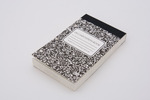
1 volume, 133 pages. A self-destroying notebook ... 2/3 usable lined sheets and 1/2 lines down the drain. -- author's website.00% recycled (30% post-consumer) paper made in French's hydroelectric-powered mill -- author's website. Small diagram card of the text laid in (4 x 8 cm) Three holes punched through the left-side of the text. Cover has black and white marbled pattern of a composition book. Perfect binding and black cloth over head of text block.
-

Decomposition Book
Kelli Anderson, Special Collections, and Fleet Library
1 volume, 133 pages."A self-destroying notebook ... 2/3 usable lined sheets and 1/2 lines down the drain. -- author's website. 100% recycled (30% post-consumer) paper made in French's hydroelectric-powered mill -- author's website. Small diagram card of the text laid in (4 x 8 cm) Three holes punched through the left-side of the text. Cover has black and white marbled pattern of a composition book. Perfect binding and black cloth over head of text block. Risograph printing. Notebook."