On was an interdisciplinary graduate periodical established by RISD graduate students in 2006. It featured essays and student work that related to a general issue theme. On was intended as a quarterly publication, but it is unclear if further issues beyond the first were ever published.
-
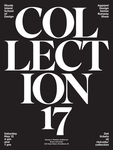
Collection 17
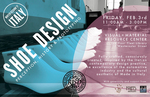
Poster for the 2017 student Apparel Design Department runway show held at the George V. Meehan Auditorium, Brown University.
-
Collection 17
Poster for the 2017 student Apparel Design Department runway show held at the George V. Meehan Auditorium, Brown University.
-
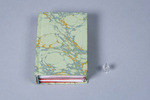
A Thought On Monsters
Ryan Alves, Special Collections, and Fleet Library
1 volume : color illustrations . Caption title. Signed and dated inside back cover. Unique book? A collection of eleven mini-comics. Eleven signatures sewn into a case binding. Marbled paper on cover.
-

Creating access and equity in arts education : strategic partnerships for systemic change
Colleen C. Andrews
Creating Access and Equity in Art Education: Strategic Partnerships for Systemic Change examines the diminished state of art education in United States public schools, reveals how nonprofit arts organizations supplement what is lacking in the current educational system, and offers current examples, based on interviews, to place these issues in context. A history of the National Endowment for the Arts and an examination of arts funding, both public and private, provides a backdrop for the weakened state of the arts in schools. Exploring educational policies such as No Child Left Behind and the Every Student Succeeds Act reveals how federal and state mandates impact the availability of art education in local districts. The author examines the integrity of art education, including curriculum development, teaching, and assessment, as well as social justice— how access to the arts in schools varies based on socioeconomic status. Crucial methods for reversing the under-valuing of the arts in public school systems are put forth: partnership-building among arts education supporters, schools, and nonprofits; strategic planning and forging a common agenda; art education advocacy and policy initiatives. Finally, an examination of current organizations working for increased access to art education reveals how crucial nonprofits are to providing art education within public schools, as well as how these issues play out in the current landscape. The author concludes that increased access and equity in art education for all students might be achieved through partners working toward educational policy change.
-
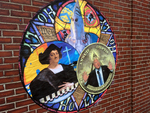
Outdoor Poster Protesting Trump Inauguration RISD Auditorium January 12, 2017
RISD Archives
Student poster protesting Trump election/Inuaguration. Southwest corner of RISD Auditorium Building. Depicts unholy trinity of Trump, Columbus, and Hooded Klansman. photos A. Martinez
-
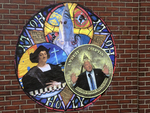
Outdoor Poster Protesting Trump Inauguration RISD Auditorium January 12, 2017
RISD Archives
Student poster protesting Trump election/Inuaguration. Southwest corner of RISD Auditorium Building. Depicts unholy trinity of Trump, Columbus, and Hooded Klansman. photos A. Martinez
-
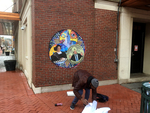
Outdoor Poster Protesting Trump Inauguration RISD Auditorium January 12, 2017
RISD Archives
Student poster protesting Trump election/Inuaguration. Southwest corner of RISD Auditorium Building. Depicts unholy trinity of Trump, Columbus, and Hooded Klansman. photos A. Martinez
-
Communicatronics
Adi Azulay
Design in its nature is a future facing practice. But the future is hard to predict or often even imagine. So how are we as designer to approach these types of problems?
In this thesis I attempt a novel design methodology to derive insights and produce new interaction models for long range communication. The methodology, which can be applied to any topic, focuses on a study of the past. More specifically using experimental archeology, the practice of rebuilding historical objects in order to test functionality and viability of a hypothesis. For this project I learned how to send smoke signals and built a working replica of the first telephone. I learned the concepts of Morse code and early visual semaphore languages. Using these as a launching point I created a series of objects which strive to create more expressive messages.
These object are tools for learning and exploring the possibilities contemporary communication methods may be overlooking. They are meant to ask questions not provide answers. The objects can be used to consider interactions in a new light to be included in future product whether they be hardware or software. Abstract
-
Proximity, interaction, and evolution : taking a deeper look at the systems around us
Rachel Back
In the new age of the sharing economy, the society is more connected than ever, but humanity has never been more disconnected from the environment and the natural world. This thesis begins with studying the dynamics of physical and non-physical systems, at all scales. Additionally, this thesis explores the physical and emotional connection to place, time, and memory. Finally, the goal of this thesis is to create spaces that reintroduce nature into architecture, and allow the inhabitant to experience the mystery and awe of the living systems.
-
Let's get hairy : women, body hair and stigma in arts education
Chaitra Bangalore
A woman who is visibly hairy might be viewed as masculine, dirty, unprofessional, or as a radical feminist. There are variations on what it means to be a woman; feminine does not have to be synonymous with “hairless”. Body hair is a stigma because it is a physical characteristic that is undesirable and shamed when exposed.
Body hair as stigma can be explored in terms of creativity and pedagogy. How can creativity work to dismantle stigma? Talking about stigma gives one the chance to express themselves in a way that is exploratory, sparking new ways of understanding. Arts education already possesses qualities that are beneficial to stigma—how can educators and students take advantage of all that creativity has to offer? Creating artwork about women and body hair and analyzing existing works can deepen one’s knowledge of body hair; as a societal form of control and as a lens to look more closely at stigma in arts education. Creativity can be the outlet to find new ways to accept and appreciate the hair on women’s bodies. Creativity can be a valuable tool to address topics that are controversial or simply overlooked. Let’s get hairy.
-
Fluid solid : can we converse with granite?
Patrick T. Beals
This investigation seeks to detect sources of the quantitative granite anomalies through various methods and use available resources to allow for an immersive, qualitative, and perhaps didactic experience, which will build a conceptual foundation for design of the in-between spaces made by the negative form of granite architectures. This thesis is about timescales and lenses by which to view them in partnership. With lenses are assumed perceptions, ones that define the understanding of the object in the viewfinder of the landscape, and in this case, the timescales which will be addressed in the following three phases:
Phase 01 Background : Geological Time
Phase 02 Registration : Atomic Time
Phase 03 Where We Are : Human Time
-
Anchored in place : locational identity + new genre public art
Stephanie Benenson
Since its inception in the 1970s when Joseph Beuys proclaimed, “Jeder Mensch is ein Kunstler” or “Everyone is an Artist”, public art that focuses on social engagement (otherwise known as new genre public art) has been tested in a variety of formats and places. Today, the breadth of work in this category is vast and the resulting aesthetics vary based on the artist’s intentions and goals. While measuring the success of these projects remains a challenge, an examination of recent history provides us with insights that can become a tool kit for artists commencing on social projects. Once examined, specific factors increase the likelihood of creating meaningful and authentic public experiences, such as mutability (giving a project the flexibility to grow and evolve) and commonality (establishing partnerships across sectors creates scaffolding of support). Moreover, new genre public art benefits greatly when the artist creates or maintains a deep understanding of the place in which the work is situated: including its people, the landscape and surrounding structures, and its history. When place imprints on the artist, a locational identity forms, and this identity guides the artist’s decision-making and social engagement. It also makes an indelible connection within the artist and encourages an enduring relationship between art and place.
-
Building a Paradise? On the Quest for the Optimal Human Habitat
Anu Besson
Do humans have a natural habitat? If yes, is it the original habitat of early hominids or the most optimal environment for today’s humans? Are these two the same thing and, if not, what does ‘optimal habitat’ mean? I examine the concept of the optimal habitat from four viewpoints: 1) paradise; 2) urban design based on environmental psychology; 3) favorite places; and 4) environment as an invitation for action. I conclude that an optimal habitat is not a collection of more or less fixed elements but an environment that can be experienced as a beneficial feedback loop based on and responding to cognitive, emotional, aesthetic, and other needs. Different environments can prompt or hinder this experience of optimal habitat and consequently improve or diminish subjective well-being.