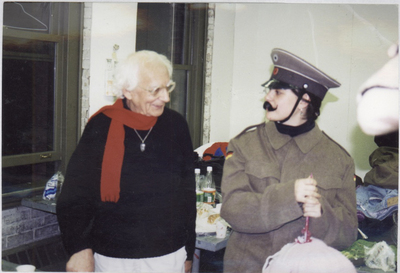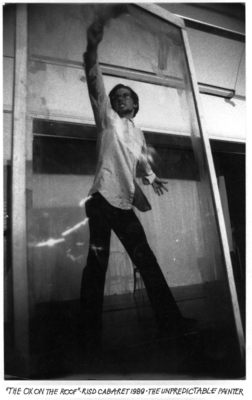
On was an interdisciplinary graduate periodical established by RISD graduate students in 2006. It featured essays and student work that related to a general issue theme. On was intended as a quarterly publication, but it is unclear if further issues beyond the first were ever published.
-
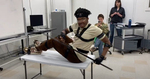
MoCap Recording Session
Billie Wynn, Sagian Shaw, Taira Schurman, Melisa Achoko Allela, and Movement Lab
-
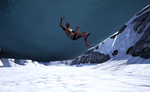
Still from Skeleton Man
Billie Wynn, Sagian Shaw, Taira Schurman, Melisa Achoko Allela, and Movement Lab
-

Gender Mirror: Giving women's perspective to men through exhibition
Jiaxuan Xu
The awareness of gender inequality in China has begun to awaken, but deep-rooted discrimination against women still exists in society. Under the influence of the thousand-year-old feudal social system, men self-righteously believe that they are superior to women and that women have received more "gender benefits." However, research shows that China’s current gender gap is behind mainstream European and American countries by more than 100 years, indicating that China still has a long way to go before reaching gender equality.
Many exhibitions in China have tried to address the challenges faced by women. However, according to the visitor data, the primary audience paying attention to feminist issues is still women. Men tend to exhibit an indifferent attitude towards related exhibitions. How can narrative environments be used to attract more men to engage in such exhibitions and become aware of the oppression experienced by women in both historical and contemporary China?
This thesis advocates using the contrast and fusion of square and circle, light and shadow to communicate the relationship between men and women, and using a dramatic structure to construct a narrative exhibition. The entire exhibition is divided into 4 parts:
(1) the opening - an outdoor theater, using free street performances to attract visitors, (2) the transition - creating light and shadow corridors and meditation areas, blurring gender boundaries, and achieving tourist identity reshaping, (3) the climax - creating narrative space, allowing tourists to resonate with the female victims in the story. (4) ending and reflection - Creating a lake view, providing outdoor space to process, and prolonging the emotions brought to visitors during the exhibition.
In this way, using the tools of narrative space and theatre design, male visitors will be forced to question their discrimination toward women.
-
Beyond Display: Crafting Emotional Journeys for Belonging and Connectivity
Jiamin Yang
In bustling urban areas like Manhattan, New York, the majority of interactions between individuals occur amidst the whirlwind of daily life. Yet, there is an absence of genuine connections within local communities, particularly among neighbors who are geographically close, creating a sense of detachment, untrusting, and anonymity. This thesis involves exploring innovative interventions with the ultimate goal of uncovering novel possibilities in interactive exhibitions, distinct from traditional displays. All of this is an effort to curate emotional journeys that transcend routine, fostering vibrant community belonging and connectivity. Against the backdrop of the city’s vertical living, where neighbor encounters are often confined to elevators and lobbies, stands Manhattan House, comprising five distinct towers enveloping a shared park. Its rooftop, serving as a horizontal connector, transcends the vertical boundaries of the towers, providing a communal space where residents from disparate units can forge relationships with each other, regardless of their usual elevator and lobby routes – however, these connections seldom form. The following book proposes an innovative concept, that envisions the exhibition as the gathering of individuals, transcending traditional boundaries of static displays. This design strategy will not only provide spaces for introspection through personal artifacts belonging to residents, but also facilitate dynamic communal activities, thereby weaving together the fabric of Manhattan Houses community group through shared experiences and storytelling. The restored roof terrace becomes a public living room and will now also serve as a repository of the building's rich history, transporting residents back to the time when this historic structure was built. By showcasing the building's past, these methods aim to strengthen the connection of residents to their shared heritage. Residents will come together in these shared spaces and curate emotional journeys that foster connectivity, a sense of belonging, and community pride, transforming strangers into familiar faces and enriching the social fabric of urban living.
-
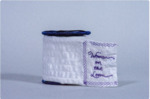
Women on the Loom
Wendy Yao, Special Collections, and Fleet Library
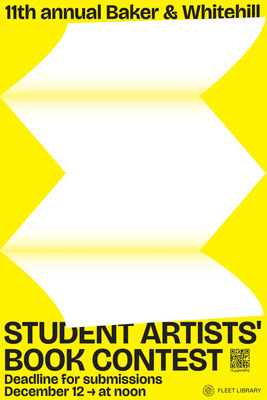
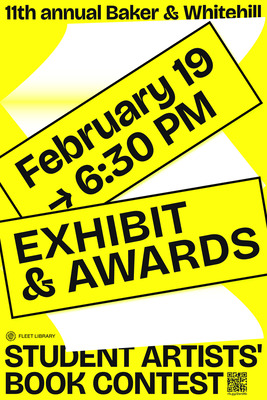
Entry for the 11th Baker & Whitehill Student Artists' Book Contest. Opening reception and award ceremony Wednesday, February 19, 2025 at 6:30pm, Fleet Library, Main Reading Room. Juror: Roger S. Williams.
-

Zombies Don’t Fall In Love
Marie You, Special Collections, and Fleet Library
Entry for the 11th Baker & Whitehill Student Artists' Book Contest. Opening reception and award ceremony Wednesday, February 19, 2025 at 6:30pm, Fleet Library, Main Reading Room. Juror: Roger S. Williams.
-
Architecture As A Carbon-Based Practice
Qixin Yu
Carbon serves as both a silent protagonist and a looming antagonist in the narrative of architecture, shaping not only the physical structures we inhabit but also the ecological legacy we leave behind.
Centuries of human exploitation of the environment have led to climate and material crises. Shifting this dynamic requires action at micro (matter), meso (material), and macro (materiality) levels. Biogenic materials offer significant potential for carbon sequestration and present opportunities for the building industry to collaborate with nature rather than merely extract from it.
This thesis establishes a research and manufacturing practice that prioritizes material innovation, carbon sequestration, environmental rehabilitation, and adaptive reuse. By strategically sourcing local materials such as water chestnut, sawdust, and automobile tires, this thesis transforms these waste products and carbon-sequestering substances into viable building materials through scientific experimentation and testing, ultimately integrating them into an architectural system.
-
Exploring the versatility of clay in double curvature surface formation
yicheng zhang
This thesis aims to investigate the efficacy of clay in shaping double- curved surfaces. In conventional interior design practices, Glass Reinforced Gypsum (GRG) is commonly employed to craft sculptural elements on surfaces such as ceilings and walls. However, despite its efficiency, GRG is not environmentally sustainable.As an excellent material for creating indoor curved surfaces, GRG, offers the advantages of easy construction and high efficiency. However, during the demolition process, the inclusion of glass fibers makes the recycling process very complicated. It is difficult to separate these materials for recycling, which ultimately leads to a significant amount of construction waste.
Additionally, the physical production process can release harmful chemicals that may impact human health.Furthermore, the additives used to make the GRG easier to work with can release volatile organic compounds (VOCs) post production, which may affect air quality. In response, this research seeks to explore the potential of clay as an eco-friendly alternative in the sustainability lab.
Clay, as a natural material, can be easily found on earth. One of the advantages found when using clay was its ability to be manipulated in terms of fluidity and softness by adding or subtracting water, which gives it more use possibilities in comparison to the liquid gypsum. viscosity GRG starts as a liquid and then cures into a solid, and clay can be manipulated as a liquid or solid, has different viscosities/plasticities which are malleable before then being fired into a solid. Clay when fired is stronger than GRG, and in addition to that requires no additives, which allows for it to be recycled easily.
Clay has played a very important role in the history of New England, influencing the economic development of the region. Most of the terrain in New England was affected by the Last Glacier Period, which resulted in the distribution of a large amount of glacial sediment, including clay. These glacial sediments are particularly common around lakes and rivers formed after glacier melting.
Secondly, the coastline of New England, especially Massachusetts and Connecticut, has vast coastal plains where sediment contains fine-grained clay.
The clay resources of New England were once an important source of raw materials for the regional pottery industry, especially in certain historical regions such as Rhode Island, where clay mining had a significant impact on the economy
GRG (plaster reinforced with glass) and clay have very similar status when they are mixed by water but due to their properties can perform very differently in usage. By comparing the performance of the two materials in efficiency, ease of operability, production process, and final aesthetic effects I hope to find if clay can be a potential replacement for GRG in building double-curved surfaces.
This study thesis is led by experimental models focused around experimenting with different examples of how clay can be used in replacement of GRG, including different potential material reinforcements such as reinforced fiber, metal mesh, Hemp rope mesh, and Plaster., Even fire clay can be strengthened itself, these methods are used to simulate the GRG process, and the double curved surface. The final experimental method chosen in this article uses clay 3D printing technology. A relatively ideal experimental method with the greatest implementational possibility was selected to simulate the ceiling shape made with GRG.
Finally we need to consider how to better apply the experimental installation method to actual projects. For example, one such issue would be the practical installation of a curved surface made of clay.
Expanding on this, future directions for research could delve into the long-term durability and sustainability aspects of clay-based surface formations, exploring how they fare in real-world applications and assessing their environmental impact over time.
-
Small Islands Commons: Retrieving Territory, Identity and Rights in The Bahamas
Fangzhou Zhao
The Earth’s surface area comprises 71% ocean and 29% land. This vast disparity has led to the conceptualization of the Earth as a collection of interconnected islands, a perspective that challenges traditional views which often portray islands as isolated, marginal, or primitive. These narratives have been further complicated by the effects of climate change, which positions islands as vulnerable and in need of attention.
This research seeks to explore new socio-cultural contracts with territories to achieve bio-socio-spatial justice. It aims to maintain sustainable and equitable relationships between governments and local communities, focusing on addressing historical inequalities. By examining landscape-based strategies for climate resilience, the study proposes innovative ways to manage and protect territories, emphasizing the social, economic, and cultural needs of local populations over tourism industry demands, strengthening the connection between Bahamians and their territory, and ultimately fostering a sustainable and equitable future.
-
EquiVision Habitat: The Collective Dreamworks
Shixuan Zhou
近年来,武汉这座充满活力的城市在经济快速增长的同时,也经历了重大的社会变革。城市的天际线不断扩大,新的商业和住宅区正在迅速涌现,吸引了更多的中产阶级家庭。作为武汉的长期居民和观察者,我看到了这种向中产阶级社会转变的诱惑力,但我也敏锐地意识到随之而来的社会成本。武汉向中产阶级社会的转变不仅体现在消费水平的提高和生活方式的转变上,更重要的是,体现在城市空间和社区角色的重新配置上。曾经为低收入居民提供住房的旧社区正在被改造成高端公寓和商业空间。虽然这种转变改善了城市的整体形象,但也导致了原住民的流离失所。这种深刻的变化凸显了中产阶级化的双刃剑性质。在这种背景下,我开始关注那些被这一进程边缘化的人的声音和需求。老年居民失去了熟悉的社区环境,年轻人尽管渴望加入新兴的中产阶级,但仍在为高昂的生活成本而苦苦挣扎。这种日益加剧的社会分层,让我深刻反思了城市更新的公平性和可持续性。本文提出了一种基于集体所有权和通过社区土地信托进行管理的社区模式。这种模式将土地所有权从个人转移到社区集体,确保开发活动优先考虑社区的长期福利,而不是短期的商业收益。其目的不仅是提供经济适用房,还旨在培养一个具有共同愿景的社区,探索在城市发展的同时维持社会多样性和包容性的方法。
-
Waste Illuminates Worlds: Printed Modular Lamp Design Based On Brick and Clay Tile
Yechen Zhu
The building industry in the New England area is often in a state of entropy, with abandoned brick buildings contributing to urban decay. The recycling rate of brick and clay tile wastes generated by construction and demolition is only 12.2%, meaning the majority is sent to landfills. The expansion of landfills can lead to significant environmental and community challenges, including increased traffic from waste transport, habitat destruction, ecosystem degradation, and contributions to climate change. Specifically, the Bethlehem landfill in New Hampshire, which is planned to undergo a 5.71-acre lateral expansion through 2026, has already encountered issues such as leachate spills and water pollution. These problems underscore the necessity of proper waste management practices to mitigate potential negative impacts on the environment and local communities.
This thesis explores the use of various biocements for the adhesion of brick and clay tile grains, examining their bonding mechanisms under Scanning Electron Microscopy (SEM). The material application of the modular lamp which incorporates digital printing technology not only minimizes waste through precise material usage but also creates special textures and remind users of the importance of protecting our planet. The creation of this lamp contributes to environmental sustainability by diverting still-usable materials away from landfills, reducing the energy required in the manufacturing process, and decreasing the demand for clay extraction, which makes sustainability development tangible.
In general, the focus of the thesis is on using recyclable rather than extractive materials to create amenities that enhance human comfort while preserving the characteristics of traditional materials and extending the history of clay in New England from a new perspective.
-
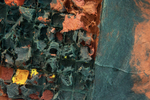
Going Beyond Borders
Janice Agustin, RISD Color Lab, and North American Hand Papermakers
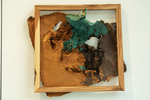
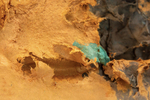
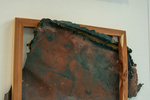
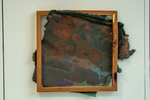
Going Beyond Borders 2022, Pulp Pouring, 12" x 12". Janice Agustin was born and raised on the island of Guam and moved to Southern California at the age of thirteen. She received her bachelor’s in Art with an emphasis in Book Arts and Publications in 2015 from the College of Creative Studies at the University of California, Santa Barbara, with Academic and Departmental Honors. Agustin is currently pursuing an MFA in Studio Art with a concentration in Printmaking at the University of Arkansas- Fayetteville.
Shared Obessions | NAHP Members' 2023 Annual Showcase exhibit on view at the RISD Color Lab, 30 North Main St., Providence, RI in conjunction with the opening reception ceremony held on the 2nd floor of the RISD Fleet Library, 15 Westminster St. Providence, RI. Additional work displayed at the RISD Fleet Library.
-
Going Beyond Borders
Janice Agustin, RISD Color Lab, and North American Hand Papermakers
Going Beyond Borders 2022, Pulp Pouring, 12" x 12". Janice Agustin was born and raised on the island of Guam and moved to Southern California at the age of thirteen. She received her bachelor’s in Art with an emphasis in Book Arts and Publications in 2015 from the College of Creative Studies at the University of California, Santa Barbara, with Academic and Departmental Honors. Agustin is currently pursuing an MFA in Studio Art with a concentration in Printmaking at the University of Arkansas- Fayetteville.
Shared Obessions | NAHP Members' 2023 Annual Showcase exhibit on view at the RISD Color Lab, 30 North Main St., Providence, RI in conjunction with the opening reception ceremony held on the 2nd floor of the RISD Fleet Library, 15 Westminster St. Providence, RI. Additional work displayed at the RISD Fleet Library.
-
Going Beyond Borders
Janice Agustin, RISD Color Lab, and North American Hand Papermakers
Going Beyond Borders 2022, Pulp Pouring, 12" x 12". Janice Agustin was born and raised on the island of Guam and moved to Southern California at the age of thirteen. She received her bachelor’s in Art with an emphasis in Book Arts and Publications in 2015 from the College of Creative Studies at the University of California, Santa Barbara, with Academic and Departmental Honors. Agustin is currently pursuing an MFA in Studio Art with a concentration in Printmaking at the University of Arkansas- Fayetteville.
Shared Obessions | NAHP Members' 2023 Annual Showcase exhibit on view at the RISD Color Lab, 30 North Main St., Providence, RI in conjunction with the opening reception ceremony held on the 2nd floor of the RISD Fleet Library, 15 Westminster St. Providence, RI. Additional work displayed at the RISD Fleet Library.
-
Going Beyond Borders
Janice Agustin, RISD Color Lab, and North American Hand Papermakers
Going Beyond Borders 2022, Pulp Pouring, 12" x 12". Janice Agustin was born and raised on the island of Guam and moved to Southern California at the age of thirteen. She received her bachelor’s in Art with an emphasis in Book Arts and Publications in 2015 from the College of Creative Studies at the University of California, Santa Barbara, with Academic and Departmental Honors. Agustin is currently pursuing an MFA in Studio Art with a concentration in Printmaking at the University of Arkansas- Fayetteville.
Shared Obessions | NAHP Members' 2023 Annual Showcase exhibit on view at the RISD Color Lab, 30 North Main St., Providence, RI in conjunction with the opening reception ceremony held on the 2nd floor of the RISD Fleet Library, 15 Westminster St. Providence, RI. Additional work displayed at the RISD Fleet Library.
-
Going Beyond Borders
Janice Agustin, RISD Color Lab, and North American Hand Papermakers
Going Beyond Borders 2022, Pulp Pouring, 12" x 12". Janice Agustin was born and raised on the island of Guam and moved to Southern California at the age of thirteen. She received her bachelor’s in Art with an emphasis in Book Arts and Publications in 2015 from the College of Creative Studies at the University of California, Santa Barbara, with Academic and Departmental Honors. Agustin is currently pursuing an MFA in Studio Art with a concentration in Printmaking at the University of Arkansas- Fayetteville.
Shared Obessions | NAHP Members' 2023 Annual Showcase exhibit on view at the RISD Color Lab, 30 North Main St., Providence, RI in conjunction with the opening reception ceremony held on the 2nd floor of the RISD Fleet Library, 15 Westminster St. Providence, RI. Additional work displayed at the RISD Fleet Library.
-
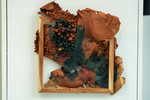
Going Beyond Borders
Janice Agustin, RISD Color Lab, and North American Hand Papermakers
Going Beyond Borders 2022, Pulp Pouring, 12" x 12". Janice Agustin was born and raised on the island of Guam and moved to Southern California at the age of thirteen. She received her bachelor’s in Art with an emphasis in Book Arts and Publications in 2015 from the College of Creative Studies at the University of California, Santa Barbara, with Academic and Departmental Honors. Agustin is currently pursuing an MFA in Studio Art with a concentration in Printmaking at the University of Arkansas- Fayetteville.
Shared Obessions | NAHP Members' 2023 Annual Showcase exhibit on view at the RISD Color Lab, 30 North Main St., Providence, RI in conjunction with the opening reception ceremony held on the 2nd floor of the RISD Fleet Library, 15 Westminster St. Providence, RI. Additional work displayed at the RISD Fleet Library.
-
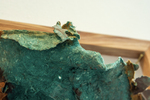
Going Beyond Borders
Janice Agustin, RISD Color Lab, and North American Hand Papermakers
Going Beyond Borders 2022, Pulp Pouring, 12" x 12". Janice Agustin was born and raised on the island of Guam and moved to Southern California at the age of thirteen. She received her bachelor’s in Art with an emphasis in Book Arts and Publications in 2015 from the College of Creative Studies at the University of California, Santa Barbara, with Academic and Departmental Honors. Agustin is currently pursuing an MFA in Studio Art with a concentration in Printmaking at the University of Arkansas- Fayetteville.
Shared Obessions | NAHP Members' 2023 Annual Showcase exhibit on view at the RISD Color Lab, 30 North Main St., Providence, RI in conjunction with the opening reception ceremony held on the 2nd floor of the RISD Fleet Library, 15 Westminster St. Providence, RI. Additional work displayed at the RISD Fleet Library.
-
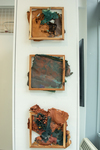
Going Beyond Borders
Janice Agustin, RISD Color Lab, and North American Hand Papermakers
Going Beyond Borders 2022, Pulp Pouring, 12" x 12". Janice Agustin was born and raised on the island of Guam and moved to Southern California at the age of thirteen. She received her bachelor’s in Art with an emphasis in Book Arts and Publications in 2015 from the College of Creative Studies at the University of California, Santa Barbara, with Academic and Departmental Honors. Agustin is currently pursuing an MFA in Studio Art with a concentration in Printmaking at the University of Arkansas- Fayetteville.
Shared Obessions | NAHP Members' 2023 Annual Showcase exhibit on view at the RISD Color Lab, 30 North Main St., Providence, RI in conjunction with the opening reception ceremony held on the 2nd floor of the RISD Fleet Library, 15 Westminster St. Providence, RI. Additional work displayed at the RISD Fleet Library.
-
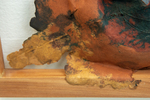
Going Beyond Borders
Janice Agustin, RISD Color Lab, and North American Hand Papermakers
Going Beyond Borders 2022, Pulp Pouring, 12" x 12". Janice Agustin was born and raised on the island of Guam and moved to Southern California at the age of thirteen. She received her bachelor’s in Art with an emphasis in Book Arts and Publications in 2015 from the College of Creative Studies at the University of California, Santa Barbara, with Academic and Departmental Honors. Agustin is currently pursuing an MFA in Studio Art with a concentration in Printmaking at the University of Arkansas- Fayetteville.
Shared Obessions | NAHP Members' 2023 Annual Showcase exhibit on view at the RISD Color Lab, 30 North Main St., Providence, RI in conjunction with the opening reception ceremony held on the 2nd floor of the RISD Fleet Library, 15 Westminster St. Providence, RI. Additional work displayed at the RISD Fleet Library.
-
Thanks for Making It | S1E5: Designing for a Feeling & Turning a Passion Into a Successful Business - Kyle Doerksen of Onewheel
Beth Ames Altringer Eagle, Kyle Doerksen, Industrial Design Department, and MADE
You have probably ridden an electric car or scooter, but have you ever ridden a Onewheel? This lightweight mobility vehicle has one giant wheel and a motor, and sensors that control the motion of the motor to balance you. So it balances for you, and you lean forward to go, back to slow down, and lean on the side to make a turn. But perhaps most importantly, it is designed to create a joyful feeling while riding it. What does it mean to design and engineer a product for a feeling? In this episode of Thanks for Making It, our host Beth Altringer Eagle interviews Kyle Doerksen, the creator of Onewheel. They discuss his background in design and engineering, how he turned a Design Engineering passion into a successful business while still working at IDEO, Onewheel's creative process, and the many benefits of mixing design and engineering.
-
Cohabitation x Adaptation, 2100: A Climate Change Epoch
Kyle Andrews
Some seventy-seven odd years in the future, the world as we know it will only be recognizable by those who are willing to accept it. The bustling metropolis of Boston Massachusetts has been transformed to appease the tides of Mother Nature as a consequence of human intervention. In the decades prior, humanity viciously fought to contain the effects of climate change, until many realized the colossal undertaking of such a battle. Municipalities across the globe had begun to accept that fighting the earth was no longer an option. Instead, the only hope forward was to adapt to a reality in which much of the teetering climate instability would be integrated as part of daily life. Boston, long ahead of climate change policy, was one of the first to dramatically shift this story.
Although this tale sounds like one of hope, it’s merely a reality of just living. This reality is one filled with a continuation of a human response, a response that resides on the basis of reactivity.
Our species isn’t the best at executing proactive plans. We can think critically and forward, but often we find ourselves taking on a challenge when we are approaching the threshold. We are surprisingly really good at crisis management when the only other option is absolute failure. We’ve seen it before with the industrial revolution when cities were choking on their own air, causing a near total collapse of powerful economic engines until people stepped in to avert the crisis. And although cities got better over the decades, they still live with yesterday’s consequences with polluted rivers, toxic soil, and crumbling infrastructure. Progress to reverse the damages have been slow and costly, albeit they are happening.
So, following a logic that has become of our species for centuries, it wouldn’t be irrational to believe that it will happen again. We are already within a storm, and the eye is approaching ever so closer. Climate change is this generation’s greatest threat and humans will inevitably respond in a fight-or-flight fashion.
So then, what does a post-flood urban environment look like on the other side of the storm?
Many speculations today paint a grim picture that the world in the near future will be that of one residing in total chaos. Others believe that we can successfully weather the situation and bring upon progress in a more just world. The answer is both, and neither. Humanity has, and will continue to evolve and move on. Adaptation is hard, but not impossible, especially in which the only means of survival requires change. Most humans genuinely do fear death, afterall. Our coastal cities may even be in a state of disarray in seventy seven years from now. The images behind me are a depiction of that. Humanity survives but still has many questions to ask themselves on how they could improve their condition.
The seaport district became that flooded, vertical urban environment as a response to an inevitable situation.
Some things haven’t changed much in several decades. The United States, if we presume is around in its current state, still operates on a capitalist system. Perhaps there are some aspects of how free-market capitalism has changed over the decades to address core issues, but the greater system still hangs over the nation. This, in return, continues to perpetuate a market driven economy. Seaport only became successful because the city of Boston had run out of space to build and thus, it became economically feasible to build over water once more. Private industry moved back in as profitability became desirable again, and in return altered the landscape into a bustling neighborhood. One that some may find uncomforting because there’s still aspects of exclusionary practices that continue to follow us through this system.
There’s plentiful amounts of LED billboards screaming for the attention of consumers, at the expense of light pollution and noise. Corporate shops line the pedestrian-scape as consumer culture still indulges in the need for easily accessible goods and services. Even city planning still isn’t separated by the needs of privatized organizations. Gondolas and private helicopter pads lead many to areas of commerce. However, High rises that once hosted offices fifty years prior are now molded into a mixed-use, vertical city hosting an array of public/private and civic services.
Even the idea of public space has changed, as the city worked to require new regulations on accessibility. Privately owned towers now must adhere to having publicly accessible pedestrian walkways inside, as the groundscape is no longer a viable space for traditional foot traffic. There is still a barrier of where the public can go, but the lines have been blurred as rooftops and entire floors became new spaces for plazas and gatherings.
The inevitable reality of the rising seas did not completely stop humanity from taking advantage of the new landscape. Even as walkability became limited on the original groundscape, a world of utilizing the water has sprung up. People now have the option to commute by boat, or shop and live on top of barges that adhere to the tides. It’s a different way of living, but not one that is out of the ordinary. Interestingly enough, sea levels had only barely risen to make the neighborhood into a permanently flooded state, but areas still peak above the water line at low tide.
Ultimately, the world is a different place than the one we are used to living in today. However, it still shares many similar characteristics we have been exposed to all of our lives. Humanity continues to move on, adapt, and innovate in the age of the anthropocene. Our species, equally, still continues to struggle under certain economic systems, social hierarchies, and proactivity. People might have a hard time understanding a different reality to the one that they are used to, but the truth is, times change, not because we want them to, but because they have to. Welcome to the year 2100.
-
Reintroducing Hemp (rongony) in the Material Palette of Madagascar: A study on the potential of Hemp Clay components and its impact on social and ecological communities.
Henintsoa Thierry Andrianambinina
When mentioning the word hemp, especially in the local language of Madagascar, the literal translation does not set it apart from marijuana, as they are both called “rongony” - creating the stigma around hemp as the negative stereotype of marijuana. However, the material has been used by the ancestors of Madagascar, as well as across cultures, in its fibrous form to produce fabrication like textile goods and packaging. During colonization, the prohibition of hemp intensified, and since then, any activity related to either of these plants is prohibited and will end in severe punitive measures. This thesis explores the strengths and sustainable properties of hemp as a building material, and how it can help empower local communities in Madagascar. Through reconnecting with an ancestral and traditional plant while also combining traditional Malagasy architectural practices in construction (primarily brick making, biomimicry, and weaving). Looking at hemp in the material palette of Madagascar gives rise to the question: how hemp can help support and innovate Malagasy communities?
-
Norteada- En Busca De un Nuevo Norte. Cocoon Portals and the Negotiation of Space.
Kimberly Ayala Najera
ACT 1
The symbiotic relationship between the turtle and butterfly through lachryphagy, where the butterfly gathers nutrients through drinking the tears of the turtle, brings us to an abandoned turtle shell, our site of exploration. Our turtle friend has long since passed, leaving behind an empty shell that’s become developed and inhabited.
En nuestro analisis de border, to borderland, we arrive at border creep. Border creep, o la fluencia de la frontera, perpetua la tierra fronteriza mas alla y se convierte en una experiencia encarnada.
“Soy una tortuga donde quiera que vaya llevo a casa en mi espalda.”
-Gloria Anzaldua, Borderlands/La Frontera: The New Mestiza, 1983.
It is home carried on one’s back, pero despues de tanto generational trauma, it mutates, y se lleva en las venas. La experiencia de nepantla, borderland, ni de aqui ni de alla se convierte en un embodied experience.
We see the section cut of the shell acquired and mutated with generations of habitation, becoming an intertwined assemblage, home to the moth and butterfly.
Muchos de nosotros, hijos de inmigrantes, exist in the third culture cultivado por la frontera, defined not by our crossing of the border but by its crossing of us, over and over. La frontera, with its demand for dismemberment, innovacion, fluidez, code switching, and self-identification, leaves us norteadas en Nepantla. Somos skillful linguists y traductores, adictas al trabajo, by-products of escape tactics, y encargadas with carrying unrealized dreams. As this border creep se avanca a traves de nosotros generacionalmente, we mutate.
ACT 2
The battle of the Butterfly and the Moth. Both are in the final cycle of a four-stage life that begins with the egg, passes through the caterpillar, transforms in the chrysalis stage, and ends with the adult stage, imago.
What makes an acceptable lepidoptera?
It is believed the butterfly evolved from the moth; the daytime moths. They both are important pollinators, but the moth is considered a nuisance that one is meant to get rid of, while the butterfly is beautiful and displayed. Even though both their needs and functions are quite similar they are pitted against one another, one despised, one accepted.
Nuestra comunidad has been pitted against one another as well, y los indocumentados are portrayed as moths to eradicate, devaluados, and seen as a nuisance. Y el resto aceptado como mariposas siempre con que se ajusten perpetuamente a las normal sociales, prove they are not like the moths, and stay silent. Tanto la polilla como la mariposa, just be grateful and don’t cause a stir.
“Los atravesados live here: the squint-eyed, the perverse, the queer, the troublesome, the mongrel, the mulato, the half-breed, the half-dead; in short, those who cross over, pass over, or go through the confines of the ‘normal’.”
- Gloria Anzaldua, Borderlands/La Frontera: The New Mestiza, 1983.
The moth is camouflaged and moves in the night so as to remain unnoticed. They live in the shadows and evolve to appear less palatable to their predators. During the Industrial Revolution they morphed from white to black within the span of 30 years to fully adapt to their soot-filled surroundings.
“De que me sirve el dinero
Si estoy como prisionero
Dentro de esta gran nación
Cuando me acuerdo hasta lloro
Aunque la jaula sea de oro
No deja de ser prisión”
Los Tigres del Norte
“Jaula de Oro”
The moths son los prohibidos, rechazados, y menospreciados que se quedan vulnerables y existiendo como outlaws para sobrevivir. Trabajan hasta la muerte, contorting their bodies and lives to morph into the soot, smog, pesticide, chemical, pollutant filled surroundings. Pero permanecen devaluados, existiendo en las sombras, y cultivando toda una existencia en la oscuridad.
Though their colorful beauty is displayed in sanctuaries and paraded for an experience, the butterfly also camouflages and assimilates to better blend in. Over time they adapt to hide their vibrancy through crypsis, a process of color modification to protect from predators.
A la mariposa le dicen, no te aguites, just follow the rules, don’t be loud, don’t call attention. Estudia, estudia, estudia. Se les pide que esten a la altura de unsustainable excellence, los migrantes ‘buenos’ o ‘seguros’ o ‘adecuados’, the monarch butterfly, sin darse cuenta que la mariposa esta atada to a puppet string. Todo lo que tienes que hacer is get a seat at the table. Pero no ven el verdadero costo de ese asiento y los terrores de esa mesa. Constantemente se les exige to dull their color (in whatever shade it might present itself) para adaptarse mejor and fit in. El Norte ha sido un scam and for those of us que nos encontramos in its golden gates, se nos ha pedido que abandonemos demasiado. Para convertirte en la mariposa estadounidense, tienes que dejar todo atras, abandonando nuestra familia, idioma, y cultura at the door, at the cage, at the ditch, para mejorar la raza.
“Is this too much reality? It is, yes. No one is watching, caring, extending a hand or taking a little demonic blame. If we are adults and past the age of having our parents come running when we cry, our only help is ourselves and one another. Yes, this is far too much reality. No wonder we need aliens. No wonder we’re so good at creating aliens. No wonder we so often project alienness onto one another...”
- Octavia Butler,The Monophobic Response, “Dark Matter,” 1995.
ACT 3
Both butterfly and moth are overworked to remain concealed and survive. Some are placed in sanctuaries and others can conceal themselves through their surroundings. But their lives remain in constant risk due to habitat loss, climate change, development, predators, and pesticides.
Como muchas de nosotras, las moths me criaron para ser una butterfly, perfectly curated and displayed, destinada a salvar la raza. I made it into the room, me sente a la mesa. Pero no te dicen que tienes que cortar todo tipo de partes de ti misma para entrar, and once youre in, estas atrapada. “No mija, tienes que seguirle, a hecharle ganas.” This is the golden seat, this is what they sacrificed for. But the inside is death. Mi cuerpo y mi mente estan destrozados. Im pissed and im tired. Esta maldita rueda de ratas keeps turning and its keepers are pumping me full of sugar water. Siguen coordinando peleas con las moths, y yo tengo que ser mejor y diferente, but definitely not too different, just enough to be displayed and exhibited. Y luego todavia me abandonan a mi Muerte, y destruyen mi hogar. Y no puedo regresar con las moths because im being dramatic, ingrata, mal creada. I have it so much easier, after all, soy una mariposa. Solo necesito orar, todos temenos que soportar cosas dificiles. No good with the butterflies, no good with the moths. Fuck this north. Chinga ese norte. I need a portal.
“I felt crazy for thinking we were under attack, watching my neighbors disappear and then going to school and watching the nightly news and watching award shows and seeing no mention. I felt crazy watching the white supremacist state slowly kill my father and break my family apart. I would frantically tell everyone that there was no such thing as the American Dream but then some all-start immigrants around me who had done things ‘the right way’ preached a different story and Americans ate that up. It made me feel crazy. I also am crazy. Pero why? My diagnoses are borderline personality disorder, major depression, anxiety, and OCD. (I love diagnoses. Gives you the ability to read about yourself.) Researchers have shown that the flooding of stress hormones resulting from a traumatic separation from your parents at a young age kills off so many dendrites and neurons in the brain that it results in permanent psychological and physical changes. One psychiatrist I went to told me that my brain looked like a tree without branches.
So I just think about all the children who have been separated from their parents, and theres a lot of us, past and present, and some under more traumatic circumstances than others- like those who are in internment camps right now- and I just imagine us as an army of mutants. Weve all been touched by this monster, and our brains are forever changes, and we all have trees without branches in there, and what will happen to us? Who will we become? Who will take care of us?”
– Karla Cornejo Villavicencio, The Undocumented Americans, 2020.
Might the formerly abandoned cocoon offer an opportunity to escape this reality.
Just as the cocoon provided what the caterpillar needed for transformation, it provides what the moth and butterfly need for a new metamorphosis, a portal. The cocoon emerges as a portal to offer moments of collective lepidoptera relief, healing, and cohabitation. The portals offer temporary places for new imagination. Temporary places for dreaming of a new reality, where survival is no longer the driving force, and the moth and butterfly can thrive. But these portals remain ephemeral and fleeting, exposed to the elements and susceptible to destruction. They cannot last and only offer brief mitigation.
The cocoon y el mutante. Como lo hemos hecho antes, encontramos formas de sostenernos mientras existimos en esta realidad.
But can we imagine a world in which both butterfly and moth are not just surviving with fleeting moments of relief to sustain, but where they can thrive?
Y donde no es uno contra el otro, sino que vive la armonia de la fluidez. In defiance to both the butterfly and the moth, para escaper de este perpetue estado de peligro, emerge el mutante, ambos/y, y ninguno. Existiendo tanto en el dia como en la noche, tanto en la luz como en las sombras. Ni de aqui, ni de alla, both from here and from there.
ACT 4
En busca de un Nuevo Norte.
How do we capture the portal. Cocoon portals translated into totemic objects, can be used to extract and cement their particularities to affix and tether the life of this experience. They provide the opportunity for inspiration and speculative fiction. We can adapt these qualities of connection, framing, and spillage to reconceptualize space making practices.
In doing so, this ideating practice can aid in conceiving renewed spatial relationships to rehabilitate and cultivate a new moth and butterfly habitat.
El mutante necesita un nuevo hogar, un nuevo norte. This north isn’t working. It’s too caught up and were all just playing tetris tratando de reformar las mismas piezas en diferentes configuraciones, pero siempre son las misma jodidas piezas. Y seguimos siendo alimentados con esta agua azucarada that has us hoping to end up with something new.
These fleeting cocoon portals abren paso en momentos de presion, rupture, Resistencia y desafio to provide a temporary escape, permitiendonos un tunel para ver algo nuevo. En estos momentos exprimimos el agua azucarada y nos llenamos de nuevo de nutrients. We see glimpses de una nueva imaginacion solo para que se disipe, mu pocos y demasiados separados, siempre en riesgo de colonizacion and gentrification.
Es dificil para mi imaginar y sonar que podria ser un mutante thriving in whatever new place the portal lets me briefly see, la vida de mariposas y polillas es todo lo que he conocido. Es como que me cerebro ya no tiene esa funcion for dreaming and imagining anymore. Actually, es mas como si hubiera sido condicionado para sonar e imaginar de una manera muy especifica. De trabajar hasta la muerte para una vida mejor. To work myself to death into a better life. Pero quiero una nueva imaginacion, y un nuevo sueno. Quiero la alegria, healing, collectivity and ancestry, boundaries, el descanso, la dulzura, self-compassion, expression, empathy, y la conexion con la naturaleza y los elementos. What we experience briefly and exists beyond these cocoon portals.
And for a new imagination to be nurtured, la estructura de la vieja tiene que ser expuesta y desaprendida. Derribando uno por uno sus ciminetos y raices para que podamos ver claramente what the portal is calling our attention to. So we can nourish a new imagination and dream a new dream. Para que podamos nutrir una nueva imaginacion y sonar un nuevo sueno.
BIBLIOGRAPHY
BOOKS
Anzaldua, Gloria. “Borderlands/La Frontera: The New Mestiza,” 1983.
Sennet, Richard. Edges: Self and City Essay, “Borders and Boundaries,” 2006.
Tsing, Anna. “The Mushroom at the End of the World, On the Possibility of Life in Capitalist Ruins,”2015.
Butler, Octavia E. A Few Rules for Predicting the Future Essay, “Essence,” 2000.
Abdurraqib, Hanif. “A Little Devil in America, In Praise of Black Performance,” 20221.
Sheree Thomas, Butler, Octavia. The Monophobic Response, “Dark Matter,” 1995.
Cornejo Villavicencio, Karla. “The Undocumented Amercians”, 2020.
Glissant, Edouard. “Poetics of Relation,” 1997.
MUSIC
“La Jaula De Oro,” Los Tigres Del Norte, 1983.
ARTWORKS
“Shelf For Curiosities”, Katie Rose Johnston, Studio Manifesto.
“Sovereignty,” “Breakdown”, Simone Leigh, Solo Exhibition, ICA Boston.
FILM
Neptune Frost, Saul Williams, Anisia Uzeyman, 2021.
Everything, Everywhere, All at Once. Daniel Kwan, Daniel Scheinert, 2022.
Rasquachismo: a theory developed by Chicano scholar Tomás Ybarra-Frausto to describe "an underdog perspective, a view from los de abajo" in working class Chicano communities which uses elements of "hybridization, juxtaposition, and integration" as a means of empowerment and resistance.