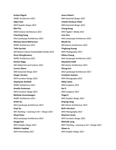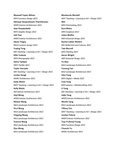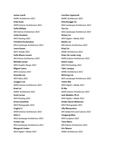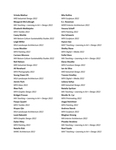
On was an interdisciplinary graduate periodical established by RISD graduate students in 2006. It featured essays and student work that related to a general issue theme. On was intended as a quarterly publication, but it is unclear if further issues beyond the first were ever published.
-

Capture, control, circulate : can we queer regulatory power in Graphic Design?
Adie Fein
Capture, Control, Circulate addresses regulatory power, the transmission and enforcement of culturally-sanctioned behaviors and identity. How does regulatory power operate in graphic design and what—if anything—can the graphic designer do to subvert that operation? The methodologies for subversion explored in this book typically draw from queer and trans* experience and thought. Therefore, the work herein takes up issues of identity, normativity, marginalization, and community.
This thesis also considers design education, and its contemporary emphasis on the capture and control of content. It advocates instead for an educational model that centers circulation; that is, graphic design’s capacity to platform, to publish, and to distribute. Capture, Control, Circulate imagines how design education can build community through informal platforms for reflection, collaboration, distribution, and collective celebration.
-
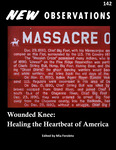
New Observations #142 | Wounded Knee: Healing the Heartbeat of America
Mia Feroleto
New Observations is a non-profit, contemporary arts journal written, edited, and published by the arts community. For more information visit newobservations.org.
-

New Observations #140 | The Rudolf Steiner Lens in the 21st Century
Mia Feroleto and Elana Freeland
New Observations is a non-profit, contemporary arts journal written, edited, and published by the arts community. For more information visit newobservations.org.
-
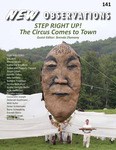
New Observations #141 | Step Right Up! The Circus Comes to Town
Mia Feroleto and Brenda Zlamany
New Observations is a non-profit, contemporary arts journal written, edited, and published by the arts community. For more information visit newobservations.org.
-
More Friends than the Mountains: A Comparative Conjunctural Analysis of Kurdish Autonomy Movements in Rojava and Bakur
Dillon Foster
In 2012 Kurds in Syria announced the formation of a radical self-administered “ecological democratic confederalist” society along the Syrian-Turkish border in a region known as Rojava. The autonomous government in Rojava stands in sharp contrast to the political situation in neighboring Bakur, a Kurdish-majority region in southeastern Turkey where, for nearly four decades, the Kurdish Workers’ Party (PKK) has waged a guerilla war against the Turkish state in the name of autonomy. This thesis situates the divergent political outcomes of the autonomy movements in Rojava and Bakur within the socio-ecological context of their occupying nationstates. Following the historical relationship between the development of the nation-state model and environmental exploitation, as emphasized by Kurdish revolutionary leader Abdullah Öcalan, I trace the ways in which land transformation served as a structural process of state formation in Syria and Turkey. Utilizing Antonio Gramsci’s theory of historical conjuncture and Immanuel Wallerstein’s world-system perspective, I show how the geohistorical process of state formation in Rojava and Bakur created diverging political conditions shaping and constraining the contours of Kurdish movements. Despite a rich history, the complexities of the Kurdish autonomy movement have gone largely unnoticed in contemporary antisystemic discourse reflecting a broader trend of undertheorizing non/anti-state social movements that seek to build alternative forms of governance and production. Therefore, the goal of this thesis is two-fold. First, the articulation of the need for an analytical framework useful in studying anti-state movements from a world-system perspective. Second, I work to reveal how long-term geohistorical processes of land transformation shape the contemporary strategies of social movements seeking autonomy from the nation-state system.