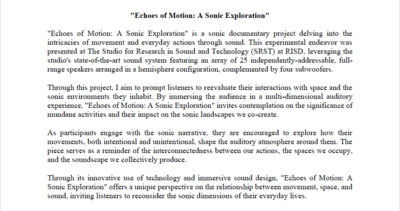
On was an interdisciplinary graduate periodical established by RISD graduate students in 2006. It featured essays and student work that related to a general issue theme. On was intended as a quarterly publication, but it is unclear if further issues beyond the first were ever published.
-

The Empire Sings Back: Aesthetics, Politics, and Postcolonial Whimsy
Namita Goswami
This essay recovers the devalued aesthetic dimension of the Bollywood film/song from its political over-determination as national allegory. The qualities attributed to the film/song, such as effeminacy, irrationality, fantasy, and non-synchronicity, which I term its postcolonial whimsy, and its surplus value as the Bollywood film’s most transnational component, allow for the free play of the imagination. This admits the possibility of another performative public culture and imagined community not premised on exploitation, calculability, and passive spectatorship and consumption. The film/song enables affect without literal linguistic comprehension, especially among those unfamiliar with the indigenous languages and musical traditions. What is derided as the sentimental aspect of Bollywood films and as its most embarrassing element is its whimsical aesthetic. The film/song as the film’s fanciful, hopeful, and dreamy core and its unmoored quality broaden the scope of its possible political meanings. The film/song dis/plays what is unsung in spite of being spectacular (inferior) excess: the dreams and aspirations are still possible in everyday life.
-
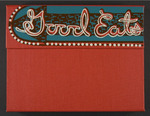
Good Eats: sit down, relax & enjoy: it's the cook's choice: selections from an appetizing array of well-seasoned moments and finely diced tales
Gretchen Hooker, Special Collections, and Fleet Library
portfolio with 4 flaps, enclosing loose plates; box cover; open box with loose prints; loose prints, 4. The portfolio cover looks like a neon diner sign and unfolds to create a placemat. Recipe cards include anecdotes about friends and special foods shared.
-
In but not of, of but not in: On Taste, Hipness, and White Embodiment
Robin James
The status of the body figures paradoxically in the interrelated discourses of whiteness, aesthetic taste, and hipness. While Richard Dyer’s analysis of whiteness argues that white identity is “in but not of the body,” Carolyn Korsmeyer’s and Julia Kristeva’s feminist analyses of aesthetic “taste” demonstrate that this faculty is traditionally conceived as something “of” but not “in” the body. While taste directly distances whiteness from embodiment, hipness negatively affirms this same distance: the hipster proves his elite status within white culture by positioning himself as, in the words of James Chance’s song title, “Almost Black.” The notion of hip contributes to my analysis of taste by focusing on both the gender politics of white embodiment, and how, by taking the social body as object of the prepositions “in” and “of,” these discourses of taste and hipness produce individual bodies as white, and maintain Whiteness as a socio-political norm.
-

Walk on Red:Soundscapes on Broadway
Hoon Kim, Special Collections, and Fleet Library
sewn signatures with soft cover; cover; interior spreads and pages. Visual and graphic representations of sounds in various areas of Manhattan, using diagrams, satelite maps, and photographs. Incorporates factual information with quotations about cities and spaces. RISD alumnus.
-

Reconstruction
Andre Lee, Special Collections, and Fleet Library
10 unnumbered pages : color illustrations, portraits. Title from cover. Date of publication from back cover. Numbered edition of 10 copies. Five double page pop-up celebrity portraits. Accordion binding, grey cloth over cover boards. Title lettering emboss in pink, silver, and green. Pagination includes pages [2] and [3] of cover. Unbound purchase. Library has copy no. 3.
-
Forming process : design through layered visual systems and multiple collection methods : a thesis
Jen Magathan
"Do not hide the structure, celebrate it in the form" ; "Approach design from multiple points of view."
These adages, so important in my architectural training, reverberate with intricate practicality in my work as a graphic designer, both as a way of building my design and as a means of developing a design process which explores multiple ways of organizing content through visual systems. Forming Process is defined by three conditions: celebrating the visual systems which organize the design, archiving content from multiple ways of collecting, and creating work by which the process of design is implicit in the design solution. There is beauty and function in the marks that are made during the design process. I believe by celebrating the process in the form, more interesting and informed design solutions can be discovered. I begin by developing visual systems which organize the objects I design. I often layer many systems such as grids, printing structures, and typographic systems in order to provide a structure that will initiate an uncertain result. These systems are then infused with elements of an archive, gathered from multiple methods of collection. Photography, writing, and surveying — often through chance operation — allow the layered visual systems to produce a serendipitous form. Trusting the systems which structure my work allows for the process of developing the form to be revealed in the design solution. Designing in this way permits the poetic nature hidden within the predictable dimensions of the study to arise, and yields work which oscillates on a spectrum across information and form.
-
Unlimited Additions to Limited Editions
Christy Mag
In this paper I target the relationship between two prints that are roughly qualitatively identical and share a causal history. Is one an artwork if and only if the other is an artwork? To answer this, I propose two competing principles. The first claims that certain intentional relations must be shared by the prints (e.g., editioned prints vs. non-editioned prints). The second appeals only to minimal print ontology, claiming that the two prints need only be what I call 'relevantly similar' to one other. In the end, I endorse the second principle. There are no trumping features over and above relevant similarity, that is, for any pairwise comparison of relevantly similar prints, one print being an artwork is both necessary and sufficient for the other print being an artwork.
-
Intentions and Interpretations: Philosophical Fiction as Conversation
Jukka Mikkonen
Appeals to the actual author's intention in order to legitimate an interpretation of a work of literary narrative fiction have generally been considered extraneous in Anglo-American philosophy of literature since Wimsatt and Beardsley's well-known manifesto from the 1940s. For over sixty years now so-called anti-intentionalists have argued that the author's intentions – plans, aims, and purposes considering her work – are highly irrelevant to interpretation. In this paper, I shall argue that the relevance of the actual author's intentions varies in different approaches to fiction, and suggest that fictions are legitimately interpreted intentionally as conversations in a certain kind of reading. My aim is to show that the so-called conversational approach is valid when emphasizing the cognitive content of a fiction and truths it seem to convey, for example, in a philosophical approach to fictions which contain philosophical purport using Sartre's fictional works as paradigmatic, and that anti-intentionalists' arguments against intentionalism do not threaten such an approach.
-
The Sensory Intention -- Art, Motif, and Motivation: A Comparative Approach
Yves Millet
Philosophers like Gilles Deleuze claimed a new outlook for aesthetics asking for a rethinking of the traditional separation between the theory of sensibility and the theory of art. From a comparative standpoint, this article examines the concept of 'sensory intention' which in our view might be able to bridge the gap between acting and doing and therefore to link the theory of sensibility and the theory of art.
Traditional Chinese art, and more specifically the script style caoshu[草書],has been chosen as the medium through which to illustrate the theoretical discussion. Analysis of traditional Chinese thought on art allows us to see how approaching art from the point of view of motivation contrasts with early Western aesthetic theory. Aesthetics appears not as the inferior gnoseologia mentioned by A. G. Baumgarten (1750) but, on the contrary, as living knowledge of the common fund of our practices and rationalities.
The discussion addresses the following issues: the traditional views of acting and doing found in Western and Eastern philosophies; the place of motivation (related to qi[氣]) in Chinese art; and, consequently, the place of motifs in Chinese traditional art and Western modern painting.
-
Encountering the Other: Aesthetics, Race and Relationality
Mickaella Perina
This essay examines the links between aesthetics and race through the lenses of accepted distinctions between Western and non-Western, colonial and postcolonial, national and transnational aesthetics, and questions the validity of the claim that there is an inherent and incommensurable difficulty in translating non-Western aesthetic thought into Western aesthetic thought. First, I argue that Manichean models are insufficient to understand the dynamics of the encounter between Western and non-Western aesthetics. Second, I illustrate the complexity of non-Western and Western aesthetics relations through the example of the encounter between Aimé Césaire’s Negritude and André Breton’s surrealism. I argue that this encounter exemplifies non-ideal translation, the temporary rendering from one framework into the other, and instantiates relationality. Third, I argue that it is possible to understand and accommodate various aesthetic experiences and different aesthetic frameworks by exploring modes of discerning between different kinds of others and different kinds of selves, and that cosmopolitanism could, but does not, provide the necessary conditions for such reversal.
-
Davidson on Rorty's Postmetaphysical Critique of Intentionalism
Kalle Puolakka
In this article I shall address the standing of intentionalist theories of interpretation through Richard Rorty’s critique. Rorty’s criticism arises from the position literature holds in the post metaphysical, liberal culture Rorty sketches As a counterbalance to Rorty’s critique, I shall develop an intentionalist theory of interpretation drawing on Donald Davidson’s late philosophy of language and his view of literary interpretation that have sadly not been taken into proper consideration in the on-going debate in analytic aesthetics on the role of authorial intentions in interpretation. The prospects of Davidson’s intentionalism for meeting Rorty’s criticism are related to the position of imagination in the Davidsonian approach. By indicating the connections between the position of imagination in Davidson’s views and how it has in turn been approached in contemporary pragmatist-inspired moral philosophy, I shall argue that an intentionalist theory is, after all, able to meet those challenges that Rorty sees literature and literary theory facing in his post metaphysical culture.
-
On Hanging Laundry: The Place of Beauty in Managing Everyday Life
Pauliina Rautio
The data of my empirical research in the field of education discussed in this paper consist of letters produced through correspondence. I asked the participants to write about beauty in their everyday lives, giving substance to the concept as freely as they could. In this paper it is only the letters of one participant, Laura, which I limit my attention to. The aim is to find out what kind of place beauty, as defined and used by herself, holds in the managing of her everyday life. The concept of beauty is virtually missing from educational research or is misguidedly restricted only to formal art education. Beauty being for Laura an occasional checking of direction in relation to changes both in the context of her everyday life and in herself as a person sheds light to the relevance of beauty at the constitutive and perceptual level of growing as a human being.
-
Presentation of Awards + Scholarships
Rhode Island School of Design
Presentation of the following awards and scholarships: Apparel Design Scholarship, Cranston Printworks Apparel Design Award, Helen Byram Scholarship, Josephine & Bernard Chaus Scholarship, Raul L. Lovett Scholarship, Robert Pacheco Memorial Scholarship, Joseph Piselli Memorial Scholarship, Mary Bowen Polk Scholarship, Louise A. Shuster Memorial Scholarship and Textron Fellowship.
-
Senior Thesis Collections
Rhode Island School of Design, Katie Gallagher, Maura Mullally, Irene Chiu, Jessica Burke, Megumi Doi, Haleigh Bernbaum, Lucy Wan Ting Chiu, Aidan Vitti, Stephanie Burgee, Dorothy Weise, Cait Shea Clark, Katie June, Aurelia Cotton, Zoe Latta, Ellen Choi, Blanche Consorti, Peggy Sue Deaven, Claire Bushey, Matt Cavallaro, Michaela Hanson, Carmine Yi Jin Ro, Nicole Puszynski, Francesca Isola, Rebecca Libman, and David Burris
PLEASE NOTE: Where applicable, the audio has been removed from this file due to copyrighted material. The garments shown here were created in response to the Senior Thesis design challenge: create a complete collection that reflects your philosophy or the essence of your personal vision.
-
Sensation as Civilization: Reading/Riding the Taxicab
Monique Roelofs
Aesthetics, race, and nation are densely imbricated with one another. This essay examines their interactions in a newspaper column that describes an aesthetic confrontation between a presumably Arab taxi driver and his passenger, a white European-Dutch columnist. In this column, taste engenders acts of identification and abjection, transmits projections of fear, and underwrites a division of labor and virtue. It thereby serves as a racial border patrolling technology and institutes racial boundaries. To clarify the racial power of aesthetic constellations in the taxicab case, the paper turns to the dualities and integrations that theorists such as Addison, Baumgarten, Schiller, and Hegel have historically located at the center of their conceptions of the aesthetic. Unwrapping the disciplinary operations sustained in the taxi scenario by differentially available separations and integrations between mind and body, public and private, individuality and sociality, the essay investigates what follows for an understanding of aesthetic disciplinarity.
-
Red, Gold, Black, and Green: Black Nationalist Aesthetics
Crispin Sartwell
This paper tries to show that black nationalist movements have been pervasively influential on the music and visual culture of the world. In particular, it focuses on the Marcus Garvey movement and some of its religious expressions or extensions - Rastafarianism and the Nation of Gods and Earths - and on reggae and hip hop music. This is also an illustration of a wider conceptual point: that political ideologies are not only constellations of texts and doctrines but multi-media aesthetic environments. Race itself is articulated in aesthetic categories, not only in terms of body appearance and color, but in cultural productions such as music and visual arts, while questions about what art is, or what are the data of aesthetics, cannot be answered in isolation from racial or other social/economic/political categories.
-
The Hijab and the Sari: The Strange and the Sexy between Colonialism and Global Capitalism
Falguni A. Sheth
By exploring the “Western” reception of the sari in comparison to the hijab, I hope to illuminate the racial aesthetic that is at work in vilifying the latter while glorifying the former. The history of colonialism and the forced domestication of the sari help to facilitate its reception as an acceptably “sexy” garment. By contrast, the hijab has not been subjected to colonial modification. It has remained unmodified, and is still experienced as culturally, racially, and aesthetically strange by observers. In order to explore the role that political and cultural authority plays in shaping “acceptable” and “unacceptable” racial aesthetics as linked to the hijab and the sari, I will explore the regulation of the sari and explore the sartorial strategies enacted by Mohandas Gandhi in his political resistance to British rule over India. Finally, I will draw on the prior analysis to highlight the contrast between the acceptability of the colonially domesticated sari in contemporary society and the hostility that the as-yet still undomesticated hijab incurs in contemporary society.