On was an interdisciplinary graduate periodical established by RISD graduate students in 2006. It featured essays and student work that related to a general issue theme. On was intended as a quarterly publication, but it is unclear if further issues beyond the first were ever published.
-
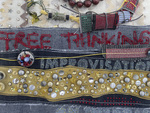
Improvisation Components Flag 6 (detail), Trend Spring / Summer 2010
Swarovski, Visual + Material Resources, and RISD Color Lab
These unique volumes of textile flags featuring Swarovski crystals were gifted to the Visual and Material Resource Center in 2017 from a local jewelry supplier. Twenty-four volumes dating from 2004-20017, they are a visual feast of color and texture created by individual artisans. Complete volumes may be viewed in the Visual and Material Resource Center, Fleet Library, second floor of 15 Westminster St, Providence, RI.
-
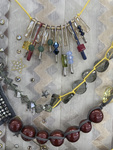
Improvisation Components Flag 6 (detail), Trend Spring / Summer 2010
Swarovski, Visual + Material Resources, and RISD Color Lab
These unique volumes of textile flags featuring Swarovski crystals were gifted to the Visual and Material Resource Center in 2017 from a local jewelry supplier. Twenty-four volumes dating from 2004-20017, they are a visual feast of color and texture created by individual artisans. Complete volumes may be viewed in the Visual and Material Resource Center, Fleet Library, second floor of 15 Westminster St, Providence, RI.
-
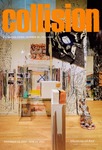
Collision
Judith Tannenbaum
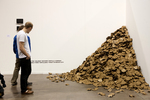
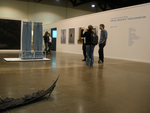
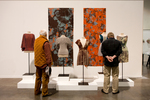
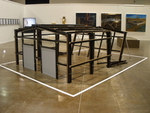
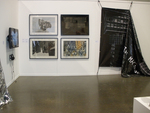
Exhibition Notes, Number 37, 2010. Collision is an experiment in exhibition-making. It began when painter Jackie Saccoccio invited a group of artists (seventeen, including herself) to contribute works of their own choosing to a show in which paintings, sculptures, photographs, drawings, prints, videos, and various hybrid forms would literally collide: butting up against each other, overlapping, and even altering one another in an improvisatory fashion. Depending on their placement in the gallery as determined by the individual artists, the works could become entirely subsumed in the larger communal cacophony.
Most often group exhibitions in museums are conceived and organized by a curator, who selects the works of art and decides how they will be displayed in the gallery space. If the exhibition includes living artists, the curator consults with them about requirements for presenting their individual work, but the overall installation is determined by the curator. In the case of Collision, the RISD Museum took a leap of faith, giving up a significant amount of its normal control, as the exhibition became a collaborative effort among Saccoccio, the participating artists, and the RISD Museum’s staff. Several artists added another layer of collaboration by inviting still more artists to assist them in making their works for the show.
The RISD Museum has a tradition of inviting artists to “guest curate” exhibitions going back to Andy Warhol’s legendary Raid the Icebox I, in which the artist made a wonderfully quirky selection and installation of objects from the Museum’s storage vaults in 1969. More recent examples of artists creating exhibitions here by juxtaposing their own work with objects from storage include Jim lsermann’s Logic Rules (2000), Betty Woodman’sII Giardino depinto (2005), and Carl Ostendarp’s Pulled Up (2009), while projects by David Wayne McGee and Alexis Rockman featured their own paintings placed within the context of the Museum’s permanent collection galleries. Collision, however, represents the first time an artist has invited other artists to participate in creating a group exhibition at the Museum.
-

Water and Stone: Contemporary Chinese Art and the Spirit Resonance of the World
Mary Bittner Wiseman
My claim that the new art in China operates at the level of matter and gesture, below that of discourse, is twofold. First, much of the art that is being made exemplifies principles articulated by Hsieh Ho (fifth century) and Shih Tao (seventeenth century) and refracted through the changes wrought by Mao in 1949 and Deng in 1979. Through their art, experimental Chinese artists ask what can art be in a world turned upside down, and what can it be to be artist in such a world and, in particular, to be a Chinese artist.
Second, in the course of working through these questions, the artists have resorted to an art that is an operation on matter, a matter inseparable from energy, and it is the artist’s activity, as much as what issues from it, that puts the artist in lockstep with the movement of the world of the twenty-first century.
-
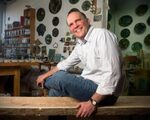
Ben Anderson
Ben Anderson and Richard Goulis
Ben Anderson, born in 1960, has a BFA in sculpture from the Rhode Island School of Design and an MFA from the University of California, San Diego. He is an assistant professor at the University of Rhode Island and works from his studio in Warren.
-

RISD Film - Animation - Video Senior Show 09
RISD Archives and Film, Animation & Video Department
The poster documents the 2009 Film Animation Video Senior Show held in the RISD Auditorium during the 2009 spring semester.
-
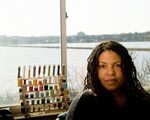
Donna Bruton
Donna Bruton and Richard Goulis
Born in 1954 in Wisconsin, Donna Bruton received a BFA from Michigan State University, an MFA from Yale University and a certificate in painting from the Art Institute of Chicago. She resided in Portsmouth, Rhode Island and was a professor of painting at the Rhode Island School of Design.
-
Thinking, the Unconscious and Film
John Carvalho
In this essay, we explore a non-standard model of the unconscious, what Gilles Deleuze and Félix Guattari call the “productive unconscious,” to correct the too-often reductive tendencies of psychoanalysis and film. This introduces the image of a form of thinking we may find in our encounters with film that aims more at pleasure-taking than problem-solving and that, in so doing, really gets us to think. Drawing on this productive unconscious, we come to a richer appreciation of classic Hollywood cinema, a new understanding of classic, nouveau vague and neo-realist films, and we enjoy the chance to ignore the rules and reconsider thinking in philosophy and film.
-
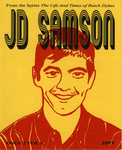
JD Samson
Special Collections, Fleet Library, and Eloisa Aquino
Cover for JD Samson, from the RISD Library Zine Collection.
-
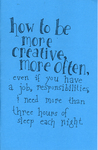
How to be more creative, more often, even if you have a job, responsibilities, & need more than 3 hours of sleep each night
Special Collections, Fleet Library, and Breanna Boland
Cover for How to be more creative, more often, even if you have a job, responsibilities, & need more than 3 hours of sleep each night, from the RISD Library Zine Collection.
-
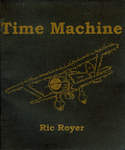
Time Machine : The Words of Famous Monks and Femail Saints and Me Too
Special Collections, Fleet Library, and Ric Royer
Cover for Time Machine : The Words of Famous Monks and Femail Saints and Me Too, from the RISD Library Zine Collection.
-
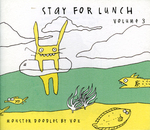
Stay for Lunch. Monster Doodles by Voz
Special Collections, Fleet Library, and Voz
Cover for Stay for Lunch. Monster Doodles by Voz, from the RISD Library Zine Collection.
-
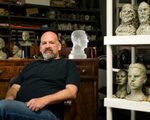
Steven Easton
Steven Easton and Richard Goulis
Born in New York City in 1961, Steven Easton came to Providence in 1978 to attend the Rhode Island School of Design, specifically to study in the glass department. He works from his studio in Pawtucket, Rhode Island.