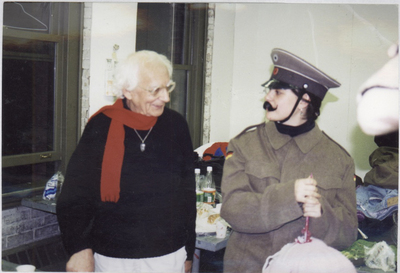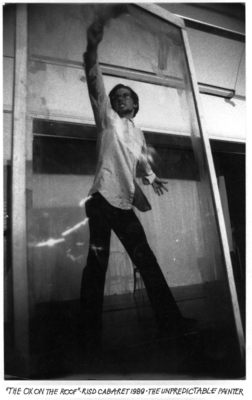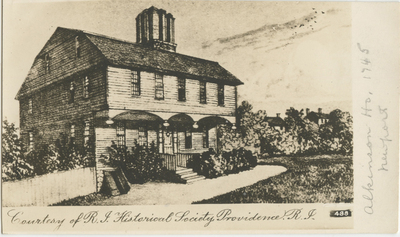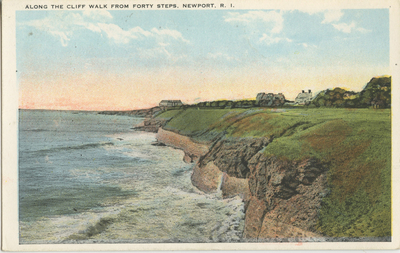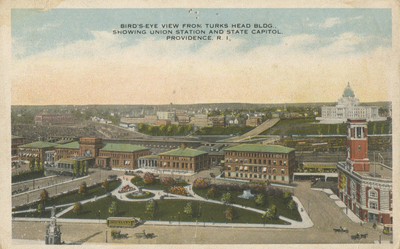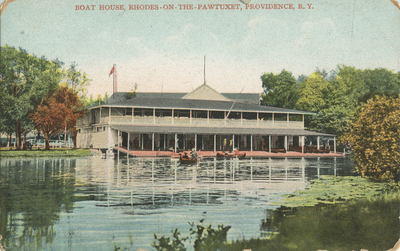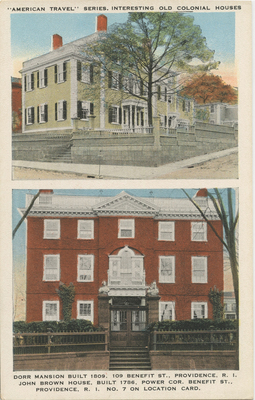
On was an interdisciplinary graduate periodical established by RISD graduate students in 2006. It featured essays and student work that related to a general issue theme. On was intended as a quarterly publication, but it is unclear if further issues beyond the first were ever published.
-
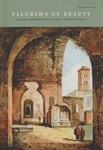
Pilgrims of Beauty: Art and Inspiration in 19th Century Italy
Crawford Alexander Mann III
Exhibition Notes, Number 38, Spring 2012. In the 19th century Italy was the most desirable destination for travelers from every corner of Europe and beyond. Thousands crossed mountains, even oceans, to go there, leaving their "barbarous” homelands to study and admire Italy’s unsurpassed aesthetic and cultural riches. A poem in the New England Magazine in 1831 described the goals and ideals of visiting Italy on a European Grand Tour, calling those who did so "pilgrims of beauty.” Like religious pilgrims of centuries past, these lovers of art participated in a ritual journey, a powerful shared experience of Italy’s magnificent landscape, history, architecture, and museums. In response to everything seen, felt, and imagined while exploring Italy, 19th-century artists and tourists created and purchased a variety of new works of art. Many visited repeatedly or settled for extended stays in Rome, Florence, Naples, and Venice, making Italy an important meeting point for artists and patrons. The vibrant atmosphere enriched the careers of many of the era’s great artists.
This exhibition presents the vast array of media and materials in which they worked, including paintings, sculptures, drawings, prints, photographs, furniture, and jewelry. Furthermore, the diversity of themes and styles among these objects, from Neoclassicism through Post-Impressionism, demonstrates that Italy remained an important center for artistic training and a consistent source of inspiration throughout a century of revolutionary changes in the worlds of politics, science, and art.
-

The Problem of Cinematic Imagination
Rafe McGregor
The purpose of this paper is two-fold: to identify the problem of cinematic imagination, and then to propose a satisfactory solution. In part one I analyze the respective claims of Dominic McIver Lopes and Roger Scruton, both of whom question the scope of imagination in film, when compared to other art forms, on the basis of its perceptual character. In order to address these concerns I develop a hybrid of Gregory Currie’s model of cinematic imagination and Kendall Walton’s theory of make-believe in section two. Section three offers a reply to Lopes and Scruton, examining the problem in terms of the tension between the normativity of films as props and the employment of the creative imagination by audiences. I conclude with a solution that admits of two incompatible conceptions of cinematic imagination.
-
Variations on Artification
Ossi Naukkarinen
The purpose of this article is to provide an overview of the most important aspects of the concept of artification. I will proceed through five main questions: (1) What does artification mean? (2) What can become artified? (3) Why does artification take place? (4) How can it manifest itself? (5) What kinds of things are accentuated in artification processes? The answers to these questions have a direct influence on how we understand artification’s real effects and those desired but not necessarily actual on both the things that become artified and on art itself. At the end of the article, I will put special emphasis on the question of what impact artification might have on art. My aim is to introduce and clarify conceptual tools for making sense of contemporary artification phenomena but I will also discuss some real-life cases that I think can be well understood by using the proposed concept.
-
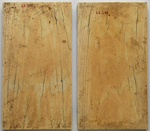
Diptych with scenes of the Nativity, the Crucifixion, and the Last Judgement
RISD Museum and Robert Brinkerhoff
This diptych was intended for private devotional viewing by privileged members of the French court and the Roman Catholic Church. Composed of four arcaded compartments once embellished with gold leaf and colored pigments, it narrates Mary’s role as mother and intercessor. The Annunciation and the Nativity of Christ at lower left face the presentation of the Infant Jesus to gift-bearing Magi. Above, Mary swoons at the Crucifixion, then reappears enthroned to be crowned by Christ. In the final panel at the upper right she kneels beside Christ on Judgment Day as souls arise from tiny sepulchers below. 1275-1325
-
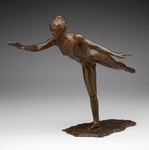
Grand Arabesque, Second Time
RISD Museum, Julie Strandberg, and Jeff Hesser
Transitional poses such as this one were constant themes of Edgar Degas’s numerous sculptural studies made in wax, wire, and plastilene. Collected from his studio following his death, these models became the sources of small editions cast in bronze, including this one of a dancer posed in a grand arabesque. In the classic ballet position, the dancer bends forward while standing on one straight leg, with the opposite arm extended forward and the other arm and leg extended backward. In the 1890s the British artist Walter Sickert visited Degas in his studio and was shown the wax model for this figure. He was struck by Degas’s interest in movement, as he “turned the statuette slowly to show me the successive silhouettes thrown on a white sheet by the light of a candle.” ca. 1885-1890
-
Everyday Aesthetics and Artification
Yuriko Saito
Everyday aesthetics aims to illuminate the rich aesthetic dimensions of our lives that have been neglected in the modern Anglo-American art-centered aesthetic discourse. Artification, a new concept and practice, encourages us to experience various aspects of our lives normally not associated with art or aesthetics, such as business, education, and medical practice, from an artistic viewpoint. Both discourses are helpful in sharpening our aesthetic sensibility and enriching our aesthetic life. However, precisely because the aesthetic dimension of our lives exerts a considerable power in shaping our lives and the world, we need to cultivate aesthetic literacy and a vigilant attitude toward the use of this power. I argue against the indiscriminate and uncritical adoption of artification by exploring the ways in which the artification strategy can undermine the intended purpose and the value of art in a workaday environment and organizational practice.
-
Projective Artistic Design Making and Thinking: the Artification of Design Research
Stephen A.R. Scrivener and Su Zheng
Artification concerns the introduction of artistic ways of thinking and doing into non-art domains, such as business, typically because the host domain recognizes that art has something of value to offer that it does not. However, it is by no means easy to establish exactly what it is that the art actually does offer. In this paper, we approach this question by examining problems encountered in what might be called the “researchification” of artistic design. Following an historical and experiential account of the problematic conjunction of artistic design and research, we conclude that the projective making and thinking strategies of artistic design offer something of value not only to the artification of research but to artification in general.
-
Flows, Vortices, and Counterflows: Artification and Aesthetization in Chiasmatic Motion on a Mobius Ring
Yrjö Sepänmaa
My first question is the general orientation towards the aesthetic and artistic in our culture. Secondly, I deal with intentional and sought-for aestheticization and artification, which are driven particularly by art and aesthetic education. Thirdly, I concentrate on the effects of the change on people and culture, in general, and on art, in particular. The processes of art and the aesthetic have their counter-movements that create tension and dynamics. I characterize the flow pattern as chiasmatic motion taking place on a Möbius ring. Art and the aesthetic are a pair, the parts of which are related to each other through the question of beauty and ugliness. At times art and beauty move apart into invisibility and at times they approach and unite and again branch and divide into their own directions, while the internal protest movements of each simultaneously form chiasmatic relationships. There is neither direction nor stable motion; there are parallels and oppositions, rotations and vortices, faster and slower, arising and vanishing.
-
When is Artification?
Roberta Shapiro and Nathalie Heinich
How do people do or make things that come to be seen as works of art? In other words, when is there artification? The answer to this question is simultaneously symbolic, material, and contextual. It has to do with meanings, objects, interaction, and institutions. We seek to define not what art is nor how it should be considered, but how and under what circumstances it comes about by way of methodical observation and inquiry in a variety of fields. Circus acrobats, break-dancers, fashion designers, chefs, graffiti artists, printers, photographers, and jazz musicians are some of the examples we explore. This pragmatic and empirical perspective enables us to present a typology of forms of artification and examine its sources as well as the questions of de-artification and obstacles to artification.
-
Artification, Fine Art, and the Myth of "the Artist"
Larry Shiner
I begin by examining three concepts of “artification:” the decoration, transformation, and modification. I argue that the typical business argument for artification claims that since businesses must be constantly innovating and since art and artists are the principal locus of creativity in our society, businesses must be “artified.” I argue that these claims about artists and creativity are based on widely accepted conventional views about art and artists that are false. I illustrate my general argument by examining one of the best statements of the case for business artification, Austin’s and Devin’s book, Artful Making, showing that artful making is closer to the idea of craftsmanship than to the modern, post-romantic image of “the artist,” that seems to enthrall so many people. I conclude that when it comes to finding models and metaphors for innovation, businesses and other organizations could better draw on such fields as science, engineering, design, or craft than on the world of high art.
-
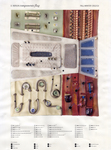
Berlin Elements inspirations Components Flag 11 (description), Trend Fall / Winter 2012/13
Swarovski, Visual + Material Resources, and Fleet Library
-
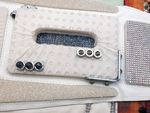
Berlin Elements inspirations Components Flag 11 (detail), Trend Fall / Winter 2012/13
Swarovski, Visual + Material Resources, and Fleet Library
-
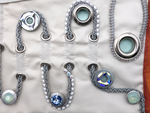
Berlin Elements inspirations Components Flag 11 (detail), Trend Fall / Winter 2012/13
Swarovski, Visual + Material Resources, and Fleet Library
-

Berlin Elements inspirations Components Flag 11 (detail), Trend Fall / Winter 2012/13
Swarovski, Visual + Material Resources, and Fleet Library
-
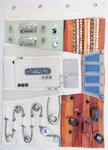
Berlin Elements inspirations Components Flag 11, Trend Fall / Winter 2012/13
Swarovski, Visual + Material Resources, and Fleet Library
-
Berlin Elements inspirations Transfers Flag 10 (description), Trend Fall / Winter 2012/13
Swarovski, Visual + Material Resources, and Fleet Library
-

Berlin Elements inspirations Transfers Flag 10, Trend Fall / Winter 2012/13
Swarovski, Visual + Material Resources, and Fleet Library
-

Berlin Elements inspirations Trend Fall / Winter 2012/13
Swarovski, Visual + Material Resources, and Fleet Library
-
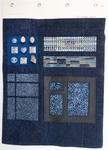
Ceramics & Ceramics Mesh XL, New Effects for Crystal Fabric & Crystal Rocks, Crystaltex Chaton Motives Flag 3, Trends Fall / Winter 2012/13
Swarovski, Visual + Material Resources, and Fleet Library
-
Ceramics & Ceramics Mesh XL, New Effects for Crystal Fabric & Crystal Rocks, Crystaltex Chaton Motives Innovation Flag, Trends Fall / Winter 2012/13
Swarovski, Visual + Material Resources, and Fleet Library
-
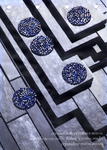
Ceramics & Ceramics Mesh XL, New Effects for Crystal Fabric & Crystal Rocks, Crystaltex Chaton Motives, Trends Fall / Winter 2012/13
Swarovski, Visual + Material Resources, and Fleet Library