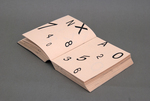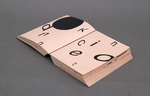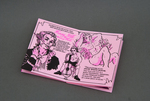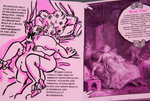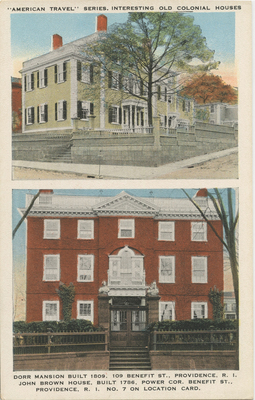
On was an interdisciplinary graduate periodical established by RISD graduate students in 2006. It featured essays and student work that related to a general issue theme. On was intended as a quarterly publication, but it is unclear if further issues beyond the first were ever published.
-

A New Creative Process: The Role of Emotion and the Social Sciences in Design Practice
Steven Faerm and Apparel Design Department
Steven Faerm will discuss how designers in professional practice are evolving the concept of “value” in designed products and systems.
Steven Faerm is an Associate Professor of Fashion at Parsons School of Design. A Parsons alumnus and Designer of the Year Nominee, he has been teaching for over twenty years and is the author of Fashion Design Course: Principles, Practices, and Techniques (3rd edition, 2022), and Creating a Successful Fashion Collection (2012). His work has been translated into nine languages and his scholarly research has been published in leading academic journals and other publications.
-

The evolution of ornament
Charlotte Ngaio Fairless
The Evolution of Ornament is a visual exploration of Darwin’s theory of sexual selection, abstracted into three textile panels representing the allure of textural ornamentation. The fragmented shapes depicted are gathered together into asymmetrical layouts that reference dissection and bird plumage. The parallel themes of glamour in the natural world, and the pulsing vivacity of flora and fauna, emerge as a vehicle for the contemplation of the innate irrationality of desire. The viewer is seduced through neon color palettes, tactile materiality, and considered placement of specifically amorphous shapes. They are intended to simulate in the viewer the reaction of a female bird when presented with a mating display, a kind of visceral attraction to an elaborate presentation that speaks more of intrigue than lust. Knit samples provide a textural complement, with many of the patterns referencing retro futurism and the projected glamour of progress evident in American midcentury design.
-
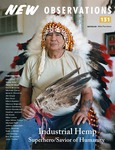
New Observations #131 | Industrial Hemp: Superhero / Savior of Humanity
Mia Feroleto
New Observations is a non-profit, contemporary arts journal written, edited, and published by the arts community. For more information visit newobservations.org.
-
Zoom-out : expansion of pedagogical approaches within moving image education
Thomas Flint
The moving image is arguably the most complex form of expression that we have ever invented. Yet, the degree to which the medium can be taken advantage of throughout its process of creation does not always seem to be grasped within the context of education. Zoom-Out examines the current state of moving image education and how the range of ways in which film can be shaped for the purpose of learning might be further expanded upon. An overview of how standard film industry practices transition into educational settings provides a backdrop for highlighting pedagogical tendencies that point to a reliance on methods of professional film production. Possible reasons for this are advanced, and the need for a greater diversity of pedagogical approaches within the field is argued for through an examination of the author’s own practice as well as those of others. The auto-ethnographic account of the author reveals specific examples of how principles rooted in Japanese philosophical and aesthetic traditions may be utilized in order to provide learners with opportunities for alternative forms of growth and learning. The author concludes that a greater awareness of the affordances of the medium will allow for a wider range of innovative approaches that will help students as well as the art form move forward.
-
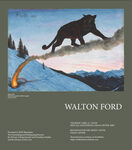
Walton Ford
Walton Ford, Illustration Department, Printmaking Department, Painting Department, Experimental and Foundation Studies Division, and Fine Arts Division
Ford (82 FAV) focuses on beauty and brutality in the natural world and spoke about the importance of establishing a strong point of view.
-
On the edge of being
Zoe Gross
On the Edge of Being represents a focused exploration of clay, craft, femininity, fragility, and self-care. The title is hopeful. It represents a certain radical gentleness with myself and with my work. It reminds me that as hard as I try, there is always room to grow and improve. It is also a bit of a joke with myself; I am rarely satisfied.
I began this body of work as a way of rejoicing in the tamped down impulses of my early artistic career. I wanted to infuse my work with magic: color, texture, pattern, flowers, frills, lace, kitsch and tchotches. In my undergraduate education I felt pressured to make serious artwork befitting serious artists. It was not until graduate school that I began to dismantle this modern aesthetic as based in institutions and pedagogies that I do not ascribe to. Craft, kitsch, ornament, and decoration are frequently looked down on in the art world precisely for the reason that they originate from the feminine. From the other. In this body of work I seek to embrace the feminine to create my own visual language with which I can explore ideas of healing, mental health, trauma, self-care, and empathy.
Primarily, I work in clay. Although I began my ceramic career as a functional potter, I determined early on in my graduate education that I wanted to explore the medium further and branch out into hand built sculptural techniques. After exploring mixed media and works on paper in my first year, I arrived full circle to create purely clay sculptures for my thesis body of work. I wanted to push my medium and myself to the outer limits of what is possible in ceramics.
In this book you will find three short essays and a collection of images from my two years of graduate education. The essays explore my artistic point of view, material and processes, and some of my early and underlying motivations for creating On the Edge of Being
-
Space in between : finding a third space for art education & creative community
Denise Gunter
The arts remain in the shadow of Education’s assumptions: the arts are a subject of skill, a place for the finished product. While counter efforts, both current and past, have been pursued by the field of Art Education to promote art as an everyday tool, the static presence of this regulated pedagogical space makes it difficult to shift art accessibility from the artist to society as a whole. In response, it is certain the field demands a new environment. A space that validates its convictions and passions into something translatable to the masses, so art education may stand alone. In this thesis, I suggest the accessible setting to be a third space. Derived from postcolonial text and spatiality theory, it references a space between what is real and imagined. I propose to find a third space for Art Education and the creative community by turning to the [learning] environments; questioning what the role of a third space might be. Since I arrived in Providence my preliminary studies, from teaching experiences with Project Open Door and CityArts to the fieldwork analysis of the case-study I conducted of a temporary drawing studio within the RISD Museum, have provided visible prototypes of a third space. A term whose multi-modal standing is mostly referenced in the theories of Edward Soja, Maxine Greene, and other scholars expanded upon in the thesis. As the results suggest, a third space creates access to the learning body while refocusing the importance of the arts from “finished product” to the possibilities of creative interaction. Moreover, third space provides a substantiated term through which Art Education can develop a qualitative language of its own; rather than continuing to borrow terms from other fields. In conclusion, art education does not need to stand alone. It needs a gathering space, a third space that enables art to grow. This is the role of a space in between.