On was an interdisciplinary graduate periodical established by RISD graduate students in 2006. It featured essays and student work that related to a general issue theme. On was intended as a quarterly publication, but it is unclear if further issues beyond the first were ever published.
-
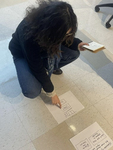
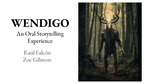
Ideation through Bodystorming for Wendigo
Raul Falcon, Zoe Gilmore, Melisa Achoko Allela, and Movement Lab
-

Oral Storytelling Session for Wendigo
Raul Falcon, Zoe Gilmore, Melisa Achoko Allela, and Movement Lab
-

Call and Response : Experiments in Storytelling
Deanne Fernandes
Being part of RISD's inaugural Masters of Illustration cohort has been an immense honor. This journey has been nothing short of transformative and healing, as it has allowed me to unearth layers of self-discovery through my creative practice.
In my thesis, I introduce a fresh research methodology rooted in the principles of call and response, with adaptability, creativity, and storytelling as its foundational pillars. Through the lenses of visual storytelling, experimental animation, graphic journalism, and fictional world-building, I demonstrate how these techniques can effectively bridge the gap between theory and practice. This dynamic approach fosters meaningful connections among diverse perspectives and lived realities, drawing from my own experiences and academic pursuits.
The narrative unfolds against the backdrop of my journey through academia, marked by moments of upheaval and uncertainty. Through this lens, I showcase the development of the methodology, aiming to embrace the resilience inherent in the experience of being human. My exploration within the Illustration Master's program at RISD serves as a catalyst, where I engage with diverse mediums and techniques, particularly visual methods, to craft narratives that resonate with complex phenomena and stimulate dialogue.
At the heart of my thesis is an exploration of various multi-sensory techniques, including photojournalism, visual storytelling, sound illustration, theatre performance, and participatory art-making. I examine these techniques for their ability to yield rich and nuanced data while prioritizing reflexivity and ethical considerations in arts-based research practice.
Ultimately, my proposed research methodology aims to deepen our understanding of social phenomena and cultivate spaces for collaborative exploration and discovery. By emphasizing adaptability, creativity, and storytelling, this approach offers a responsive framework for researchers to engage with complex issues and diverse perspectives, fostering connections and insights that transcend traditional research paradigms.
-
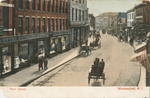
Main Street, Woonsocket, RI
I. F. Flynn, Woonsocket, RI; Visual + Material Resources; and Fleet Library
-
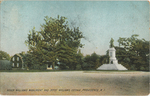
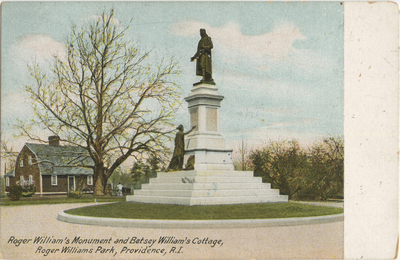
Roger Williams Monument and Betsy Williams Cottage, Providence, RI
F. M. Kirby and Co. (retail), Visual + Material Resources, and Fleet Library
-
Beach Autonomous Zone
Carl Garvey
This thesis project responds to issues surrounding beach erosion on Long Island’s Atlantic Coast by envisioning policy and design decisions that activate a destabilization of the shoreline and a managed retreat away from beaches. Contrasted to methods and goals of conventional coastal engineering, a beach autonomous zone sets an extended, moving setback in which coastlines are treated, in effect, as conservation easements, allowing for and encouraging beaches to return to more natural states. On four sites of different scales representing different built beachfront conditions, I visualize the negotiations between human desires and the needs of a beach that arise under this spatial designation.
My research methodology for this project consists of various strategies performed on and off site including primary strategies like sketching, secondary research such as map making, and research through a process of iterative site plan drawing. The outcome of this is the beginning of a coastal planning approach that balances the beach autonomy with human access and cultural preservation. Though a beach autonomous zone poses staggering logistical challenges, this project serves as a representation of alternative strategies for more sustainable cohabitation with coasts and a starting point for a difficult conversation about choices we face on eroding shores.
-
Thickness of Place: Urban Stratigraphy and Rammed Earth Construction in Cambridge, Massachusetts
Alexandra Goodenough
How can people connect with a place through a new understanding of its stratigraphy? In urban environments, there is an inherent separation between people and the ground beneath us. We experience our landscapes solely through what is visible on the surface, and lack an understanding of the complex underground strata which create the world around us. Too often, landscape architecture contributes to this dissociation through superficial designs which mask the history of a site, bury its internal workings, and rely on global materials, resulting in landscapes which lack a sense of place and strain the planet's resources. In order to create site-specific landscapes which reconnect people to the ground, we must look below the crust and engage with the thickness of a place. Through a careful approach to site analysis, this thesis explores the intricate strata of Danehy Park in Cambridge, Massachusetts, and its recent but forgotten history as a marsh, clay mine, and landfill. The proposed design reimagines the historic boundary of the clay pit as an elevated rammed earth pathway, and carefully carves a stormwater swale and meadow into the deep cap. The new topography, ecology, and materiality invites visitors to form a revisit their relationship with this forgotten edge.
-
Culinary community: Collaborative Relationship Building through Improvisational Fine Dining
Victoria Goodisman
I am redesigning the fine dining experience to create a space for community building and forming new interpersonal bonds. In response to the pandemic, people learned the pressing need for face to face connection. The current landscape of fine dining inadvertently perpetuates isolation by creating a hierarchical dynamic that separates customers from service staff. This project proposes a restaurant where patrons actively participate in creating their dining experience, blurring the lines between customers and staff. By understanding the restaurant experience through the lens of performance and improvisational theater, we can redefine how people engage with this space. Customers collectively assume responsibilities ranging from chef to lighting designer in a designed restaurant space that facilitates and encourages collaboration. By organizing workstations with strategic overlap, customers assigned different roles and responsibilities have to work together and share a space. This shared experience brings new people together, encourages collaboration and creates new relationships.
-
Textile Tectonics: Shaping Space Through Soft Studies
Lela Gunderson
Textile Tectonics: Shaping Space Through Soft Studies challenges the conventional use of fabric as an architectural material, seeking to expand its potential utilization in architectural spaces through re-thinking the partition wall.
Architecturally, textiles tend to exist in tension, attached to a support structure that provides the pliable, planar material a fixed form. The sensory qualities of the material (its ability to filter light and the way it moves in response to outside factors) along with the material’s practical qualities (its light weight, flexibility, and acoustic properties) make textiles a popular choice for architectural spaces—but there is a narrow understanding in practice of how it can be used to reshape existing spaces.
My thesis project seeks to extend the possibilities of fabric’s application in architectural spaces and challenges pre-existing material conventions through the design of a self-supporting fabric partition wall. Design considerations from the micro to macro scale allow for the fabric to begin to act in compression, pushing our understanding of fabric's inherent strength. Considerations from the fabric's weave to the formal expression of the curve impart strength and rigidity onto the soft material through this re-imagined spatial condition.
-
Embodied Abstractions: Identity and Representation in the Digital Era
Srikar Hari
The digital image is a copy in motion. As it accelerates, it deteriorates.
It is a ghost of an image, a preview, a thumbnail, squeezed through
digital connections, resized, uploaded, downloaded, reformatted
and re-edited.
- Adapted from “In defense of the Poor Image” by Hito Steryel
With today’s digital technology, the image is no longer a stable
representation of the world, but a programmable database that
is updated in real time. It is not only part of a program, but it
contains its own operating code: the image is a program in itself.
Consequently, the image’s rhetoric has taken on factual significance:
we increasingly live in a world where images are involved in a
multitude of processes that are hidden behind their appearances on
screen and their so-called “interactivity”.
The intention behind the works presented within this thesis is
to develop processes to experiment with the malleability of our
perception of reality and an unthinking reliance on the solidity of
the photographic image and technologies producing it; creating
works as an intervention to rethink the status of the image and selfidentity
after the digital.
-
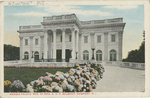
Marble House, Residence of Mrs. O. H. P. Belmont, Newport, RI
Herz Bros., Newport, RI: publisher; Richard Morris Hunt (American architect, 1827-1895); Visual + Material Resources; and Fleet Library
-
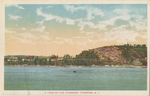
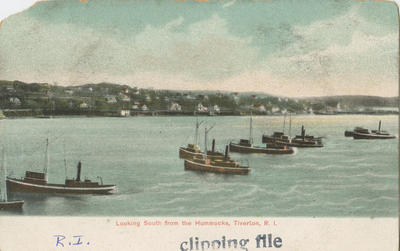
A View of the Hummock, Tiverton, RI
William A. Hodgson, Tiverton, RI; Visual + Material Resources; and Fleet Library
-
Hong Kong’s Architectural Resistance: Practice Through Research
Jingjing Huang
This thesis research politically charged public spaces in Hong Kong due to the past social movements and acknowledges its uniqueness formed by the intuitive use of the vernacular public spaces in the context of both day-to-day life and social movements. The way of freely utilizing elements in public spaces makes the public space in Hong Kong a space to be, a space to express, and a space to resist. However, a unique public space like this often causes misunderstanding, misrepresentation, and sometimes fear from other sides. Thus, this thesis aims to create a subjective analytical view of the formation and usage of HK's public spaces to create a viewport into this case and hopefully inspire future strategies made in social movements.
-
Bilateral Vertical Urbanization
Yifan Huang
Bilateral Vertical Urbanization envisions a bright future for urban development. Metropolises are currently facing the dilemma of dense population, small living area per capita, long commuting times, traffic congestion, and other urban problems. My thesis proposes an innovative urban development strategy, suggesting the redevelopment of underground space resources in cities to improve urban space utilization and help alleviate the crisis of overcrowding. San Francisco, the shining jewel on the West Coast of the United States, is facing this dilemma, as well as the long-term risks of devastating earthquakes and rising sea levels.
My urban planning methodology points out that we can not only adhere to the method of developing the city vertically toward the sky but also create new possibilities for urban development toward the center of the earth. I redefined the ground surface of the city, established new connections between underground space and space currently in the air, and elaborated on the advantages of Bilateral Vertical Urbanization compared to traditional urban development methods. Bilateral Vertical Urbanization can not only improve the population problems of large cities but can provide cities with bonuses, such as preventive measures against earthquakes.
-
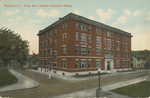
Pawtucket, RI., Young Men's Christian Association Building
Hugh C. Leighton Co., Portland ME: publisher; Visual + Material Resources; and Fleet Library
-
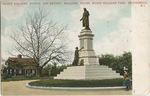
Roger Williams Monument and Betsy Williams Cottage at Roger Williams Park, Providence, RI
Hugh C. Leighton Co., Portland ME: publisher; Visual + Material Resources; and Fleet Library
-
Mixed Race Futurity Through Contemporary Archetypes: Mutants, Cyborgs and Dhampirs
Kobe Jackson
Analysis of Enlightenment philosphes reveals how the contemporary archetypes, mutants, cyborgs and dhampirs may be situated as sources for understanding mixed race positionality. Arranged on a trajectory of hybrid mythology reaching from ancient times into the present day, their contemporary relevance is put into context. Through modern speculative fiction, historical mythology and the theoretical frameworks of sociology, and philosophy, two tropes are revealed to be imposed roles for mixed race people. The first one, the tragic hybrid is a term which references a character specific to the context of American colonial slavery, the tragic mulatto. By reframing the term, tragic hybrid, hybrid archetypes who match similar narrative themes beyond both the 18th and 19th centuries and the Black/White binary are included. The second trope, the extinctionhacker, is a term coined by extending Cultural Studies professor Felecia Rose Caton-Garcia’s recent term, the futurehero. This is a character who not only triumphs above worldly troubles but saves the planet, specifically from mass extinction. These roles represent polar opposite experiences, one demonstrates advantages and hope, the other, conflicts and failure. Finding this binary model to be troubled by its limited range, this thesis traces an epistemology of the concept of the human in Western thought from the Enlightenment through its postmodern criticism to the revitalization of animism within posthumanism. In the contemporary framework of posthumanism, the hybrid figure evolves away from anthropocentrism and the aforementioned binary tropes, through a radical hybrid imaginary and toward a multifaceted, rhizomatic mixed gaze which centers complexity, partiality, mutability and unpredictability.
-
An Abundance of Caution
Gonçalo Preto Jorge
Abstract
An Abundance of Caution
3 puffs and breathing stabilizes...
Must have been the pollen last night.
Quiça
An eerie sense of emptiness takes over
And incidentally
The inability to express and verbalize any articulated thought.
Quiça
I seek sensations...experiences. To indulge.
The fascination with dreamscapes hails from the daunting lack of them.
Poooooxa
I listen, imagine, and process scenarios around me
In a precarious attempt to interpret and translate instances into something meaningful.
Oxalá, Matéria pictórica.
Oxalá.
I see my shadow but only an elusive silhouette
I observe the way it follows the wall and fades into the sidewalk, in tandem with the headlights in traffic.
Meanwhile, celestial bodies wave through the clouds
Nó na garganta
Foda-se!
Esqueci-me da p*#a da roupa...
Eloquence is easier when one speaks little
It acquires its own intonation and volume, but even today I wonder why I don’t speak more.
Outrora fantasma?
Accusations of neutrality and silence are recurrent:
“Breathing doesn’t count”
“Even when you speak you are silent”
Pestanejo,
E respiro fundo.
Afinal, o que é querias dizer?
Quiça
-
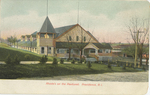
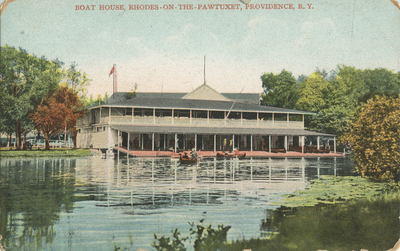
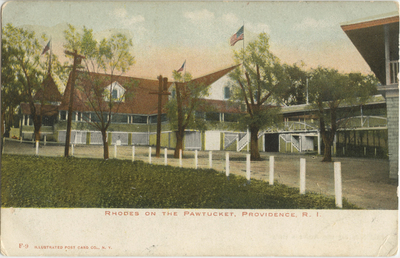
Rhodes on the Pawtuxet, Pawtuxet, RI
Langsdorf and Co., Visual + Material Resources, and Fleet Library