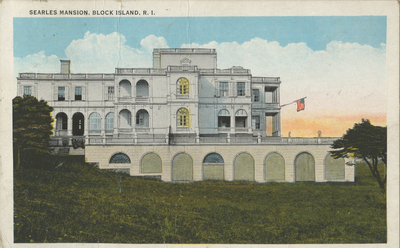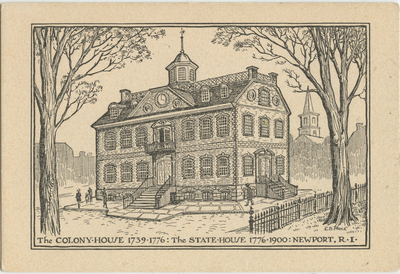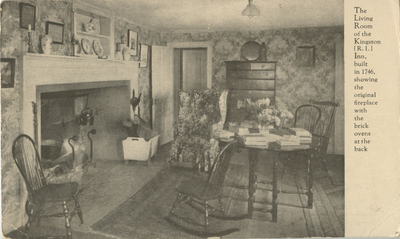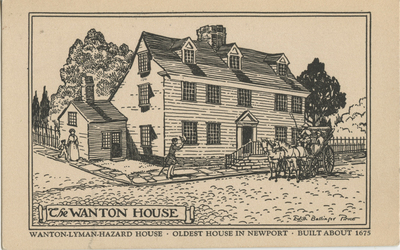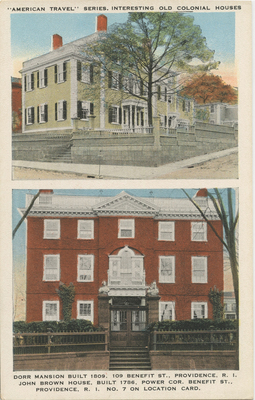
On was an interdisciplinary graduate periodical established by RISD graduate students in 2006. It featured essays and student work that related to a general issue theme. On was intended as a quarterly publication, but it is unclear if further issues beyond the first were ever published.
-
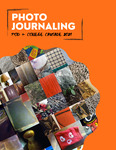
POD + Onward We Learn (College Crusade) Photo Journaling 2021
Project Open Door
Participating artists: Ashley, Claudia, Daniel, Izenia, Jennifer, Keyleth, Musta'an, and Perla.
POD partnered with Onward We Learn (formerly known as College Crusade) to provide unique and engaging virtual summer workshop experiences during the COVID-19 pandemic. In this online workshop, students were given daily photo challenges to create portraits and still life photographs. They found textures, shapes, colors, numbers, and letters through photographic explorations of their familiar surroundings. In doing so, students created an individual photo journal over the week.
Photography is a tool that can help us to “SEE.” What does this mean? If we are not visually impaired, we can, of course, physically see. But how much do we miss seeing? How much do we take for granted unless we take the time to look? With assignments that hope to inspire careful observation, we can use the camera to observe things in our familiar surroundings in quite extraordinary ways. Photography can help us become more observant and help us have a fulfilling visual life. During this time of limited mobility due to the Covid-19 pandemic, finding creativity close to home is an essential part of a healthy balanced life.
-
Spring Session Exhibition 2021
Project Open Door and Teaching + Learning in Art + Design Department
Our Spring Session Saturday Portfolio Program Exhibition features artwork from our two classes offered this semester, On My Block: Small Scale Printmaking and Things That Surround Us: Sculpture.
-
Winter Session Exhibition 2021
Project Open Door and Teaching + Learning in Art + Design Department
Our Winter Session Program Exhibition features artwork from our four classes offered this semester, Character Animation, Character Design 101, Pen + Ink, and Portrait Painting.
-

Regeneration with Shey Rivera
Shey Rivera and Edna W. Lawrence Nature Lab
January 28 hosted the fourth conversation in the Regeneration series with Shey Rivera Ríos, an interdisciplinary artist, cultural strategist, and arts administrator. Take a look at this document with resources that were mentioned during the conversation to further your learning.
During their conversation, Shey emphasized how artists have the unique opportunity to shape our futures and impact policy through creative expression and collaboration. By telling historically censored stories, artists can help dismantle systemic oppression and nurture regeneration by creating diverse narratives that transform communities.
Shey’s projects epitomize this and the regenerative power of social and research based art practices. They shared how FANTASY ISLAND, a transmedia story about Puerto Rico, served as an anchor to build civic engagement around how selling a "fantastical" luxury lifestyle twists humanitarian crises into “opportunity.” With their project Stormwater, a mixed-media installation piece in Olneyville, Providence, RI, Shey aimed to bring awareness to the environmental issue of storm runoff in urban settings. These are only a few of the many ways that Shey merges their creative practice with social action.
When discussing the social responsibility that we carry as creators and thinkers, Shey asked, “What are the futures that you are pushing for when you create art? Who is your art speaking to? How can your art stop perpetuating harm and systems of oppression?” As creatives, we need to address these questions and develop a culture of care taking within our communities and collaborations. In speaking more on the transformative power of art, Shey said that “art can reimagine what monuments look like, rewrite histories that we’ve been carrying that no longer serve us, [and challenge] the singular narrative… We [can] expand our own brains and challenge our society to think outside the box.”
We each have agency and we can collectively use our voices to improve our shared futures. It takes emotional energy to create the spaces that heal us and speak to our authenticity. As we work towards this and aim to improve the next decade, take Shey’s words to heart: “Show appreciation to yourself….[and] create narratives that heal you.”
-
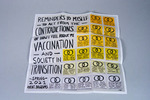
Reminders to myself : to act from the contradictions of how I feel about my vaccination, and, society in transition
Rachael Schragis, Special Collections, and Fleet Library
1 poster. "Spring 2021 event diagram" A series of post-it notes with contradictions related to the COVID-19 Pandemic and vaccination. Offset printing.
-
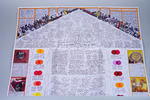
Understanding antisemitism : an analysis-in-process by Jews for Racial & Economic Justice (JFREJ): a grassroots, membership-based organization in New York City
Rachael Schragis, Rebecca Katz, Erin Brownstein McElroy, Audrey Sasson, Jews for Racial & Economic Justice, Special Collections, and Fleet Library
1 poster : illustrations (black & white and color). Starting in 2018 and into early 2021, more than 70 JFREJ members participated in a cultural organizing project to understand, struggle against, and imagine a world free from antisemitism. JFREJ members and artists Rachel Schragis and Rebecca Katz facilitated this process, which involved JFREJers of all ages and backgrounds, including members of our Mizrahi & Sephardi, Jews of Color, and Poor & Working Class Caucuses. A 40-page pamphlet on the subject by JFREJ was produced to accompany the poster. Library does not have the pamphlet. Offset printing. Flowchart. Gift of Angela DiVeglia.
-
Synthetic undulation: improving the marine life quality on the Indonesian island of Seleyar
Shreeyaa Shah
Beginning with a study on the properties and properties of plastic, this thesis examines perspectives and experiences of coastal communities forced to deal with overwhelming quantities of plastic pollution in their waters. With a focus on Indonesia, the second largest plastic polluter in the world, the study examines Selayar island’s vernacular ways of being and making as a possible way to understand and deal with the problems affecting their local marine health. Through different research methods, a complex set of factors are identified besides plastic pollution, including the decline in farming and practices that contribute to overfishing.
Through design investigation, three types of aid operating at distinct timescales are proposed in triangulation – immediate, continuous, and long term. These strategies include dealing with plastic, integrating land and water-based practices, and proposing alternative material uses to plastic. The thesis suggests that without access to biodegradable, environmentally friendly products, and a more circular system to deal with plastic utilization and pollution, coastal communities and surrounding marine ecosystems will continue to be inundated in plastic waste.
-
Oral History Transcript | Interview with Rosanne Somerson, June 10, 2021
Rosanne Somerson, Andrew Martinez, and RISD Archives
-
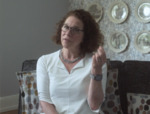
Oral History Interview with Rosanne Somerson, June 10, 2021
Rosanne Somerson, Andrew Martinez, RISD Archives, and Josephine Sittenfeld
Interview of Rosanne Somerson conducted by Andrew Martinez at the President's House at 132 Bowen Street in Providence, RI on June 10, 2021. Somerson speaks of her time in Denmark and her interest in photography as a high school student, leading to her working with Tage Frid as a student at RISD. Somerson also recalls working as a provost for RISD and establishing the Furniture Design department due to her struggles with the Industrial Design and Sculpture departments as a student. Along with this, Somerson discusses her many successes as president of RISD, including plans such as the Social Equity and Inclusion Plan and her goals in fundraising and sustainability.
-
Ritualizing of space in the 21st century: fostering of communal identity through celebration of Tamil culture
Mridula Swaminathan
South India is known for its traditional belief systems and the numerous architectural manifestations of these beliefs. The scale and extravagance of temples and the palaces for the kings are an example of how important culture and ritual were in the past. Now some of these structures, such as the Thirumalai Nayakar Palace in the city of Madurai, the cultural capital of Tamil Nadu, stand in a modified societal context with no cultural or ritualized significance. Moreover, the host of this project, the Thirumalai Nayakar Mahal, situated in a city brimming with multiple sacred rituals performed along the city streets, characteristic of the city and state culture. The Tamil language forms a major part of this culture. Tamil Sangam, which were literary academies or corpus at which Tamil scholars discussed and recited Tamil poetry and other literary works, have played a pivotal role in the retainment of this unique culture. Analyzing the relevance and basis of the city’s sacred rituals provides a more nuanced understanding of the local culture and traditions of the society. Using basic elements of space management such as circulation, wayfinding and distinction of character of space, a new urban space can be created within the palace grounds to give a contemporary order and meaning to people using the host structure.
This thesis is a study of how societies with strong existing culture and sacred rituals can dictate the design of spaces inspired by the values rituals bring to life. The adaptive reuse of this space will demonstrate how history, culture and existing traditions can be used as materials to re-engage the public with a historic host structure. The Thirumalai Nayakar Palace will be adapted to the new context by spatially incorporating the essence of the existing sacred rituals and bring the community together through the common thread of Tamil Culture. Adapting these spatial cues will help create a space for all visitors that brings the people of Madurai together, creating a center for Tamil Culture through the celebration of the literature and the palace’s architecture itself.
-
Community steward of the deep bay: staging Lau Fau Shan for resiliency through collective participation
Lauren Tam
This thesis explores tensions of utopian ideals through the lens of stakeholders living and working in the Deep Bay coastal region of Hong Kong, Using Lau Fau Shan as my case study, I have worked on ways to build socio-ecological resilience through bottom-up strategies of community engagement through first hand experience of interacting with a local oyster farmer. In understanding how the different forces of climate change and development pressures are currently impacting the community and the daily workings of the fishing community, my goal is to demonstrate how design can advocate for the importance of community driven strategies to design for resilience. Design strategies developed include flexible and multifunctional systems such as market networks and elevated oyster-mud bunds that work for both the fishermen and tourists.
-
Sensory refreshment: TCM reconsidered
Ni Tang
With the rapid development and expansion of our cities and the economic demand placed on residents, city dwellers are under more personal stress than ever. Long commutes, overtime work, irregular rest, unhealthy diets, urban pollution and noise all adversely impact wellbeing. These unhealthy conditions overwhelm the mind and make residents mentally and physically sub-healthy. Sub-health is a state between complete health and sickness, which is especially common in large cities. The sub-health rate in Shanghai and Beijing has reached more than 70%.
Chinese medicine can regulate the human body from a holistic perspective and help solve sub-health problems. Chinese medicine refreshes the human body by sensory experience. The environment and atmosphere of the traditional Chinese dispensary are similar to those of ordinary hospitals: serious, calm and rational. These characteristics don’t encourage a good experience, and even bring some further psychological pressure to adjust to the sub-health problem. This thesis proposes a Chinese medicine center to facilitate people’s understanding of TCM using multiple senses, through immersive experiences.
The host site for this TCM rest center is the Shanghai Botanical Garden, which is distinctly separate from the external urban landscape in order to create a relaxing setting to readjust your perspective and learn about TCM.
At the urban scale, Shanghai's subway system serves as a network connecting the entire city. People in Shanghai spend 40 minutes commuting to work every day. The broad ambition of this thesis is to incorporate the healing and relaxing elements of traditional Chinese medicine, such as aroma, into part of the subway system. City dwellers can temporarily escape from the high-paced urban city and be refreshed and healed, through both active engagement with a Traditional Chinese Medicine center and passively as they go through the work day.
-
Reconstructing property, borders, and sites: nestling the built
Christina Truwit
The built environment is built for resilience. It is curated to have prominence over natural systems, formulated to withstand, and rebuilt to withstand, once ruined. The power of the biosphere is subverted, however, building to protect against nature undermines opportunities within natural systems to protect us.
My thesis is focusing on the problems at play with property and our pressing climate issues. I will be looking at what opportunities exist to deprioritize owned property, to allow for a dispersal of stewardship, and acknowledgment of natural systems.
-
I think we have some connection difficulty: a review of architectural vocabulary and representation in our condition of remote communication
David Waite
The distance required to slow this pandemic created a need for Zoom technology in maintaining our economies of mental production and social closeness. Just like scientists examined the COVID-19 virus globally in its petri under the electron microscope, Zoom exposed our domestic interiors. This platform stitched together our personal existence into an infinite interior. To some extent this places Zoom attendees into a new space of vulnerability where the platform turns passive observers into active participants in a hyper self-aware virtual world where all are forced to share their fragile environments of everyday life.
While videotelephony software thankfully facilitated communication beyond just language, we lost the connectedness of a myriad of stereo sensations such as time, touch, gesture, and context. . . Using the architectural tools of drawings, scans, probes, and models at varying scales, one may better connect spatially their own space and empathize with other distant rooms.
This thesis proposes an addendum to the architectural discipline’s forms of representation and language in the framework of this past year’s spaciotemporal condition. A reexamination of vocabulary and representation may provide a model of how to curate our spaces for more empathetic connectedness.
-
Counting pebbles wasn't even a class in high school: seeing visual arts education through a process-forward lens
Em Xiangning Wang
This thesis explores process-forward visual arts education in the Greater Providence arts education community. The researcher conducted interviews with arts educators as well as administrators working within organizations guided by a “process-forward” philosophy. Interview transcripts are analyzed to identify any emergent themes of intended and actualized student learning outcomes as well as other commonalities which exist among the interviewed organizations. This investigation found that, within these organizations, multiple, significant forms of student learning outcomes were identified that extended well beyond any particular aesthetic merits of the artistic products created by students
The author calls, in this thesis, for a recalibration and expansion of existing methods of assessing visual arts learning in order to take greater account of process-forward learning outcomes, which will, the author argues, provide a much more comprehensive view of what students gain through engaging in the visual arts.
-
Across the boundary: addressing segregation along transportation infrastructure
Ruochen Wang
Across the United States, we can see examples of cities where highways and railways pass between two ethnic communities or through communities of color and are used to further divide and segregate cities. Increasingly we are seeing a new typology of landscape architecture projects to transform, redesign, or remove transportation infrastructure to help ameliorate the negative impact of transportation infrastructure on neighboring communities and support public uses. However, these projects often lead to gentrification, whereby surrounding housing prices rise, and the original residents are displaced or lose their sense of belonging. The goal of my research is to understand how landscape architects are redesigning transportation infrastructure to address divisions within cities, as well as possible ways to prevent and address issues of gentrification. Eventually making benefits to community members and enhances their understanding and communication between each other. After study of examples of landscape projects reusing transportation infrastructure in several North American cities, design principles, guidelines and toolkits are developed to guide the similar types of design. Finally, these are teste on a site of Providence city which has a long segregation history due to the construction of the I-95 corridor. New community gardens, terrace lawn, gathering plaza, small business programs are working together to make a strong link for the long divided surrounding neighborhoods.
-
Dead space: the changing discourse of death: how to design a contemporary and enduring funeral practice
Xin Wang
My thesis seeks to design my grandfather’s cemetery to regain a piece of my personal memory. It also seeks to situate this issue in the contemporary context of the pandemic, which helped inspire my topic. I started my thesis in a very turbulent year. I found myself missing family members far away on the other side of the earth.
How are they doing now?
I suddenly missed my Grandfather’s village, which I had only visited once a year prior to the great pandemic. My Grandfather passed away when I was very young. I get along well with my Grandmother, but I rarely hear the story of my Grandfather from my Grandmother, and his photos have always hung on the wall of the living room, which conspicuously reminds me of his look. Maybe my Grandmother misses him the same way. When I went back, that photo was no longer there.
Does that mean this memory over?
I didn't remember my Grandfather’s Cemetery because I only participated in his funeral ceremony. The news broadcasts that public cemetery prices are getting higher and higher. Can the pain of losing a loved one be measured by money? No one really mentioned this pain. I started to reflect and decided I want to tell this story by rebuilding my Grandfather's cemetery.
-
Regional food self sufficiency: new visions for productive landscapes
Yiling Wang
Food is an important resource for the survival and development of civilization. Its potential is so huge that it affects physical and mental health in an individual sense, and it affects landscapes and even public relations in a social sense. For most people, having food is never a problem that the importance of food is overlooked. However, the right to food is not equal. There are still a considerable number of people have low food access, which means…, and they may also be forced to be in an unbalanced diet leading to health problems such as obesity. A large amount of food and the resources used to produce food are wasted, and unsustainable production methods cause the deterioration of the production environment are problems that need to be solved urgently.
I believe it’s time to reimagine the role of food in our daily lives in terms of new ways of people participating in productive landscapes. Those landscapes can have a primary function as food production as well as secondary and even tertiary functions for example being places for public activities and education. Productive landscapes have have way more possibilities as long as we can give full play to our creativity.
In the thesis I’m going to explore the possibility of food self-sufficiency in order to shift people’s visions and engagements with productive landscapes using New Bedford region as the test ground. During the design process, there will be new transformations of land based on calculated data. Those types of land will be multi-functional combining food production, environmental justice and human engagement together.
-
Wandering land: landscape on space station
Xin Wen
When the exploration of the universe and the colonization of the universe are getting more and more attention, this thesis book focuses on the question of “What role will landscape play in space resettlement?”, and conducts research and design based on this, trying to explore the possible landscape attempts and experiences on space stations in the future.
This thesis starts with the background research of space habitats and clarifies the definition and advantages of the space station landscape. And through the study of the physical models of the future space station, Stanford Torus was selected as the subsequent design site. The research and analysis of Stanford Torus helps to define the characteristics of its landscape system. In this highly artificial space, what will we bring from the earth’s nature? When simulated gravity coexists with low gravity or even zero gravity, what does the universe inject into the landscape we created? I worked on these questions and described the landscape travel through gravity change in the space station habitat by design. Meanwhile, this thesis book also leaves some room for reflection on the landscape of the space habitat. After experiencing the landscape from the earth to space, what will the future landscape that is entirely based on space be? What have we lost that is unique to earth?
-
Ecotourism in vacationland: shoreline development and economic inclusion on the Southern Maine coastline
Quinn Christopher Wilcox
The tourist economy in Maine, while profitable, has been a catalyst for the removal of local communities on the coast through the privatization of ecosystem services. Inclusive master planning that reconnects Maine’s coastline to its upland areas in the southern beach region will restore a lost local and working class identity. This proposal enables year-round and flexible programming and stewardship of the natural environment, and challenges the current model of commodification of a landscape and its people. Furthermore, celebration of the right of way to ecological systems and development of supporting markets for both the working and playing communities of the vacation landscape benefits the modernization of the Maine identity and diversification of its labor force. Maine’s economy in the past relied heavily on timber harvest and manufacturing for paper, an industry that existed within the Arcadian image. In the late-1970’s Maine pivoted toward a tourism, hospitality and real estate centric system.;An 11.5 billion dollar industry that operates only six months out of the year. As a result Maine density has moved to an aging and unaffordable southern coastlines with relatively little economic activity generated in the center or northern areas of the state. Out-of-state ownership has led to part-time communities and the polarization of the working and leisure populations. Southern Coastal towns like York, Kennebunk, and Ogunquit are unable to execute comprehensive master planning that seeks to stabilize yearround communities in the face of annual winter abandonment. The beach community of Wells is one such center for tourism where coexistence between the two communities’ use of the surrounding natural and built environments would create a model of holism in a seasonal city typology.
Tertiary strategies that work in tandem with architectural intervention to unbind the privatization of public resources are coastal devaluation models, creation of conservation easements, and mixed use zoning. Additionally, coastal categorization as vulnerable to climate change and past developmental negligence limit the use of a landscape and should be challenged by building more responsibility and with appropriate materiality. The architect’s role in the seasonal city is to facilitate the relationship between the people who use the built environment and instances of shared experience to nature for all. The institution of perpendicular community programming repairs the delamination of the Maine coastline and restoration of agency on the shore for both the tourists and the working class.
-
Material Encounters: Making Memory Beyond the Mind
Ariel Wills
Can acts of making carry the memories of our embeddedness within the world? This thesis explores how making things can nurture a sense of kinship that cuts across the organic and inorganic, erasing the distinction between living and dead, material and spiritual. Through handwork such as art-making, sewing, knitting, cooking, woodworking, and beyond, the burden of remembering and of archiving is shared across human and non-human bodies, cultivated through practices of making, and through the materials themselves. By recounting the stories of my family’s experience as Jewish immigrants in the United States, I aim to reveal how their domestic practices of making allowed them to make memory tangible and curb the experience of loss. In these encounters, maker and material interact in communication. Their collective dialogue serves not only to remember the past but to remake memories for the future. By identifying such modes of memory-making beyond the mind, I challenge the purely psychological models of memory and the modern division between mind and body on which they rest. As such, this thesis is both a personal account and an invitation to acknowledge our deep and inherent kinship with the material world.
-
Everyone I have every crowed with 2021-
Hannah Lutz Winkler
I started taking walks at sunset to feel better. It was January of 2021, nearly a year into the COVID pandemic. On these antidepressant walks, I kept running into crows, participating in their own sunset ritual, hundreds of them in a raucous shimmering black net. They flew around the city, my hometown, gathering, gossiping, and ultimately sleeping together in trees. I was both intoxicated by and jealous of the nightly crow party—standing under them was my only crowd experience in nine months. For the next three months, I tracked them every night I could. My solo practice of paying the crows attention grew into a participatory art project. The 50 human participants were my community in Providence: my classmates, partner, students, professors, mother, childhood friends. I had the urge to share the crow crowd with my crowd, keeping the parameters of human engagement loose enough to leave room for chaos, refusal, or play. Each walk was different: the crows took a different route, the weather changed. I invited the more performative humans to bring something to share: a poem, a song, a dance, a ritual. I shot video and wrote journal entries documenting each night’s quest. In this thesis book, I have modified my journal to tell you the story of the project, which began with these participatory walks and developed into a video installation. You will get to know the humans and crows whose labor, play, and care intermingled to make the piece. I will bring you into the mess and joy of making work about non-human animals as a human—and the complications, limits, and possibilities brought up by paying close attention to specific communities of crows and humans.
-
Sculpture and its Meaning in the Context of Berleant’s Aesthetic Engagement
Anna Wolińska
It is not my intention to provide a comprehensive analysis of Berleant’s notion of aesthetic engagement. My goal is modest. I hope to account for the key significance of the philosophical problematization of sculpture, in the context of engaged aesthetics. In writing about the philosophical problematization of sculpture, I am thinking most of all about the problem of space, a phenomenon that emerges in the relationship of the solid form to its surroundings. It is a relationship that is usually perceived as directly connected with the sculpture. I want to emphasize that Alicja Kuczyńska was well aware of the significance of this problem. She expresses this awareness discretely and indirectly by taking up the problem of space and sculpture, in the context of Brâncuși in her essay in this special volume on Berleant’s aesthetics, “Berleant’s Phenomenology of Sculptural Space: Brâncuşi.” Kuczyńska’s interpretation goes beyond the topics taken up by Berleant in his essay on Brâncuşi but is consistent with his way of thinking about the relationship of a specific volume to its surrounding space and to movement.