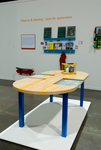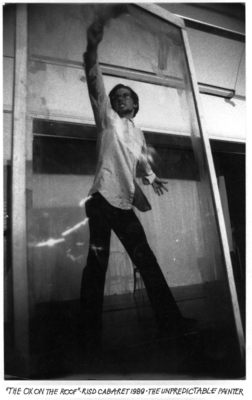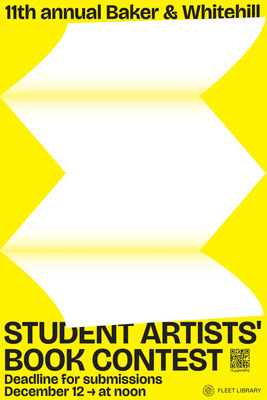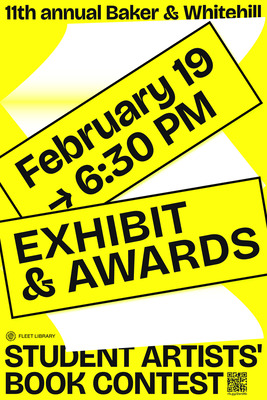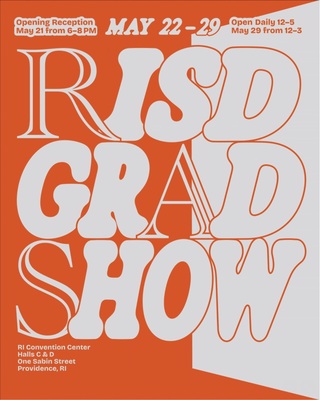
On was an interdisciplinary graduate periodical established by RISD graduate students in 2006. It featured essays and student work that related to a general issue theme. On was intended as a quarterly publication, but it is unclear if further issues beyond the first were ever published.
-
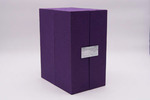
Visionaire 55: Surprise
Stephan Gan, Cecilia Dean, James Kaliardos, and Greg Foley
11 volumes : chiefly color illustrations,+ 1 advertiser's insert. Books with pop-up illustrations and movable tabs designed by various artists. Title and author information from book covers. Housed in box 29 x 23 x 16 cm. Limited edition of 4000 numbered copies. CONTENTS: [volume 1]. Pyongyang; Pyongyang II, diptychon / Andreas Gursky -- [v. 2]. Head on / Cai Guo-Qiang -- [v. 3]. [Untitled] / Steven Klein -- [v. 4]. Les seins miraculeux / Sophie Calle -- [v. 5]. [Untitled] / Mario Testino -- [v. 6]. The passing winter / Yayoi Kusama -- [v. 7]. [Untitled] / Alasdair McLellan -- [v. 8]. Naomi / Sølve Sundsbø -- [v. 9]. [Untitled] / Gareth Pugh Witch, Gary Card & Nicola Formichetti -- [v. 10.]. [Untitled] / Steven Meisel -- [v. 11]. [Untitled] / Guido Mocafico. "Visionaire issues often find their origins in commercial publishing techniques like lenticulars and flip-books, then elevate them to new artistic heights. Issue 55, SURPRISE, reimagined the children's pop-up book by adapting work from artists like Yayoi Kusama, Andreas Gursky, Cai Guo-Qiang, Sophie Calle, Steven Klein, and Steven Meisel into three-dimensional paper sculptures. To execute the mind-bogglingly complex pop-ups, Visionaire called on renowned paper engineer Bruce Foster, who shared his infinite wisdom. "Many of these techniques had never been done before," says Foster. "So each one was challenging in its own way"." -- From visionaireworld.com. A collaboration with the Champagne house, Krug.
-
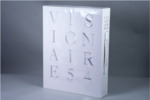
Visionaire 54: Sport Lacoste
Stephan Gan, Cecilia Dean, James Kaliardos, Greg Foley, and Chemise Lacoste
4 parts in case : color illustrations Title from title page of attached text. "A collaboration with Lacoste in celebration of their 75th anniversary." Each case contains three polo shirts (1 small, 1 medium, 1 large) with photographically-printed designs by different artists. Each case also contains three attached boxes (each with a shirt inside) and [28] pages of attached text at end. Limited edition of 4000. Set 1. Nick Knight, Karl Lagerfeld, Michael Stipe. -- Set 2. Inez van Lamsweerde & Vinoodh Matadin with M/M (Paris), Thomas Demand, David Byrne. -- Set 3. Peter Lindbergh, Thomas Ruff, Pedro Almodóvar. -- Set 4. Richard Phillips, T.J. Wilcox, Phil Poynter. Library has edition 65 of Volume 1 ; edition 6 of Volume 2 ; edition 63 of Volume 3 ; edition 64 of Volume 4. Publication labels for each volume were saved and mounted on archival paper and laid-in each volume. Gift of Greg E. Foley, RISD Alumnus 1991 AP.
"Visionaire 54 SPORT celebrates the 75th anniversary of Lacoste, using the polo shirt as an artist’s canvas to create the first-ever wearable publication. Realized in full-color, full-coverage photographic printing, the polo shirts in 54 SPORT featured eye-popping artworks by Nick Knight, David Byrne, and Thomas Ruff, just to name a few. For a polo shirt that reinterpreted vintage posters of Pedro Almodóvar movies, art director Juan Gatti took inspiration from the street. “I tore actual posters and then we took a picture for the polo shirt,” he said. For artist Richard Phillips, SPORT captured his process from start to finish. “The shirt became a physical representation of the complete creative process.” This edition is comprised of 4 Volumes sold together as one edition. Each volume contains 3 different artist-printed Lacoste polo shirts. Volumes are as follows: VOLUME 1: Michael Stipe Size Small, Karl Lagerfeld Size Medium, Nick Knight Size Large VOLUME 2: Thomas Demand Size Small, David Byrne Size Medium, Inez and Vinhoodh Size Large VOLUME 3: Pedro Almodovar Size Small, Tomas Ruff Size Medium, Peter Lindbergh featuring Linda Evangelista and Kirsten Owen Size Large VOLUME 4: Phil Poynter Size Small, TJ Wilcox Size Medium, Richard Phillips featuring Coco Rocha Size Large" -- publsiher's website https://visionaireworld.com
-
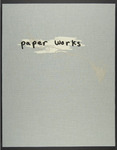
Paper Works: a play on the possibilities of a piece of paper
Jennifer Grimyser, Special Collections, and Fleet Library
portfolio with loose plates; cover; title page inside portfolio; title page; interior pages. A playful look at things you can do with a piece of paper.
-
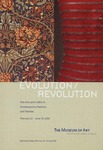
Evolution/Revolution: The Arts and Crafts in Contemporary Fashion and Textiles
Joanne Dolan Ingersoll and Amy Pickworth, Editor
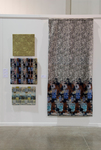
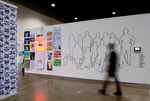
Exhibition Notes, Number 28, Spring 2008. Evolution/Revolution brings together the textile work of designers from the U.S., Britain, Europe, South and Central America, and Japan, and draws philosophical parallels between these contemporary artists and those of the Arts and Crafts Movement of 19th-century Britain.The exhibition is organized around the themes of Storytelling, Experimentation and Materials, Collaboration, and Art and Life—key ideas that spring from the Arts and Crafts spirit.
One of the most widely influential art and design movements of the 19th and 20th centuries, the Arts and Crafts Movement was an aesthetic and political response to a world stripped of meaning by the Industrial Revolution. It sought to right this wrong by championing beauty and truth in everyday objects, and in the process profoundly changed architecture and the decorative arts. Members of the movement were especially appalled by the inhumane work conditions created by the factory system. By celebrating the honesty and authenticity of hand work and the traditional arts, they sought to reconnect the makers and users of objects through a more holistic approach to work itself. The movement offered a model for reform; work would be more meaningful if factories did not dominate production, and life would be better if cheap machine-made goods were replaced by objects that were carefully designed and crafted. The movement, abhorred badly designed goods but did not necessarily reject technology out of hand. Rather, it sought to use it in ways that facilitated, rather than fragmented, the process of making.
Arts and Crafts philosophy has continued to influence new generations, as we see in the work of the contemporary artists and designers of Evolution/Revolution. Like their predecessors, these new designers grapple with mass production and consumerism. Using state-of-the-art technology as well as traditional methods, they are redefining what “handmade" means. By developing humane and ingenious solutions to contemporary problems such as sustainability and cultural preservation, they, like the Arts and Crafts artists of the 19th century, are the creators of a new tradition.
-
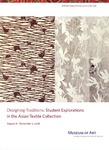
Designing Traditions: Student Explorations in the Asian Textile Collection
Kate Irvin, Laurie Anne Brewer, and Anais Missakian
Exhibition Notes, Number 32,Summer 2008. RISD’s newest generation of textile designers source the RISD Museum’s vast Asian textile collection in this popular collaborative project and biennial exhibition. Traditional craftsmanship sparks contemporary creativity as objects inspire innovative new textiles and garments.
-

The Friends of Jones' Paintings: A Case of Explanation in the Republic of Art
Graham McFee
All too often the agenda for discussion of institutional accounts of art has been set by George Dickie's (putative) institutional definition of art. To offer a new beginning, the paper addresses the question of explanation with an institutional framework modeled as Terry Diffey’s Republic of Art. In exploring the argumentative resources here, it meets the objection that institutionalism cannot explore the case of so-called ‘first art’: objects created before the concept art came into being. In particular, the paper uses an example to consider how disputes within the Republic might be resolved through rational means, while still maintaining the institutional character of such discussions. For we need not assume that institutionalism has no mechanisms for rational self-correction nor that one, timeless resolution is always possible. Instead, we can find rational activity in the disputes among art critics, as well as contrasting their (broadly contemporary) perspective on the case with the detachment of the (philosophical) aesthetician.
-

Oral History Interview with Thomas (Tom) Lyon Mills, May 5, 2008
Thomas (Tom) Lyon Mills, Andrew Martinez, and RISD Archives
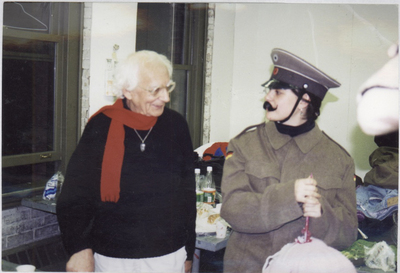
Interview of Thomas (Tom) Lyon Mills, conducted by Andrew Martinez in Mills' home and studio in Providence, RI on May 5, 2008 for European Honors Program (EHP) documentation. Mills speaks of his time as a chief critic for RISD's European Honors Program in Rome and his relationship with director Ezio Genovesi. Mills also recalls the different locations in Rome he visited with students and tells stories about their experiences. Along with this, Mills shows his paintings and discusses working in isolated spaces like the Catacombs in Rome.
-
Oral History Transcript | Interview with Thomas (Tom) Lyon Mills, May 5, 2008
Thomas (Tom) Lyon Mills, Andrew Martinez, RISD Archives, and Peter O'Neill
-
Bernoulli Equation for unsteady potential flow
Amandine Nabarra-Piomelli, Special Collections, and Fleet Library
1 sewn book in slipcase. Title from colophon. Edition of 40 numbered and signed copies. Bernoulli's equation for unsteady potential flow in Greek symbols above title on colophon and on first leaf. "This book visually and tactilely mimics the action of a body in water. The Bernoulli equation for unsteady potential flow (named for Daniel Bernoulli, 18th-century Dutch-Swiss mathematician is used, among other places, in the theory of ocean surface waves and acoustics."--Artist's website. Artist's book by Amandine Nabarra-Piomelli, comprised of a sequence of strips of photos which represents the nature and meaning of water, traditionally associated with the qualities of emotion and intuition. Book is constructed in a palm leaf structure, sewn with thread through the body of the book, intended to be manipulated to allow pages to fall. The wavy patterns of each strip, as well as the book as a whole when extended, suggest the flow of waves on the surface of the ocean, described in mathematical theory by Bernoulli's equation for unsteady potential flow. "Digital pigment prints on Epson Premium Luster Paper, 2008"--Colophon. "A nine photo series of bodies in water that when held in a hand can flow in the other or can behave like waves"--Artist's statement from Vamp & Tramp, Booksellers, website. In box (29 x 18 x 4.5 cm), green paper throughout, magnetized closing-clasp. Box has equation printed on cover.
-
Senior Thesis Collections
Rhode Island School of Design
PLEASE NOTE: Where applicable, the audio has been removed from this file due to copyrighted material.
The garments shown here were created in response to the Senior Thesis design challenge: create a complete collection that reflects your philosophy or the essence of your personal vision.
-
A Silent Rhetoric: The Mechanism of Propaganda as Persuasion
Ken-ichi Sasaki
Under ongoing globalization the particularity of cultures has become a major topic in contemporary aesthetics. Someone insists on the right of national culture against globalism, others wish to bridge cultures.[1] Apparently opposing one another, they share the same gaze on the individual character of every culture. To confirm or transcend our cultural or national affiliation through art there exists the common dimension of aesthetic persuasion: that is the subject of this paper.
-
Activist Compnents Flag 13 (description), Trend Fall / Winter 2008/09
Swarovski, Visual + Material Resources, and Fleet Library