On was an interdisciplinary graduate periodical established by RISD graduate students in 2006. It featured essays and student work that related to a general issue theme. On was intended as a quarterly publication, but it is unclear if further issues beyond the first were ever published.
-

Lunar Calculations
Katherine Venturelli, Special Collections, and Fleet Library
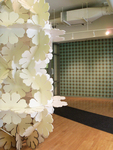
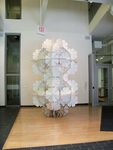
3 folded sheets. Publication information from Vamp & Tramp Booksellers website. Variable edition of 5. "Three Turkish map folds. A three-dimensional celestial map intaglio printed on white Lenox print papers. Bound in black linen book cloth over boards. Embossed circle on boards. Cord loop on each board to facilitate hanging"--Vamp & Tramp Booksellers website (accessed November 8, 2016). "Lunar Calculations is a book which opens up into a three-dimensional celestial map. My etched imagery printed on the interiors and exteriors of the pop out pages are lunar phases and mathematical symbols which are archetypal symbols that I have utilized in my on-going work. The book can be displayed by hanging it from the ceiling or on a wall. I selected the Turkish map fold/pop out format for two reasons. One, it enables the lunar and mathematical imagery to be viewed as if it were a celestial map, and two, the pop-out structure element captures and recreates the excitement of infinite possibilities"--Artist's statement, Vamp & Tramp Booksellers website (accessed November 8, 2016). Includes wooden stand.
-

Artification for Well-Being: Institutional Living as a Special Case
Susann Vihma
Millions of people live in institutional residences that differ significantly from their homes. This article looks closely into the quality of these habitations and points out some critical characteristics based on a research project called CoWell. One salient question circles around the concept of homeyness, which in many countries is the main objective to realize in institutional living. Some kind of artification is implemented and is seen as a means for achieving a homey atmosphere and of stimulating the inhabitants and the staff. However, very little research has been done on homeyness. Cleanliness, permanence, and randomness are often recognizable in institutional living. These three features create a special quality and they affect artification. However, the question of who should make decisions concerning artification is not dealt with in official reports and research literature. The conception of artification as a process would support measures to improve the milieu and help to meet the many divergent interests the habitat should fulfill.
-
Pending on Art
Pauline von Bonsdorff
Artification is mostly approached from a contextualist perspective where “art” refers to objects that are presented and appreciated within socially recognized art institutions. Artification then means that the notion of art is extended to non-art areas. Yet it can be argued that contextualism is circular, since it starts with an unquestioned assumption about what art is. Another weakness of contextualism is that by privileging theory it tends to downplay the role of creative and appreciative practices. Alternative approaches are possible, and this article explores in a preliminary way what a naturalist approach could mean for how we see art and artification processes. The naturalist approach developed here considers the arts first of all as cultural practices that evolve together with discourse, but where discourse is not privileged over practice. As Wittgenstein suggested, understanding (and skillfully practicing) any art is about socially mediated, long-term engagement. By analyzing the evolutionary and onto-genetic origins of art and its function in all human cultures, and by describing the criteria of art as a cluster, naturalism opens the border between art and non-art. With naturalism, we can ask whether some of the changes described as artification allow us to recognize art outside institutionally legitimized art worlds. It allows us to ask to what extent something is art; it provides a perspective where phenomena can be studied case by case; and it re-introduces the relevance of evaluative criteria in the process of identifying or recognizing art.
-

Film/Animation/Video Senior Show RISD 2011
RISD Archives and Film, Animation & Video Department
The poster documents the 2010 Film Animation Video Senior Show held in the RISD Auditorium during the 2010 spring semester.
-
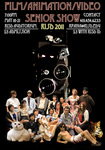
Film/Animation/Video Senior Show RISD 2011
RISD Archives and Film, Animation & Video Department
The poster documents the 2011 Film Animation Video Senior Show held in the RISD Auditorium during the 2011 spring semester.
-

Andrew Moon Bain
Andrew Moon Bain and Richard Goulis
A multi-faceted artist and musician, Andrew Moon Bain was born in 1974 in Texas and grew up in the Pacific Northwest, playing classical music in the Seattle Youth Symphony Orchestra. Since receiving a BFA in sculpture at the Rhode Island School of Design, Bain has become an active part of the Providence arts community as an exhibiting artist, songwriter, musician and producer. He also is the co-founder and head designer of Urban Social Empowerment, which focuses on branding social marketing concepts for Rhode Island youth.
-
Virtual Dance and Motion-Capture
Marc Boucher
A general view of various ways in which virtual dance can be understood is presented in the first part of this article. It then appraises the uses of the term “virtual” in previous studies of digital dance. A more in-depth view of virtual dance as it relates to motion-capture is offered, and key issues are discussed regarding computer animation, digital imaging, motion signature, virtual reality and interactivity. The paper proposes that some forms of virtual dance be defined in relation to both digital technologies and contemporary theories of virtuality.
-
Icon and Image in Modern Thai Art: A Preliminary Exploration
John Clark
Thai modern art is marked by the actual deployment of religious or august symbolic icons or the quasi-iconic use of images of variable indexicality in otherwise highly secular contexts. What were the sources for such modern uses and have the semiotic functions of icons shifted? To answer these questions, at least partially, religious functions for images are examined by tracking the use of court images and Buddhist figures.
-

The End of the Fucking World : Part One
Special Collections, Fleet Library, and Charles Sanford Forsman
Cover for The End of The Fucking World : Part One, from the RISD Library Zine Collection.
-

Alex : Privacy and Persona
Special Collections, Fleet Library, and Alex Hays
Cover for Alex : Privacy and Persona, from the RISD Library Zine Collection.
-

The Ghost Electronic
Special Collections, Fleet Library, and Lara Henderson
Cover for The Ghost Electronic, from the RISD Library Zine Collection.
-

Tofu Baby : collection of favorites
Special Collections, Fleet Library, and Missy Kulik
Cover for Tofu Baby : collection of favorites, from the RISD Library Zine Collection.
-

Birds of America : 2010 supplement, 2011 back & white edition
Special Collections, Fleet Library, and Billy O'Callaghan
Cover for Birds of America : 2010 supplement, 2011 back & white edition, from the RISD Library Zine Collection.
-
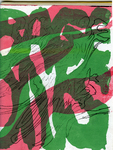
Garbage Goons
Special Collections, Fleet Library, and Tom Toye
Cover for Garbage Goons, from the RISD Library Zine Collection.
-
The Role of Westerners in the Conservation of Legong Dance
Stephen Davies
The image of legong-sumtuosly costumed girl dancers crowned with frangiapanis-is the face of Balinese culture. Yet it is only one of twenty dance/drama genres and prominent in only some centers. Legong, a secular court dance, has often been (and still is) in danger of extinction. Balinese are now less interested in legong than ever before and musicians prefer to play other kinds of music.
Since the 1930s, legong has been presented at tourist centers and by ensembles touring overseas. Western expatriates have founded legong groups and generally brokered the relation between Balines and foreigners. Foreign scholars have studied, recorded, and filmed Balinese performers. Balinese scholars take higher digress abroad and co-author books on Balinese dance with Westerners. Balinese performers teach across the world, whie United States and Japanese student dancers in Bali employ teachers at rates of pay locals cannot match. Legong groups tour Bali from the US and Japan. Non-Balinese influence what aspects of Balinese culture are promoted and sustained. The impetus for the current (modest and localised) revival of legong seems to come mostly from non-Balinese.
Despite all this, legong has retained its autonomy and integrity as an emblematic Balinese dance form, and for some surprising reasons.
-
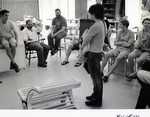
Mickey Ackerman and Shane Richards 2011, Photo by MacDonald Wrightjpg
Experimental and Foundation Studies Division, Mickey Ackerman, and Shane Richards