
Channel, RISD Museum’s new audio program, explores the multifaceted lives of objects—beginning with about 100 unique recordings by artists, designers, scholars, and students speaking about select works of art from the Museum's collection. This collection contains streaming and downloadable recordings, transcripts and images of the artwork.
-
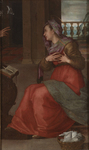
Annunciate Virgin
RISD Museum and Evelyn Lincoln
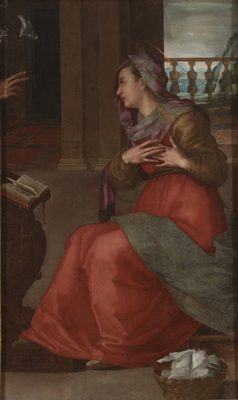
This scene from the Annunciation is all that remains of a commission for the Church of Santa Margherita, the devotional center of a hospital and monastery in the Tuscan city of Prato. Its daring color and figural exaggeration are aspects of a late-Renaissance Mannerist style for which the Florentine artist Mirabello Cavalori was known. Like many candlelit altarpieces, the painting was damaged by fire, destroying the figure of the Angel Gabriel. At left, his surviving hand draws the gaze of the Virgin Mary, who is seated in a 16th-century palazzo near a balcony overlooking a mountainous landscape. Her modest but luxurious attire represents Prato’s renowned textile industry and suggests as patrons the powerful families and guilds under which it flourished. Her brilliantly striped headcovering and deep-hued gown and sleeves attest to the artisanal expertise of the city’s weavers and wool dyers. Draped across Mary’s lap, a gold-edged cloth serves as a scapular, or work apron. A basket at her feet is filled with bobbins, shears, and bits of lace, symbols of the unfinished task to which she has been called. ca.1560
-
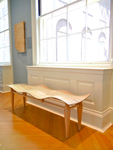
Baily RISD Museum Bench
RISD Museum, Scot Bailey, and Peter Walker
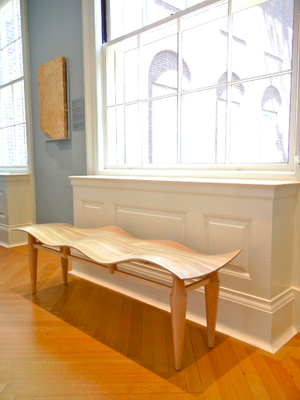
This bench was made as part of a graduate class to design museum seating for the ancient Greek and Roman galleries in the RISD Museum. It aims to capture the quiet character of the space, while creating a seating surface that just asks for tactile interaction. The top surface allows for a variety of seating heights and configurations, catering to the many museum visitors.The undulating seat was made by a digital process called CNC (computer numerical control). The legs, which recall an attenuated lekythos (an ancient Greek oil flask) in shape, flare out below the seat to a sharp edge at the level of the riser and then gradually taper down in circumference towards the feet. This bench was installed in the museum as visitor seating fall 2011. 2011
-
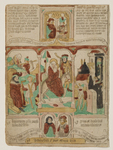
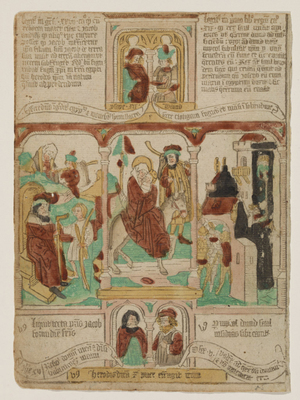
Biblia Papuperum: The Flight into Egypt with Jacob fleeing Esau and David fleeing Saul
RISD Museum and Emily Peters
ca. 1460s
-
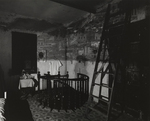
Camera Obscura (image of Havanah Looking Southeast in Room with Ladder
RISD Museum and Abelardo Morell
This photograph holds special significance for Cuban-born artist Abelardo Morell, as it was created during the first trip he had taken to his homeland since he fled Castro’s regime with his family in 1962. To make this image, Morell transformed a room into a camera obscura, an optical device that preceded the modern camera which projects its surroundings onto its interior walls. In this room-sized version, the landscape outdoors is projected, upside down, on the interior. 2002
-
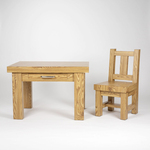
Chair and Table
RISD Museum, Tony Cokes, and Rosanne Somerson
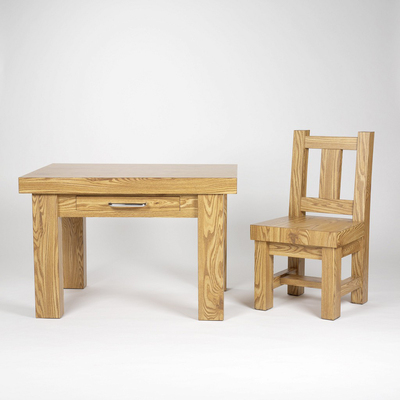
Richard Artschwager was a scientist and a furniture maker before becoming an artist. Through a witty transformation of material and scale characteristic of Pop Art, his work considers the relationship between art and everyday objects as it explores ideas about both sculpture and furniture. The exaggerated thickness of the chair and table negates their traditional function: the narrow space between the seat and tabletop make it impossible to sit there. Artschwager’s use of Formica® with a simulated wood-grain pattern raises questions about what is real, fake, or a simulation of something else. In the case of his Exclamation Point, Artschwager turns a normally small flat punctuation mark written or printed on a page into an oversized three-dimensional object suspended in space. 20th Century
-
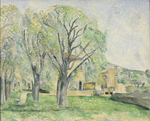
Chestnut Trees and Farm at Jas de Bouffan
RISD Museum, Deborah Bright, and Eric Kramer
The Cézanne family’s country home outside Aix-en-Provence appeared often in the artist’s work. Called Jas de Bouffan (“sheepfold of the winds”), the property consisted of an 18th-century manor house with surrounding gardens and a farm. Just out of sight of this view, beyond the farm buildings at right, loomed another favorite motif: the shimmering Montagne Sainte-Victoire. In 1881 Paul Cézanne built a studio at Jas de Bouffan and for the next eighteen years spent much of his time painting nearby landscapes. This composition features an allée of chestnut trees seen from the garden behind the house. Cézanne massed the trees at left, covering the yellow stucco planes of the house with a blanket of spring foliage. The trees, lawn, and sky are rendered as organized patches of color whose surface rhythms embrace the interlocking geometric shapes of the house, wall, and farm buildings. ca. 1886
-
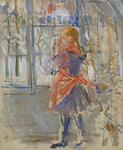
Child in a Red Apron (L’Enfant au tablier rouge)
RISD Museum and Maureen O'Brien
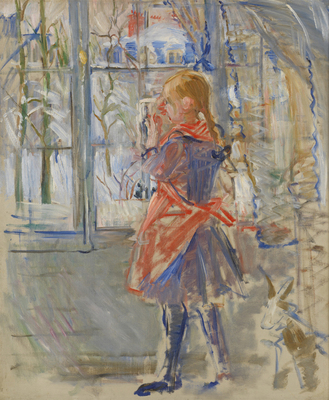
This painting depicts Julie Manet, the seven-year-old daughter of the artist Berthe Morisot and her husband, Eugène Manet. She peers at a wintry landscape outside the family’s home in Paris, perhaps holding a prism to her eyes. The setting was Morisot’s bedroom, distinguished by a window whose small panes function as a compositional device that connects interior to exterior space. Across the canvas, a fluid net of slashing and spiraling marks rush through the room and animate Julie’s costume and pose. The vertical glint of a brass knob suggests that the window is ajar, introducing a breeze that lifts the ties of the child’s red apron and causes the curtains to flutter behind her. Owned by the artist’s descendants for more than a century, this is the first painting by Morisot to enter the RISD Museum’s collection. It represents the work of one of the primary members of the group of Impressionist painters, whose technical and representational inventions transformed the appearance of painting in the late 19th century. Morisot was a close friend of Edgar Degas and Pierre-Auguste Renoir and the sister-in-law of Édouard Manet, whose portrayal of her in a painting titled Repose is on view in the adjacent gallery. Individual in their styles, each of the Impressionists explored the use of broken brushstrokes and flattened spatial relationships and all were preoccupied with themes of modern life. Morisot built her images slowly and preferred to begin directly on a white surface, frequently leaving parts of the background bare. She often skipped the stages of preliminary drawing and instead used color to deliver the effect of line. Whether working in pastel, watercolor, or oil, she sought the same effects of gesture, transparency, and blur. In this seemingly sketch-like impression, what appear to be hastily placed marks are elements of a selective process intended to capture movement and light. A domestic space, a mesmerized child, and a snowy Parisian landscape all emerge from Morisot’s strategic web of animated and abbreviated strokes. 1886
-
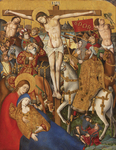
Crucifixion
RISD Museum and Susan Ashbrook Harvey
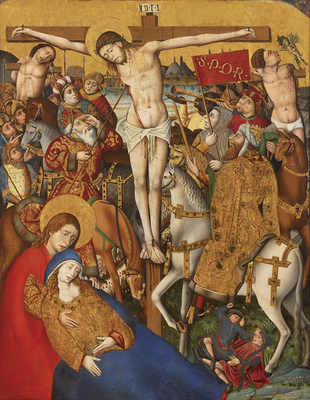
In this depiction of the Crucifixion, the Roman centurion Longinus is shown lancing Christ’s side as Mary faints in the arms of John the Evangelist. Beside Christ hang two thieves, one repentant, the other offering his soul to a demon. The gilded and punched surface and lavishly costumed figures reflect a late International Gothic style, here dominated by Flemish realism. Although this altar panel once hung in the parish church of El Cubo de Don Sancho in Salamanca, it likely was commissioned by a wealthy donor for a more important setting. Unpainted upper corners indicate that its original frame had a curved inner edge. The panel may once have been located at the center or top of a more elaborate altarpiece. ca. 1490
-
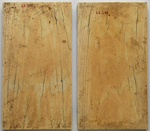
Diptych with scenes of the Nativity, the Crucifixion, and the Last Judgement
RISD Museum and Robert Brinkerhoff
This diptych was intended for private devotional viewing by privileged members of the French court and the Roman Catholic Church. Composed of four arcaded compartments once embellished with gold leaf and colored pigments, it narrates Mary’s role as mother and intercessor. The Annunciation and the Nativity of Christ at lower left face the presentation of the Infant Jesus to gift-bearing Magi. Above, Mary swoons at the Crucifixion, then reappears enthroned to be crowned by Christ. In the final panel at the upper right she kneels beside Christ on Judgment Day as souls arise from tiny sepulchers below. 1275-1325
-
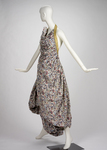
Dress
RISD Museum, Kate Irvin, and Pradeep Sharma
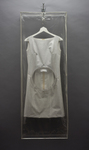
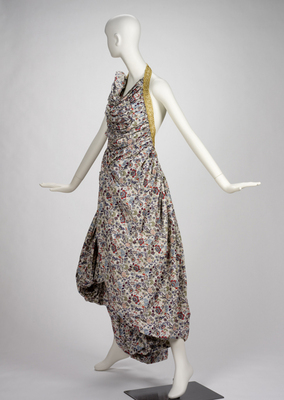
Junya Watanabe is a master of shaping and manipulating carefully chosen, often technically advanced material. This dress, designed for his Spring 2008 collection, exemplifies the designer’s keen interest in sculpting novel creations replete with historical references. Collaborating with Liberty of London, Watanabe employed yards of the English firm’s renowned Tana Lawn fabric, patterned in tribute to the Indian export textiles eagerly consumed in Europe in the 17th and 18th centuries. In a twist to the story of East-to-West trade, Watanabe worked with Liberty fabric produced in Japan to develop a silhouette that references the Indian dhoti, a traditional garment worn by men. 2008
-
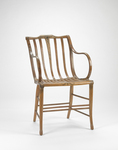
Elastic Armchair
RISD Museum, Alicia Valencia, Matthias Pliessnig, and Rosanne Somerson
Based on the ancient Greek klismos form, this chair incorporates bentwood lamination, a technique using steam to shape wood into graceful curves. Patented in 1808, Gragg’s design and construction process benefitted from his experience using this technique to make Windsor chairs, an example of which is on the right. Inspired by the proportions and lightweight construction of the Windsor chair, Gragg fused the classical past with the industrialized future. The chair is adorned with motifs that date to antiquity, such as the painted peacock feathers along the chair back, the acanthus leaves on the seat rail, and the carved hoof feet. Alicia Valencia, RISD (furniture design) / Brown BA student, 2015: The Elastic chair has an anachronistic energy, with the design and construction appearing far more advanced than the skills and mindset typical of its era. The process by which the chair was made can be read in its form, which makes it a wonderful teaching example. Construction included steaming straight-grained wood, bending the malleable wood in a jig to dry, and merging the pieces together with straight or dovetail joints that vary from each other in size and angle due to the gentle compound curvature of the back. My favorite aspect is the delicate and surprising hoof-like feet. This chair communicates substantial information about its making and offers a great model for designing furniture today. ca. 1808
-
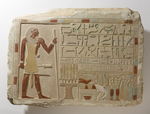
Funerary Stela of Heni
RISD Museum, Antoine Revoy, and James Allen
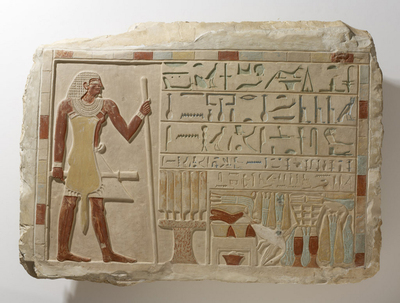
Offered symbolically, the images and hieroglyphics depicted on the right of this funerary stela ensured that Heni, a local high official, would never experience hunger or thirst in the afterlife. The slightly awkward proportions of Heni’s figure are typical of monuments of the First Intermediate period, when there was no centralized government in Egypt. The lack of royal control over artistic production during this time allowed artists to experiment, as seen in the multiple levels of relief on Heni’s kilt, the particular green of the hieroglyphs, and the striped border. 2134-2040 BCE
-
Goddard Bookcase and Desk
RISD Museum, Robert Emlen, and Timothy Philbrick
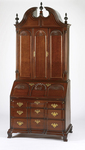
This lustrous mahogany desk and bookcase represents a pinnacle of achievement for American cabinetmakers. One of nine known examples, this block-front desk and book-case with six carved shells is associated with the Goddard/Townsend family of cabinetmakers in Newport. The desk exemplifies their superb craftsmanship in the delicate dovetailed construction of the drawers. Their mastery of proportions is evident in the piece’s well-balanced broken-scroll pediment, alternating convex and concave surfaces, and integrated flame finials. In a Rhode Island house of the period, the desk and bookcase was the most expensive piece of case furniture. A combination office, safe, and library, it offered space for account books and writing materials, a flat surface for writing, and small lockable drawers for securing money or jewelry. 1760-1785.
-
Goddess Maat
RISD Museum, Gina Borromeo, and Ingrid Neuman
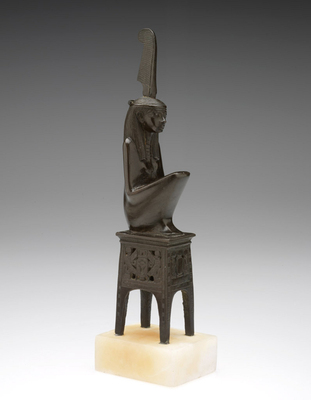
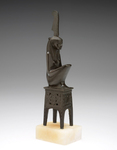
This depiction of Maat appears to be cast in three pieces: the altar, the figure, and the feather. Smooth, highly polished surfaces contrast with the concentrated detailing of the feather, wig, broad collar, and openwork altar. The goddess embodying truth, balance, and proper action, Maat pervaded all aspects of Egyptian culture. Traditionally represented as a woman with an ostrich feather headdress, Maat here sits in a characteristic pose. Similar bronze figures of Maat suggest that this piece is incomplete, and was most likely part of a group composition in which the goddess was juxtaposed with a larger figure of the ibis of the god Thoth. Maat, therefore, would have been viewed from the side or back. 664-525 BCE
-
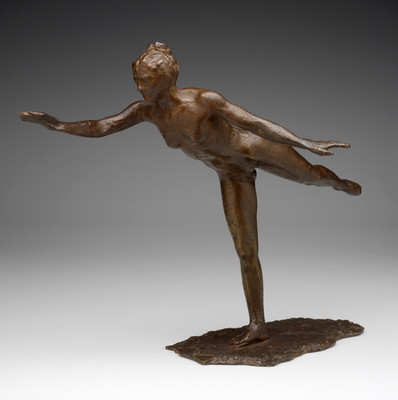
Grand Arabesque, Second Time
RISD Museum, Julie Strandberg, and Jeff Hesser
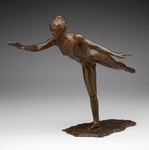
Transitional poses such as this one were constant themes of Edgar Degas’s numerous sculptural studies made in wax, wire, and plastilene. Collected from his studio following his death, these models became the sources of small editions cast in bronze, including this one of a dancer posed in a grand arabesque. In the classic ballet position, the dancer bends forward while standing on one straight leg, with the opposite arm extended forward and the other arm and leg extended backward. In the 1890s the British artist Walter Sickert visited Degas in his studio and was shown the wax model for this figure. He was struck by Degas’s interest in movement, as he “turned the statuette slowly to show me the successive silhouettes thrown on a white sheet by the light of a candle.” ca. 1885-1890
-
Head of Buddha Shakyamuni
RISD Museum, Gregory Schopen, and Vazira Zamindar
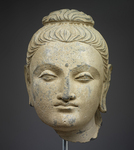
The earliest images of Buddha are found in modern-day Pakistan at sites along ancient trade routes. The region once known as Gandhara was familiar to the Greeks as early as the fourth century BCE. Traces of their influence are visible in the classicizing features of this head of Buddha (top), combined with all the traditional attributes of Buddha—the skull protuberance, the spot or tuft of hairs between the eyebrows, and the elongated earlobes of ancient Indian nobility. The simplified and youthful facial features and the coiled knots of hair are typical of Gandharan representations. This head would probably have been sculpted for a full-length, approximately life-size robed statue. There is evidence that the nimbus originally appearing around the head has been removed. 1-200 CE
-
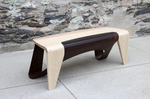
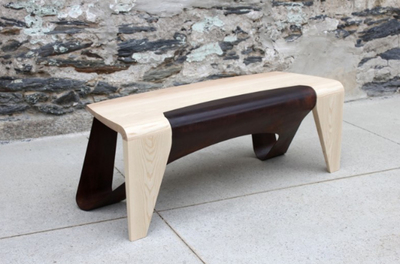
Kopp RISD Museum Bench
RISD Museum, Andrew Kopp, and Peter Walker
This bench in one of a pair made as result of a graduate class to design museum seating for the ancient Greek and Roman galleries in the RISD Museum. Each bench features a front seat made of bent, patinated steel that curves downward and back upward to form the back "leg." The two front legs are made of resawn ash, as is the majority of the seat. The benches were installed in the RISD Museum in October 2011. 2011
-
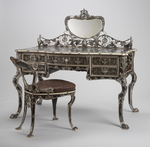
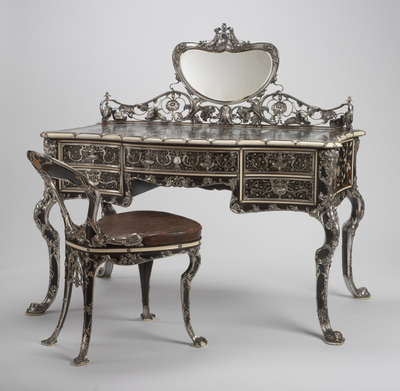
Lady’s Writing Table and Chair
RISD Museum, Ben Blanc, and Elizabeth Williams
Commanding as much attention now as when they debuted at the 1904 World’s Fair, this writing table and chair were conceived as showstoppers in a crowd of stunning objects made by Gorham’s competitors. More than 10,000 hours of labor, 47.5 pounds of silver, and a panoply of exotic materials make up this unique set, which deftly melds sinuous European Art Nouveau floral and figural motifs, 18th-century French Rococo forms, and traditional Hispano-Moresque designs. Intricately wrought symbolism—seen in the daytime poppies and the night owl below the mirror and the decoration of the legs, each representing one of the four seasons, with female masks surrounded by lilies, roses, chrysanthemums, and pine cones—attest to the complexity of Gorham’s design, which brought them the grand prize in silversmithing. 1903
-
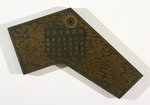
Lithophone
RISD Museum and Shawn Greenlee
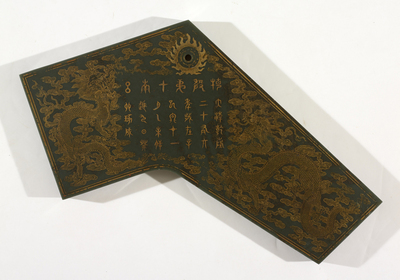
This inverted L-shaped stone, gold accenting its design and calligraphy, was meant to be struck with a wooden mallet during imperial musical rituals at the Temple of Agriculture in the Chinese capital. Originally one in a set of 12 chimes—for the 12 lunar months—each stone had a distinct pitch, tuned to reflect a mathematical relationship with the celestial world. 18th Century
-
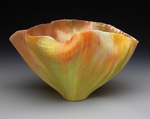
Lucent
RISD Museum, Sebastian Ruth, and Toots Zynsky
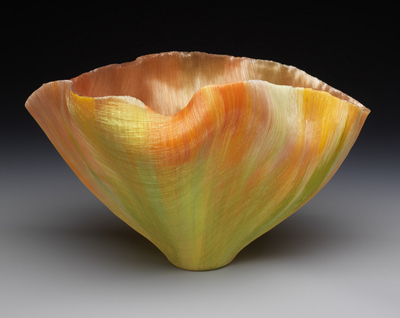
Toots Zynsky is internationally regarded as one of the most innovative figures in studio glass. Lucente is a vibrant example of her signature ‘filet de verre’ (net of glass) technique, in which she fuses thousands of intensely colored hair-thin threads of glass together on a flat surface and then allows them to slump into a bowl-shaped mold. The colors undulate and evoke feathers, flames, or woven textile designs. Zynsky’s glass-layering technique has a painterly quality unique for the medium. In Lucente, the exterior wash of green and yellow threads gives a misty appearance to the oranges and reds seen through it. 2001